Review of Justice League: The New Frontier (2008) by Jeffery S — 03 Mar 2008
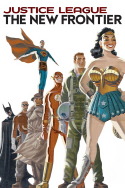
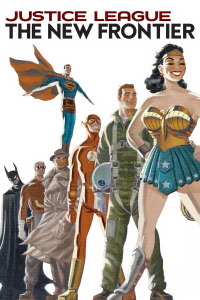
The Story in brief: A primal force called the Center who has observed and guided life on earth, has been spurred into action by man's entry into the atomic age, and lays plans to call an end to this creature Man. In response, a new age of heroes emerges: some old guard heroes have survived the purge of the red-scare either by going underground (Batman) or by collaboration and license with the American government (Superman and Wonder Woman). Some new ones face pursuit by the government (the newly minted Flash). The government has it's own agents in play, represented by the sleek King Faraday.
Woven into the fantastical storyline are two outsiders: one, Hal Jordan, a pacifist jet jockey and his struggles to follow his "Right Stuff" dream of seeing the stars, the other, an accidental visitor, "John Jones", a shapeshifter from another world, struggling to fit in while yearning to return to the stars.
Ultimately, humans, heroes, and aliens alike must face the fact that the forces that stand between us and the New Frontier of space are not just unearthly monsters, but the forces of fear, division, and hatred in ourselves that stand between us and the New Frontier of our future.
==================================================.
Having been a fan of film about as long as I've been a fan of comics I've watched both mediums grow and change. When I started, both were at a point where their history was viewed as a cheap commodity and therefore readily available: tv stations could buy packages of movies for next to nothing as filler, and comics could draw on (at that time) 35 years of back issues to fill up rack space at the newsstand. It was therefore easy to not only see the latest and greatest, but everything that had come before. It was all there was, really - a diet of old stuff, periodically splashed with new product. This is something a lot of younger folks tend to forget - working on the assumption that anything that's new and hot couldn't possibly have been around before their time (how many realized that "3:10 to Yuma" was a remake?) It was therefore not a tremendous jolt when Darwyn Cook's "Justice League: the New Frontier" hit the stands - I was fully comfortable with seeing Superman and Batman and company in a 50's setting. What made it fresh and new was that instead of telling a story of these characters in the idyllic time and simplified world they were invented with (well, reinvented with - not going to unroll the history of the Golden Age as well), but telling their story transposed into the world their world was created by - think Superman meets "Good Night and Good Luck". A 1950's with anti-commie paranoia, a budding civil-rights movement and a goodly proportion of walking wounded who thanks to modern medicine partially survived their wartime experiences.
Warner Bros has been fairly successful in mining the more adult bent it's comics have moved towards - from their 1992 Batman series' aesthetic use of background paintings that work up from a black canvas as opposed to the usual painting on white to suggest the overall darker feel of the character (in contrast to the always grinning Superfriends incarnation, or Adam West's campy mugging), up to the JLU use of shadow government agencies and cautionary visions of superheroes as global dictators. These are still scaled down to a younger audience from the impact such storylines would have in the comics themselves, but certainly a step forward. Enter DC's new made for video adaptations of some important stories from the comics - not intended to fit into the cartoon continuity, thus allowing for more stylistic exploration. The resulting "Superman: Doomsday" was a first attempt, that for my money didn't really take off - the short running time didn't allow for Superman's death, the most important part of the story, to really sink in, thus relegating it to a "fight-death-resurrection-fight some more" sort of story. "Justice League: the New Frontier" succeeds more fully, insofar as it tells a story that isn't just advanced by fights, though it does, as many have noted, fall apart towards the end when it DOES come down to a fight.
Where it succeeds best is in humanizing some of these characters - Batman's revelation after rescuing a child from a cult sacrifice and having the child cringe in terror from him, resulting in the next time Superman meets him, finding his appearance softened and sporting a boy sidekick. Still grimly determined but now avowing that he fights crime to scare criminals, not children. Or Hal Jordan (pre-Green Lantern), pacifist recon pilot in Korea, being shot down after the ceasefire, and parachuting into a trench with a young Korean soldier. During their scuffle, where Jordan tries to tell the soldier that the war is over, Jordan is forced to use his gun - graphically, in silhouette - and ends up shooting the soldier in the face. Lying there, spattered in his opponent's blood, a shocked Jordan keeps repeating "the war is over". Not only is this a first, to the best of my knowledge, in mainstream cartoons (the actual visible use of a gun to kill someone, and not have it followed by "Dirty ratzi - let's move out!") but it underscores what I've held for a long time: that guns in cartoons should have a real impact (See: every GI Joe equipped with a gun, and yet no one ever dies). Here you see why a superhero as a man, eschews lethal force in what they do. His pacifist nature and time spent in the VA will prove to be problems in his future.
Due to the short running time of the movie, a great deal of back and side stories had to be cut, and understandably, though most are alluded to: the lynching of black superhero John Henry in the south, the original opening bit with WWII squad the Losers on an island full of dinosaurs, the retcon (retroactive continuity: wherein the history of a character or characters gets rewritten) retirement of the Justice Society when it was faced with "unmask or quit" orders from the House on Unamerican Activities (used in the comics to explain why most superheroes disappeared after WWII before being reinvented in the Silver Age - the reality was a combination of obsolescence of characters designed to fight Nazis, the impact of House on Unamerican activities taking a look into everything in print, and the publication of "the Seduction of Innocents" - a scathing, if lopsided assault on the dangers of comics which was largely responsible for the imposition of the Comics Code). Still, despite losing focus in the end, "Justice League: the New Frontier" takes strides beyond it's competition in even attempting to tell a more mature story, and by mature, dealing with issues not usually addressed in a children's venue, and not the oxymoronic use of mature to indicate bad language and nudity (I once saw a "mature" warning on a broadcast of "Porky's" fergodssake - a mature audience wouldn't be caught dead watching Porky's!).
Stylistically, I don't agree with some complaints - there is a very obvious attempt to echo the graphic novel's stylized retro look, particularly in the settings - the character animation less so, but then I'm sure they have to make allowances for studio constraints on time and budget that creating a whole new animation style would have pushed. The voice actors, while not the ones people have become used to in Justice League related media (Batman [Jeremy Sisto] in particular was a predicted sore spot for many - I personally feel his voice worked fine), were on the whole suited to the material, though Kyle Maclaughlin's (as Superman) delivery on what amounts to the St. Crispin's Day speech for this film came out somewhat anemic, but was made up for by the occasional Xena-snarl in Lucy Lawless' Wonder Woman.
All in all, not the train wreck I expected - the source material while not rendered in it's full depth was at least not trampled underfoot and diluted into pablum. It may even stir up some parental concerns because it does step above the kiddie show (the kidnapped child is rescued, hanging from the nail in the feet of a crucifix in an abandoned church, there're a few deaths with some blood splatter, and one of the primary characters at least gets ribs broken if not his back before being dragged, grenades in hand, into the maw of a monster). If anyone's listening, that's how I would like to go: a grenade in each hand as I'm swallowed my a giant monster. Nibbled by voles is not an adequate substitution.
This review of Justice League: The New Frontier (2008) was written by Jeffery S on 03 Mar 2008.
Justice League: The New Frontier has generally received positive reviews.
Was this review helpful?