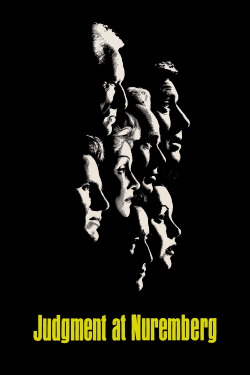
Review of Judgment at Nuremberg (1961) by Christian C — 30 May 2013
Wow, Spencer Tracy, Burt Lancaster, Richard Widmark, Marlene Dietrich, Montgomery Clift, Judy Garland and even a young William Shatner are but a few people in this $3 million period epic, so I think it's safe to say that Stanley Kramer knew how to save money more than he knew how to save on time. Yup, in case "It's a Mad, Mad, Mad, Mad World" wasn't overlong enough for you, well, this probably won't impress you, because I hear the original cut of "World" is, for some reason, about thirty minutes longer than this film, and plus, as overlong as this film is, it's a bit more worthy of a hefty link... apparently. I don't know what is up with everyone's ideas that courtroom dramas have to be really, really long, but hey, we've still gotten some pretty good, really long legal dramas, so it's only fitting that this, a film that is about as long as any legal drama, be good. Man, I can't help but think about how weird it is that Stanley Kramer did this sprawling, thorough study on the trials against the particularly high-ranking Nazi monsters against the merciless purging of millions of people in the name of anti-semitism, then followed it up with "It's a Mad, Mad, Mad, Mad World". Hey, say what you will about the guy's taste in runtimes, he was nothing less than versatile, or at least I think he was, because this film and "World" are the ones of his that people remember, and even then, people barely remember this "little" number. It's a shame, quite frankly, because we should never forget any kind of portrayal of the terrible, terrible travesties against the Jews, especially if those portrayals are as long as this one, because, I don't know about y'all, but if I'm investing three hours of my life into something, I better enjoy and remember it. Well, as sure as sunshine, this film is worthy of your time, though not entirely, as this legal epic is guilty of more than a few problems.
Opening up only on the first night before the first day of the Nuremberg trials, this film doesn't really feel the need to give you all that much insight into the stories of the characters who will be driving this epic-length character study, and sure, compensation for expository shortcomings can be found within meaty characterization and richly well-defined performances, yet development issues still stand, giving you little immediate information and leaving you to go somewhat distanced from the full human depths of the final product. It's fairly impressive how much this film is able to flesh out its characters in spite of developmental shortcomings, especially considering the limitations in storytelling sensibilities at the time, but only so much can be done to obscure lulls in exposition, and even less can be done to drive your attention away from lulls in atmospheric kick, because as firmly secured as intrigue generally is, there are slow spots, something that a film this bloated cannot afford to have. At an astonishing 186 minutes of courtroom dramas and more simple, less juicy talkativeness beyond the courtroom, this film outstays its welcome by a considerable margin, seeming tight in some areas due to its being so good at sustaining intrigue on the whole, but truly being nothing if not exceedingly overlong, with excess material and filler, and, of course, repetition. The film is three hours well-spent, but this is still three hours we're talking about, and as momentous as the thematic depth of this important and humanly rich subject matter is, the plotting structure concept itself is anything but sweeping enough to sustain a runtime that boasts this sprawling of a length, which in turn only calls your attention further to natural shortcomings. Really, the flaws just discussed aren't as severe as I make them sound, as expository shortcomings are compensated for more often than not, and the runtime is made generally comfortable by intrigue that also thins out the sting of the atmospheric slow spells, so what might very well be the most serious shortcomings of the final product are of a natural persuasion, because there is something very minimalist about this conversationalist legal drama, thus the final product was never to be as potent was it clearly wants to be, and the sprawling runtime that was to breathe more well-rounded power into this worthy subject matter ends up doing only so much more than bloat storytelling into aimlessness. No matter how aimless the film gets, it grips, but not tightly enough for you to feel exactly what Stanley Kramer clearly wanted you to feel, as there is too much aimlessness to this overlong and slightly undercooked dialogue drama to consistently sustain your investment. Still, on the whole, no matter how much it is shaken, your investment never slips so far that the final product finds itself unable to reward, for although flaws are difficult to deny when it comes to this overblown drama, strengths are abundant enough to compensate and attract, even on a visual level.
Shot completely in black-and-white, this film found enough visual shortcomings within its being lensed at a time with limitations in photographic quality, so don't go into this film expecting its visual style to be especially advanced for its time, but do expect Ernest Laszlo to still show that he, at least when backed by Stanley Kramer's sharp directorial eye, sure knew his way around a camera, playing with framing in an occasionally stylish and consistently intimate fashion, while keeping what lighting there can be deep enough to give a sense of grit, augmented by the limitations in coloring. Stylistically, the film is hardly killer, but it is impressive when you step back to meditate upon what is accomplished here, unless, of course, it's too difficult to see this film's stylistic strengths through all of the much more rich substance strengths, which you should have no trouble seeing through all of the shortcomings in storytelling. Again, the film is too long for its own good, going into aimless spells - occasionally exacerbated by atmospheric limp spells - that give you more time than you should have to think about how limited this film's story concept is when it comes to structural meat, and yet, no matter how limited this story is in dynamicity, at its core is subject matter that is very worthy, rich and all around intriguing, with the potential to be executed into the compelling legal drama that it, in fact, is at the end of the day, partially thanks to Abby Mann's script's which boasts sharp dialogue to keep intrigue from slipping too much when struck by all of the narrative lulls, as well as many areas of subtly genuine characterization that may not be able to fully compensate for expository shortcomings, but do an adequate job of earning your investment in the characters, whose depths are truly powered by the performances that were somewhat ahead of their time. Not enough material is there for everyone to be stellar, but if nothing else is surprising about this film, especially considering the dramatic limitations of the time, it's just how much this star-studded cast delivers, with most every member having his or her time to shine as distinguished and effective, perhaps even powerful forces who drive much of the human depth within this character drama, whose outstanding secondary performances include such much too briefly present talents as the strong Montgomery Clift as a nervous, unstable and all around traumatized witness, and a piercing Judy Garland as a woman whose faith in a Nazi she thought was kind goes crushingly shaken while she finds herself tortured with accusations of an illegal statutory affair with the Nazi in question, and whose more primary cast members command your attention throughout the film, with Spencer Tracy being charismatic as the trial's chief judge, and a then-up-and-coming Maximilian Schell being effectively convincing in his immersed and layered portrayal of an intense seeker of justice for the unjust whose passion grows to corrupt his understandable, if somewhat misguided intentions, while the great Burt Lancaster all but steals the show in his initially quietly striking and gradually intensifying portrayal of a guilty man who regrets the terrible crimes that he and his peers are accused to exacting in the name of love for their flawed country. The names just mentioned are but a few worth mentioning in this hefty cast of classic talents, almost all of whom deliver with onscreen inspiration that goes matched only by Stanley Kramer's offscreen inspiration, because in spite of his inability to fully compensate for the final product's shortcomings, Kramer does enough to flesh this story out with a subtlety and range that is surprisingly audacious, being unafraid to take what chances it needs to (This film even has the guts to shamelessly feature a sequence that shows the fainthearted audience of the early '60s footage evidence of what was going on in the concentration camps) in order to reinforce intrigue of both a human and legal nature. The film is too overdrawn, aimless and naturally thin to be all-out powerful on the whole, but the thoughtfulness that Kramer puts into the telling of this intriguing tale gracefully fleshes out depth and intrigue enough to compel you time and again, and craft a final product that overcomes, not necessarily its natural shortcomings, but its flaws enough to reward the patient.
To come to my own judgment, moderate expository shortcomings slow down momentum, though not as much as the slow spells and repetitious padding that reflect the natural limitations in this relatively thin story enough for the final product to fall short of what it wants to be, though not so short that you can't still appreciate it as rewarding, as there is enough attractiveness to Ernest Laszlo's cinematography, sharpness to Abby Mann's script, power to the performances within this star-studded cast, and audaciously intriguing thoughtfulness to Stanley Kramer's inspired storytelling to make "Judgment at Nuremberg" a thoroughly compelling, if naturally restrained dramatization of the Nuremberg Trials and study on how passion can intensely corrupt.
3/5 - Good.
This review of Judgment at Nuremberg (1961) was written by Christian C on 30 May 2013.
Judgment at Nuremberg has generally received very positive reviews.
Was this review helpful?