Review of Joe (2014) by Brett C — 19 Jan 2015
Review In A Nutshell:
Coming of age films tend to be viewed in a bright and positive light, a time where young boys transition smoothly into young men, whose problems only involve finding a sexual partner and succeed in their studies. Joe takes a darker and honest approach; it explores the necessity of employment, the dysfunction of families, the search of a healthy role model, and petty prideful disputes. These are aspects that many filmmakers choose to bypass as their afraid it would alienate a film's potential audience, in a way that is true, but an over-saturation of these light-hearted films had led people ignorantly dismissing these more thoughtful and gloomy films. Those light-hearted films are experiences that we wanted for, or would want for ourselves, a life where problems do not seem as awful as the characters make them out to be; in films like Joe, it depict life at its most heartbreakingly honest, opening and exposing humanity's hidden flaws and how that influences a young boy's growth to manhood.
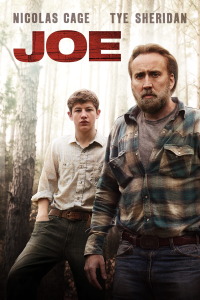
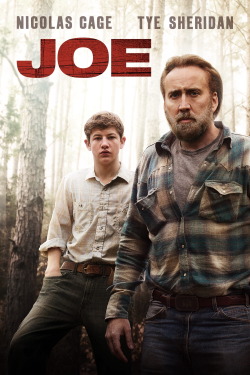
Joe follows two central characters; the first is a young boy named Gary, who lives with his dysfunctional and poverty-stricken family, with a father that is verbally and physically abusive to him; the second is an ex-criminal named Joe, who keeps himself isolated and honest through his work in deforestation; whom which he hires people to poison and cut down trees. Both characters meet through Gary looking to find work. Joe was impressed by his capabilities and determination that he gave him a position, but all that went to hell and was let go when Gary's father also was employed, as he was inefficient and caused disruption to the workers around him. When Gary and his father were getting paid for their day's work, Joe caught a glimpse of the father's aggressive treatment on Gary, but decided not to intervene due to his determination of keeping a low-profile. Out of desperation, Gary asks for his job back, which he eventually does out of pity and admiration from Joe.
From this point, the film would go on to exploring the relationship between the two characters; how Joe would make a significant mark in this young man's life. It may sound melodramatic and clichéd, but the delivery is far from it; the film does not fill itself up with tear-jerking or overly profound dialogue and scenes, instead it builds through subtle conversations and quick but profound looks towards one another; to completely be aware of it, one must actively search for them, but the overall effect may still be felt if one simply let themselves go and view the film as a whole. It is under the direction of David Gordon Green that the film's drama feels well executed, allowing to be more about the travellers rather than the pit-stops; creating emphasis only slightly through the occasional monologues and slow-motion imagery that gives the film a slight larger than reality type of effect. I found it to be handled quite tastefully, ensuring the purity of its characters and their drama remains intact throughout. I did however find minor elements of Joe's personal life to be slightly dull, not coming off clearly in regards to his need to constantly revisit the local brothel, or sheltering some random woman; these could have been better explained by Green, and allowing them to bleed into the central conflict, instead of leaving them as separate entities on its own.
The film's serious and darker approach to the genre is supported by a moody score by Jeff McIlwain and David Wingo. The music never at a point becomes overbearing, allowing the dramatic and emotional elements to swell but only to a certain point; ensuring what is shown is still honest and pure.
The performances in this film are strong, particularly from Tye Sheridan, who some might recognise from films like The Tree of Life and Mud. Sheridan inhabits the role of an emotionally damaged young man, but rarely does it ever seep out in the character's exterior, we could only see this in the way he sees certain things and how he reacts to them, it never becomes a defining quality of the character. It is in the way Sheridan plays off with his co-stars Nicolas Cage (Joe) and Gary Poulter (Wade), the attitude and reactions he projects towards them allows the character to feel complex and most-importantly human. The young actor truly owned the role, showing audiences to look out for him in the coming years. Nicolas Cage was excellent in this, portraying his role with a layer of depth that has been lacking in many of his recent films. Cage plays it subtle, with only elevation in his emotions in scenes that demand it. David Gordon Green truly knows how to bring the best performances out of his cast, as even the un-professional actor, Gary Poulter, killed it in the role as the constant and unappealing drunk of a father; a person whose presence causes a great deal of grief to the foundations of his family. Though his role is antagonistic, he was able to sneak in elements of his character that allow the audience to slightly show sympathy towards him. It is such a shame that he died a few months after filming this.
Joe turns the tables on the coming-of-age genre, conveying a darker atmosphere and a sense of honesty to its characters that it is simply to not be emotionally invested. The performances by Sheridan, Cage and Poulter were mesmerising, playing off one another with great dramatic triumph, something that many acting combinations have been unable to achieve.
This review of Joe (2014) was written by Brett C on 19 Jan 2015.
Joe has generally received positive reviews.
Was this review helpful?