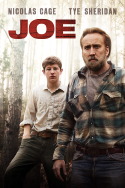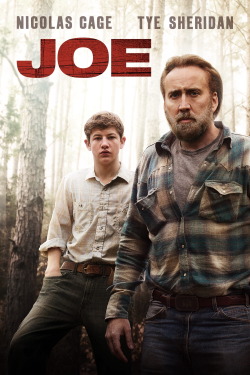
Review of Joe (2014) by Philip J — 30 Dec 2014
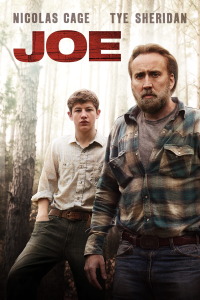
Somewhere in the deep rural south, on the west side of the Mississippi river, we see a group of laborers being picked up in a truck and taken to their latest work site: a pine forest with frail trees that clearly need to be cut down and removed. The laborers are given "juice hatchets" which they use to hack down trees. Only these hatchets have been attached to containers of poisonous herbicide to help speed the process of killing those trees. This will allow for the planting of healthier trees in this forest. Their supervisor is foreman Joe (Nicolas Cage), a hard living ex-con who, in his roughly 40 to 50 years of his life, has experienced more hardship than most people do in their lifetime. Joe and his crew are commissioned to get this assignment done by a mysterious landowner. The legitimacy of the job itself is questionable and the workers are obviously paid under the table. But they do not expect much out of life. They appreciate the simplest things and are grateful to have a job and be able to make a living wage. By the end of the day, when the work is done, the laborers drink beer, cheer, and sing a few songs.
But Joe's day is just beginning. When he's not being shot at by Willie (Ronnie Gene Blevins), the local tough guy who holds a grudge against Joe for reasons unknown, Joe likes to patronize the local brothel, where he gets to have some action with his favorite prostitute, Connie (Adriene Mishler), who is his sort of live-in girlfriend. While Joe definitely cares about Connie, he seems very reluctant to engage in a long term relationship with her. When Joe heads home, he is greeted by his loyal, longtime companion - his pet bulldog. Just for shits and giggles, Joe likes to have his pet bulldog get into fights with other dogs when visiting places - and his bulldog would often come up on top albeit in bloody shape.
Joe has just served time in prison for drunken behavior and assaulting a police officer. And he doesn't want to go back to the penitentiary. But although Joe is trying to stay on the straight and narrow, he sometimes lets his temper get the best of him. Interestingly enough, the local town sheriff Earl (AJ Wilson McPhaul) seems to have sympathy for Joe and even tries to help him get back on his feet. Why he extends his hand to Joe is something only Earl and Joe know, but Sheriff Earl seems to go out of his way to get Joe out of any legal jams...or at least keep him in check before he does something stupid to land himself back in a jail cell.
Gary (Tye Sheridan), a 15-year-old teenager has just moved into town with his family. Gary's father is Wade (Gary Poulter), who is a transient who doesn't know much in the way of stability. He has never really held down a real job and doesn't seem to have the slightest clue as to how to take care of his family. He does find solace in a bottle and sports a cool jacket with the name G Dawg emblazoned on the back. Gary also lives with his younger sister who is mute likely due to an unexplained childhood trauma. Gary doesn't attend school at all but instead is looking for work, any kind of work.
Gary approaches Joe about possibly getting a job with the crew cutting down and poisoning trees. Joe at first seems reluctant, but is eventually swayed into giving Gary the job. Joe hires Gary's father as well. While Gary's work ethic has impressed Joe, Wade on the other hand doesn't seem to give a damn about the job. The other workers are annoyed by Wade's laziness and inability to do the job but Wade fire back and claims he's doing a great job cutting down those trees.
Eventually, Wade's ineptitude gets both him and Gary fired from the job and Wade goes back to his usual alcoholic ways (though it's not like he's ever quit them in the first place). Wade also likes to beat up Gary and take his earnings so that he can buy more booze. Despite this, Joe agrees to give Gary more chances of earning money working.
Gary learns to grow up fast because the real world ain't so kind. He hides many family secrets. However, Joe seems to know this and tries, in his own way, to guide Gary in the right path and help him to become a good man. Joe befriends this teenage boy who has to face his alcoholic and abusive father on a daily basis and the two form an unusual but unforgettable bond. Joe becomes the father figure that Gary has always yearned for. Somebody that Gary could look up to. Somebody that cares for Gary and gives him some sense of direction in life. Somebody who sees the full potential in Gary. Sadly enough, Wade doesn't see it that way and as the bond between Joe and Gary grows stronger and more meaningful, his pent up resentment builds further towards his own son, who is already more of a man that he will ever be. Because it is his son who is holding the family together. And it is his son who is the one hustling to find a job so that he can earn money to support his family.
And what is Gary to Joe? Is Gary the key to Joe's own salvation? Wade's seething anger is about to explode and the people Joe cares for the most are about to get hurt badly. Can Joe save the people who mean the most to him, and in the process, save his own soul? As the old saying goes, the road to redemption is fraught with peril...
Joe is not an easy film to watch and the movie often times does not shy away from the ugly side of life. But I consider Joe to be essential viewing, because there are not many films like this. Director David Gordon Green, who has directed similar dark dramas like Snow Angels in 2007 before transitioning to slapstick comedies like Pineapple Express and The Sitter, has crafted a bleak, nihilistic masterpiece with dark characters and even darker underpinnings. It is an uncompromising look at life in the rural American South where the hardest thing to do is to keep your dignity intact.
Cinematographer Tim Orr really captures what the backwoods of America look like. For a place that prides itself on being God's Country, the drab cinematography doesn't do much to highlight the countryside's beauty. If anything, it gives the impression that the whole place itself is stuck in the past, unable to move forward and adapt to modern times. The dying trees themselves, with their dead branches and shriveled leaves, symbolize the moribund state of this rural community. The filmmakers do not present a romanticized picture of the American South. Instead, the film depicts a part of society that we often don't want to face and instead turn away from; the American countryside with a population that is more or less permanently disenfranchised and mired by economic strife. One can see poverty affecting all of the community from the boarded up and abandoned homes to brothels being seen as legitimate businesses and economically viable. It's the part of America you won't be seeing in travel catalogues.
Yet, people still manage to get by and live their lives the best they can. From the laborers who cut down the trees to the prostitutes who cover themselves in makeup and perfume to hide the bruises and dirty stenches, the people who populate this small, impoverished town realize they don't have much of a future and are likely never going to see life outside the town they are living in. Yet they try to live day by day and are hopeful that maybe there is a better world out there.
The workers are a stark contrast to many of the main characters, who try to get by but are not happy with where they are in life. Gary's father Wade is constantly drunk and seems only able to communicate using physical violence or berating his own family. His son yearns for a better life but can't seem to escape the thought of revenge. Joe himself reflects on the mistakes of his past but always feels that something is pulling him back and pushing him down, whether it's an "old friend" of his who has issues with him and has to resort to using a shotgun to get his attention - and incidentally, when Joe gets a shotgun blast to his shoulder, he seems to be able to just shrug it off - or the local sheriff's deputies who always try to find an excuse to harass the poor guy and provoke him by stopping him whenever he commits a traffic violation no matter how minor. Because Joe himself has an issue with authority figures, particularly if they wear uniforms, and he always feels they are out to get him.
Despite his extensive criminal history, Joe tries his best to maintain his sense of morals, even if he continues to hang around with shady people. He believes in hard work, gives people second (or third or fourth) chances, and values the importance of getting the job done. When he narrates and contemplates the fragility of life and thinks about the decisions he's made in the past, many of which he has likely regretted, he looks back and tries to find some spark of hope in his own life. He does his best to stay clean and stay out of trouble, but sometimes, it's just too tempting to fall back to his old ways - which have led to him being in and out of the revolving door known as the criminal justice system, or more bluntly, prison.
Really though, it's the characters - and the performances behind them - that make this movie. Joe is one of the more fascinating antiheroes I've seen in cinema. Because you truly are hoping that he is true to his word and that he's a changed man. But you also see his struggle with wanting to do right and the easy temptations of basically just beating up whoever is ticking him off. It is a burden for him to toe the line and play by the rules, especially when he sees and feels that nobody else is playing by the same rules. But Joe's not just a walking cliché; he comes across as very believable and you root for him as he works hard to turn his life around. That kid, that teenager who has experienced hardships that no teenager should have to face, symbolizes not just Joe's own personal redemption, but hope for a better future. The moments where you see him and the kid bonding are truly touching. Yes, Joe is an ex-con trying to go straight and pay his debt to society while running from his dark past. But that doesn't mean he is incapable of changing for the better. One of my favorite scenes is when Gary buys Joe's old truck so that Joe can get an upgraded model, and when I mean upgraded, I mean basically a brand new model SUV. In a way, Joe is teaching Gary personal responsibility. It's also those moments like where you see Joe and Gary trying to find Joe's lost dog, who has gone astray, that give this movie some unexpected tenderness.
Honestly, this film features some of the best acting from Nicolas Cage in years, perhaps even his strongest performance in a long time. I have not seen such an amazing performance from him since the days that he was Leaving Las Vegas. There are times when you can see that Cage is tempted to revert back to his over-the-top ways, but he shows a maturity and depth in his acting that makes one question why the hell he was in such crapfests as The Wicker Man remake. Watching Nicolas Cage in this movie will make you forget his embarrassing turn as the bearsuit wearing detective in The Wicker Man. He gives an honest-to-God powerful performance in this movie as the title character.
Tye Sheridan does a very solid job as the troubled teenager and has shown remarkable growth as a young teen actor during the past few years. But to me, what made Joe a truly exceptional film, is the casting of Gary Poulter as Wade. When I first saw Poulter's superb performance as Wade, I was riveted and wanted to know who the actor was. I thought I recognized his face and seen him before and that perhaps he was a prolific character actor with a lot of credits but not much name recognition. When I looked up the actor's name, much to my surprise, I learned that the actor himself was homeless in real life.
It turns out that the actor who portrayed Wade was himself a struggling alcoholic and drug addict who has been homeless throughout much of his life. But Gary Poulter wasn't always that way. In his youth, Gary Poulter actually was raised in a stable household with two parents who both held very successful careers. Though Poulter had family stability as a child, he often times clashed with his father. Poulter eventually enlisted in the US Navy but was dishonorably discharged because he went AWOL in Japan. When he returned, drugs and alcohol took a toll on Poulter and destroyed much of his family life. Eventually, Poulter found himself living on the streets in Austin, Texas, struggling to find his way when two casting agents were sent down to Austin by the film's director to go and find "characters." Call it serendipity, but the casting directors found Poulter and brought him in for a taped audition. Poulter performed a pop-and-lock dance routine for the camera (he gets to perform the pop-and-lock dance in the actual movie itself) and director David Gordon Green was so impressed that he cast him to be this movie's third lead.
Regarding the filming of Joe, the film crew had some concerns about Poulter's punctuality and his ability to take the craft seriously. Understandably, Poulter was still an alcoholic and questions remained as to whether that would interfere with his ability to work on set. But he has shown up on time, memorized his lines, and dedicated himself to his craft. And in turn, he gave a courageous performance.
Poulter's real life story is worthy of a Hollywood script. From what I read about Gary Poulter, he doesn't have the vicious sociopathic tendencies of his on-screen character. He was by all accounts, a very decent man who was unable to overcome his drug and alcohol addictions. He lost his whole family in the process and lost basically everything. But one family member hasn't given up on him: his younger sister. Somehow, Poulter's younger sister managed to establish communication with him and the two eventually reconnected and reconciled. As well, something special came along, and it gave Gary Poulter a new lease on life. Sadly, he was not able to follow through and make the most of his second opportunity. He passed away in 2013 shortly after completing this movie. It's not to diminish what he has accomplished because what he has achieved is no short of remarkable in light of all his problems; it's simply to show that addiction is like a straitjacket, the more you try to fight it, the more it tightens it grip on you.
Real life is often times a more valuable teacher than school. Gary Poulter gives a raw and unbridled performance as Wade. Because of all the struggles he's been through, Poulter portrays his character with the blunt realism that no professional actor could ever replicate. He shares his life experiences through his character and infuses his real life troubles into his character. You can even smell the alcohol under his breath. One has to live his life to fully understand what his character has gone through. And because he has lived that struggle, Poulter gives a truly convincing performance. There's a vulnerability to his character that Gary Poulter was able to tap into because of his own life afflictions. Poulter knows and understands what it's like to have to survive living on the streets, worrying about basic necessities like food, shelter, and a job - things that we often take for granted. For these people, "A person just don't know from one day to the next which one's going to be their last." And for many living on the streets, this is their reality, and their only escape is through a bottle or drugs.
Gary Poulter is truly an artist in the purest sense. Because he doesn't wear a mask; through his performance, Coulter lays bare his soul for all of the public to see. His willingness to open himself up makes him far more relatable to us. Because we probably know somebody like him, even if it's not on a first name basis. We see that guy sitting on the bench every day while we pass by, on our way to work or some other destination, and we don't think he has people who love him or he has.
This review of Joe (2014) was written by Philip J on 30 Dec 2014.
Joe has generally received positive reviews.
Was this review helpful?