Review of Jaws (1975) by Charles L — 29 Apr 2014
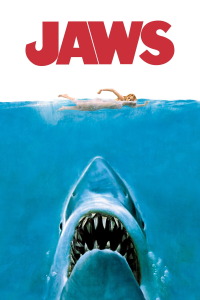
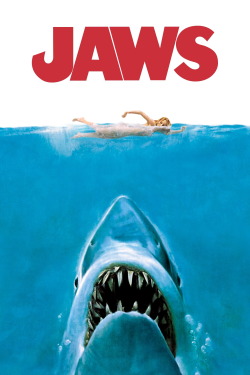
Director Steven Spielberg put himself on the map with his famed father of summer blockbusters on June 20, 1975. The highest-grossing film in history at the time of its release, Jaws established a formula for future summer pictures to follow, which places greater focus on high concept premises and action-adventure.
Its story is based on the novel of the same by Peter Benchley. A great white shark begins to terrorize swimmers at a small New England resort town, and the police chief, Brody (Roy Scheider, The French Connection), responds by closing the beaches. But, as the profitable Fourth of July is fast approaching, Mayor Larry Vaughn (Murray Hamilton) reopens them, allowing the shark to continue wreaking havoc upon the shoreline. When the shark attacks Brody's son, Brody, oceanographer Matt Hooper (Richard Dreyfus, American Graffiti), and shark hunter Quint (Robert Shaw, From Russia with Love) set out to sea to destroy the beast.
Jaws's three leads are sharply written and possess strong personalities that sometimes band them together and sometimes drive them apart. The interactions between them and other characters are precise, unique and nuanced; they all feel real. However, while the scholarly Hooper and crusty Quint have acquired sea legs and have exciting professions, Scheider's Brody is the everyman caught in the middle of an extraordinary conflict, an archetype that Spielberg now commonly employs. He is a man who knows what is right, but finds himself chained by society's foolishness and, as a result, more deaths follow. Thus, Brody's motivations for destroying the shark are both personal and moral - he intends to right his past wrongs and protect his family and town. Plus, he's scared of water, and that's definitely not helpful in a movie that spends a lot of time in the open ocean.
The action is endlessly thrilling. As the mechanical shark suffered from a multitude of technical problems, it remains hidden for most of the movie, and that makes Jaws incredibly powerful. Because the human mind has the tendency to fear the unknown, the shark becomes more than just a monster; it becomes a dark, ominous presence implied by John Williams's superb score and attacks seen from its point of view, causing us to construct a horror beyond comprehension within our own minds. In a stroke of genius, the camera focuses only on the panicked thrashing of the first victim (Susan Backlinie) and her piercing screams, her desperate pleads to God - the death is brutal because we see and feel her fear. Gore is sparsely used, but when it does appear, it is all the more shocking. Spielberg makes us wait until we see the shark for the first time, building suspense and excitement all the way to the climactic battle. And yes, while the shark has a habit of looking like the robot it is whenever its head fully emerges from the water, one can't deny that it is an impressive feat of engineering that mostly fulfills its purpose during its brief screen time during the film's final act.
Spielberg's shark flick is also a lot deeper than people credit it to be. Quint, a character just as greedy as the mayor, seeks to exploit the town's money in return for catching the shark. He is in the quest for glory, selfish desire, and to fulfill a personal vendetta against all sharks, so it's no coincidence that he's the only lead character who perishes. The shark itself represents the force of nature and shares a relationship to Quint similar to the one between Moby Dick and Captain Ahab. It attacks people not because it is evil, but because it is just an animal seeking to survive. Humans in the film, and real life, habitually tempt fate, venturing into regions where they have no right to be, regions occupied by other living creatures, regions where interactions between man and beast are inevitable. Instead of understanding this as an inevitability, humans, like Quint, seek to right perceived wrongs by creatures seen as evil only because that concept is assigned to them. With that in mind, the movie is less black and white than it seems. Like the great Shakespearean plays, Jaws holds a mirror up to us and forces us to truly examine ourselves.
Jaws is an ambitious, adventurous and masterful film that takes a deceptively simple concept and executes it to the highest degree through iconic performances, fantastic spectacle, and excellent mood-building devices. It is one of those rare movies that makes us forget about reality and draws us in completely. Though Spielberg and his daring crew battled numerous setbacks and failures during a long, arduous shoot, the film remains triumphant to this day because its creators came up with creative ways to overcome its problems. Perhaps more so than any of its peers, Jaws is very much the definition of "art through adversity.".
This review of Jaws (1975) was written by Charles L on 29 Apr 2014.
Jaws has generally received very positive reviews.
Was this review helpful?