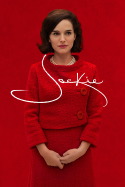
Review of Jackie (2016) by Spangle — 31 Jan 2017
Nobody will ever understand Jackie Kennedy and the pain she went through after the death of her husband. While we all have lost loved ones, few have lost a spouse. Even fewer have lost that spouse while the First Lady of the United States and none of those women were alive to be there for Jackie. She was isolated and all alone. Nobody could comprehend her grief and nobody, thankfully, can today. Sitting next to her husband driving through a parade, he is shot and his mangled head rests on her lap and she sits there with his blood splashing on her body. In this eternally lasting image, few have sat down to truly examine what that day and the succeeding few days were in the mind of Jackie Kennedy. However, in director Pablo Larrain's intimate look at her mind and grief in those days, he finds beauty, pain, and agony. But, above all, he finds a woman with so much strength, so much grace, and so much power, it is chill inducing. Punctuated by a powerful and articulate performance by Natalie Portman, the film leaves you in emotional ruins repeatedly and is an entirely beautiful, moving, and stirring portrayal of the strongest and hardest week of Jackie Kennedy's life.
Upon its release, Jackie gained notoriety for its unique structure. It is not a biopic at all. Shot with grainy documentary style footage, the film is an inside look at both Jackie's life after her husband's death and the descent into madness experienced by the country afterwards. However, that is not what makes it unique. Rather, the film is lyrical and poetic. Its dialogue is overwrought, begging to be quoted. It feels too prim. Too precise. Too detached from reality. Yet, that is entirely the point. This is no biopic about Jackie Kennedy. It is an album composed of "songs" about her life and key defining moments: the death of her husband, the televised tour of the White House, planning for the funeral, and talking to a priest. Complemented by interludes courtesy of an the famed interview with Life Magazine, the film takes on a poetic approach to telling its story and this is incredibly irregular for the genre. As a regular of the poetry of the storytelling, it is nonlinear and it shows scenes from those aforementioned moments before and after the assassination in varied order.
This structure truly lends itself to the way in which the film is quotable, but overwrought. Its dialogue is aching to be recognized as powerful. As timeless. As stirring. Yet, it is all of those things. He may feel a tad forced in this regard, but it works. Matching the hypnotic, dream-like, and thoroughly lyrical nature of the storytelling, the dialogue feels mystical, other worldy, and unattainable. Jackie's words are so well chosen, as are those of her counterparts. In this, the dialogue catches the class, the grace, and the power with which women in her position are expected to act and speak. Her words are well chosen for fear of portraying herself and her husband negatively. In her interview with the journalist (Billy Crudup), she unleashes at times and becomes less formal, but never allows him to print these words. In these moments, she becomes wordier. With those she acts entirely formal around, her words are limited and more carefully selected. While I say the film is overwrought, it is not to detract from the film. Rather, it is perfectly elaborate in its limited words and prim/proper dialogue. Each word and each line feels quotable and verbose.
This verbosity is certainly what led the Kennedy's and others in power to seem unattainable. In particular, their life was a fairy tale. It was spectacular, overwhelming, and extravagant. Their wealth was obscene and otherworldly. It embodied regality and the belief that this was the royal family of the United States, if there ever were to be one. Larrain, a Chilean-born filmmaker, has managed to eloquently and brilliantly captures this cult of personality surrounding the Kennedy family and captures it so well, in fact, that the film has been criticized for the same reasons Jackie was criticized in her life. It is too cold. Too distant. Too reserved. Yet, it is for these elements that the film is so brilliant. Not only is it poetic and gorgeously crafted narratively, but its feeling and emotions as a film keep the audience at a distance. It never hopes to understand Jackie and her mindset after her husband's death, as that is an impossible enterprise to undertake. It is simply something that could never be accomplished. As such, instead, Larrain's film reduces intimacy. He uses grainy documentary style footage, old school television footage, and has a cold and carefully orchestrated Portman in the lead role. She embodies Jackie Kennedy to the very last detail both in her manner of speaking, walking, and body language. It is a film that is cold and dead behind the eyes, shutting out the world from every hoping to understand the pain its main character underwent and preventing us from fully grasping who she was.
This review of Jackie (2016) was written by Spangle on 31 Jan 2017.
Jackie has generally received positive reviews.
Was this review helpful?