Review of Isle of Dogs (2018) by Trevorsview — 25 Apr 2018
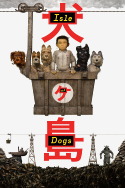
Chucking away people’s furry companions into a castaway of our own junk sounds unpleasant. If the government decided to pass such an act in real life, it’d be no laughing manner. However, Wes Anderson’s Isle of Dogs explains his own unpleasant reality for the near future in a strong sense of repugnantly clever dark humor.
You maybe heard Japan historically made holy good fortune symbols out of cats: the maneki-neko (Fortune Cat) and the “Nambu Jinja” (Cat God Shrine) to name a few, well once upon a time, feline lovers declared war on canines, beneath Mayor Kobayashi’s command, due to an incurable dog flu and snout fever conspiracy theory, alongside canine overpopulation. Therefore, those dogs must live off rotten apple cores in Trash Island while everyone pushing the quarantine strokes a stink-eyed kitty in his lap. In this ominous future, dogs behave like humans, and humans behave like dogs, all in an inventive level of turning dogmatic excrement into gold more movies should reach.
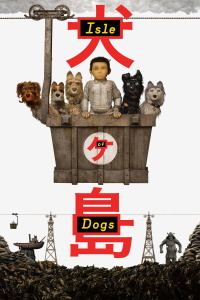
The set pieces diverge across modern Japan’s high-contrast imagery that brims the manageable branding of Harōkiti (Hello Kitty) into the monotone, not-so Kawaii (A Radiant Face) Trash Island with many garbage cubes signifying ultimate imprisonment. Green shows up almost nowhere in this feature, causing the entire island to glow of blood-stained muddy hues much like whatever your quadruped friend may have left on the front mat. If there is anything in the real world that would normally gag your reflexes, here, it instead exhausts beauty, say for instance, an illuminated glass bottle cave that silhouettes a dog pack who rest there for the night.
Wes Anderson commands everything under his own mind game, as if he’s adapting the wartime manga series “Norakuro” (Stray Black). Claymation cinematographer Tristan Oliver uses the light scheme to artfully mimic a spotlight on Mayor Kobayashi’s control; the abandonment he details in each dense frame almost always positions pack leader Chief in center, the camera pivoting on an axis to draw our attention on each individual pooch.
Chief leaves a greater impact than any other dog or human followed throughout the story, black from living through soot his entire life, zero nametag in sight. Each of the hounds’ other nametags help you to identify their souls behind their fleas, not their imprisonment number tattoos, a lot like the following of typewriter names recorded as the holocaust victims state themselves in Schindler’s List. One of these hounds, King, flaunts whiskers curled in a pompous high-class moustache fashion, just one small example of the stop-motion dolls’ memorable designs. However, amongst the maggots Chief’s pack must consume, they undeniably do little anything plot-productive. The standard American voice actors in part hurt it further, who never sound drunk off toilet bowl fluids as this film demands.
Though Chief is an exception to the narrative flaws his pack carries; right from the start he needs a Hachikō (Eight-Affection) type hero, until Atari, a twelve-year-old in search of his guard dog, Spots, triggers a change in attitude. Although Atari has few thoughts about each dog he meets, the main relationship between himself and Chief surprisingly sweet, topped off by some handsomely animated tears built to churn your pancreas in sorrow.
In this Japanese fantasy-dystopia, captions in parentheses accompany Japanese text, dialogue mostly media translated. The dogs’ barks are translated into English, ensuring easy international adaptation. To counteract the smog of pooch anti-paradise, familiar historical images of Japan include a Neko Jinja (Cat Shrine), Taiko boys, sumo wrestling, a Nō (Talent) production, and a humorously gross seafood bento box prep sequence.
The Japanese murals here resemble toys recycled for affordable government-funded programs: a world where puppets control smaller puppets within perfect compositions that suggest political control upon whatever meticulous movement made. These fascist solutions, including robot canines built to replace regular canines, ends up less feasible than public lies, leading to few surprises why an Empire of Dogs might attempt rebellion toward the oppressive leaders’ theatrical playset.
Unlike most propaganda, Isle of Dogs turn the nation against itself in a weirdly entertaining way which safely repulses you enough to take initiative.
This review of Isle of Dogs (2018) was written by Trevorsview on 25 Apr 2018.
Isle of Dogs has generally received very positive reviews.
Was this review helpful?