Review of Inside Out (2015) by Kyle M — 24 Jan 2016
Disney Pixar's latest classic "Inside Out" stars Joy and Sadness as your main emotions you'll be feeling when watching the film, alongside with Fear in a form of worry in a minor role of your emotions throughout this wonderful, inventive experience.
Twenty years ago, Pixar made themselves well-known by creating the first ever computer animated film in the animated genre of film, "Toy Story". From then on, Pixar has shared various wonderful stories in different areas and sizes, but their grandness was constant throughout. Their best originality belongs to "Brave" while their best film belongs to "Toy Story 3". Now it didn't seem that "Toy Story 3" would be dethroned when it has that much heart on growth, while "Brave" however shows a possibility that it might get dethroned sometime eventually, even if it consists a heartwarming side while being a great fantasy flick. But now, those two films have gotten dethroned by Pixar's latest fun masterpiece "Inside Out".
"Inside Out" explores an imaginative/creative, thought-provoking concept of our emotions inside of our heads that takes care of us on how we express ourselves and think. The film centers on an 11-year-old girl named Riley, who's going through what any kid would go through: leaving your hometown and old friends behind because one of your parents got a better job at a faraway city. To Riley's parents, she's a happy girl who's a bundle of joy to them. As she adjusts to her new life at a new place while trying to make new friends, as it's a usual routine for a kid to experience, her emotions are there to take care of her.
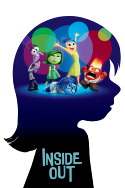
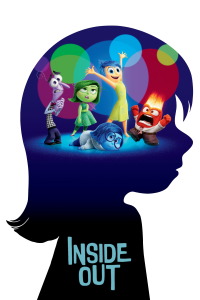
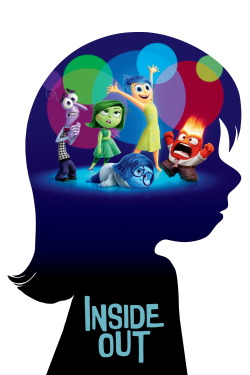
According to the film, there are five basic emotions: joy, sadness, fear, anger and disgust. Joy (voiced by Amy Poehler) makes sure that Riley's happy, positive, spirited and having fun, and optimistic if possible. Sadness (voiced by Phyllis Smith) brings the tears and sadness out of Riley's eyes, but she hasn't discover her purpose like the other emotions have their purposes in Riley's life. Fear (voiced by Bill Hader) keeps Riley safe from anything that'll cause harm or would hurt her, physically or mentally (i.e. nightmares). Anger (voiced by Lewis Black) makes sure that Riley's life is fair in a way that she'll be in modes of disapproving and being argumentive or just simply negative without positivity. And finally Disgust (voiced by Mindy Kaling) keeps Riley from anything that'll "poisoned" her physically or mentally, or simply just providing judgement and common sense.
The way things work is that the five physical forms of Riley's emotions controls her mind (Joy's the captain in Riley), and whatever actions they make, it becomes a memory orb (and Joy's done most of the memories). Furthermore, whatever memory that builds Riley's personality, it becomes a core memory and creates an island that holds that personality from the memory. That's where the complicating action comes in when Sadness touched one of them, and the Joy-ful memory becomes a sad one. As Joy's trying to fix whiny Sadness's mistake, it leads to a mishap of the core memories on the loose and were sucked to where long-term memories are located, with both Joy and Sadness sucked along as well. While Joy and Sadness are on the reflective, explorative journey back to their headquarters, it was now up to Fear, Anger and Disgust to help Riley, which led into not-so-good consequences sense Joy isn't around to put a smile on Riley's face.
It's not really a near-tearjerker sad like the ending of "Toy Story 3" and the duration of Ghibli's latest "When Marnie was There", but it's truly sad. It would genuinely garner tears from different viewers who'll watch this and would shed some tears or one. The emotional level from the perspective Riley's life is like a coming-of-age at a young age adjusting her new life in the city. Also, speaking of coming-of-age, you'll feeling worry for Riley as what she's going through, outside of her and inside of her, during Joy's absence (which is why Fear has the minor role of the "Inside Out" viewing experience).
But besides those two emotions, the obvious reason why Joy is the main star of both the film and the experience is enjoying what the film has to offer: fun comic and a great, typical, cute heartwarming emotion. Joy's spirit seen in the film was both made perfectly by Amy Poehler's performance, while expressed with gorgeous animation that covers the whole film as Pixar's best job well done since "Toy Story 3". The film also builds up to a powerful meaning after some reflections and explorations through more creative ideas under the concept.
There's no doubt that this film would win Best Animated Feature, despite the upcoming releases of "The Peanuts Movie", which ought to be great as well, and Pixar's second treat "The Good Dinosaur", which was postponed from last year. It's also the top contender of Best Original Screenplay since out of all the films that were and not yet released this year, I really don't see any of them, or their stories, that would top the five emotions' adventure within a little girl. It could also be nominated for Best Original Score since it'd signified the older magic of Pixar seen in the older classics.
"Inside Out" is a definite must-see as it provides something thought-provoking that'll keep you thinking about it even though it was imaginative with high creativity that stayed faithful to both the emotions and the mind's process topic of psychology. Director Pete Doctor, who've done "Monsters, Inc." and another emotional tale "Up", done a thorough research to make the concept logically work without a missing gap, which makes this his best work by the look of the end result. The end result of this most recent instant animated classic is great like this year's combo of "Big Hero 6" and "How to Train Your Dragon 2", and it's one of the rarest of all films to be flawless.
There's no reason to not like this - or miss this when it's irresistible and lovable - like there's no reason to not have Joy in your life. (A+).
This review of Inside Out (2015) was written by Kyle M on 24 Jan 2016.
Inside Out has generally received very positive reviews.
Was this review helpful?