Review of In This Our Life (1942) by Antonius B — 07 Sep 2018
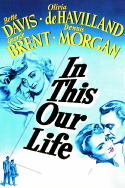
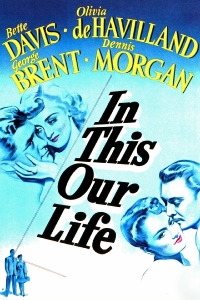
Olivia de Havilland and Bette Davis are sisters named Roy and Stanley in this film from director John Huston, and surprise surprise, Davis is conniving and de Havilland is virtuous. In a mirror relationship, their father (Frank Craven) is a nice guy who has been taken advantage of by his loud-mouthed business partner, his own brother-in-law (Charles Coburn). We get a glimpse of the character of Davis and Coburn when she flirts with him and he showers gifts on her, expecting a kiss on the lips in return. It's a creepy relationship that we'll see resurface a few times in the film. Early on, we find de Havilland married to a doctor (Dennis Morgan), and Davis engaged to a lawyer (George Brent). de Havilland is faithfully devoted to her husband, so imagine her shock when she discovers that, out of the blue, one day he's run away with her own sister. I won't say too much more about the plot lest I spoil it, but suffice to say that Davis's character doesn't stop there.
Bette Davis is as entertaining as ever. At her best in the film, she's playing a manipulative character who is essentially acting, but not acting quite as well as a professional would. We basically see a great actor portraying a character who is only a good actor. At her worst in the film, which is still pretty darn good, she over-acts, or at the very least, pushes the limits of the character. de Havilland is a contrast both because of her role, and her more subdued approach. It's interesting to see her process being abandoned, hardening and becoming guarded a bit, but also living in the moment and remaining true to herself. What a nice little exchange she has when she starts seeing Brent's character:
Roy (de Havilland): "There's nothing permanent but now. The moment. That's all there is.".
Craig (Brent): "There'll be other moments. And there'll be other days. I'm not going to lose you.".
Roy: "You'll only lose me if you try to hold me. Don't do that...".
In Charles Coburn, we see the classic successful capitalist, a man with few scruples and who will stop at nothing to come out on top. No wonder he gets along with Davis's character so well; he betrays his own brother-in-law, and she betrays her own sister. We see his view of the common man (and non-caucasians) in these lines:
"He's coming by for me later. Probably one of those civil-liberty affairs. Civil liberty. Ha! If you ask me, they're concerned only with liberty for the wrong people.".
"Who are the wrong people, William?".
"The people who aren't worth a cent and never will be, that's who.".
And that's what clinches the film for me - aside from de Havilland, Davis, and Huston, it's got a quiet little social message, and stands up for African-Americans. We see a young man (Ernest Anderson) studying a law book late at night to advance in the world, because, as he puts it:
"...a white boy, he can take most any kind of job and improve himself. Well, like in this store. Maybe he can get to be a clerk or a manager. But a colored boy, he can't do that. He can keep a job or he can lose a job. But he can't get any higher up. So he's got to figure out something he can do that no one can take away. And that's why I want to be a lawyer.".
It's wonderful to see de Havilland encourage him after he says this, and at first that seems to be just an interesting little side note in the film, but the character resurfaces later. After he's made it in a law office, he's falsely imprisoned when it's his word vs. a white person's (being vague on purpose). While the eventual jailhouse confrontation scene is a little contrived, Huston's panning across other African-American prisoners can't help but make at least a part of the audience wonder how many of them may also be innocent, and there is no ambiguity in the overall moral message of the scene. Anderson is earnest in his performance, and Hattie McDaniel (as his mom) is as well.
The film is a little over-the-top and melodramatic in places, and it strains credibility by just how easily Davis is accepted by the family after what she does. It does rile us up a bit though, and I was mesmerized by these two legends. The thought occurred to me as I was watching it that it would have been more interesting had the two actresses been in each other's role, since they are a bit typecast here. Entertaining film though, and look for the cameo from Huston's father, Walter.
This review of In This Our Life (1942) was written by Antonius B on 07 Sep 2018.
In This Our Life has generally received positive reviews.
Was this review helpful?