Review of In the Valley of Elah (2007) by Nicky B — 30 Aug 2009
Doesn't Need the Baggage.
We as a nation are conflicted about the war we're in. Was it a good idea? Now that we're there, what do we do? Whose fault is it? Is there any safe way to get us back out? I don't know what the current figures are for Americans who really think we found WMDs, but it's probably depressing and I probably don't want to know. One of the first things we look at when we are selecting politicians for national office these days is how closely their stance about the war matches outs. And of course, you get the people who conflate supporting the war and supporting the troops. (I've always been amused by that phrase, given that I was, during the time Graham was away, being supported [i]by[/i] our troops, or at least one member of them.) I think probably there are usually this many stances about war. Even World War II, the one we pretty much now universally think of as "the good war," had its opponents. Especially beforehand. In fact, Andy Rooney, who spent time as a [i]Stars & Stripes[/i] reporter, said that although he joined because of Pearl Harbor, he didn't really support the war until they liberated a camp and he really saw.
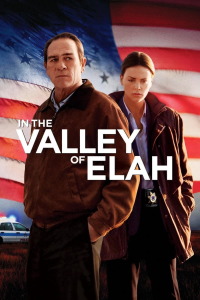
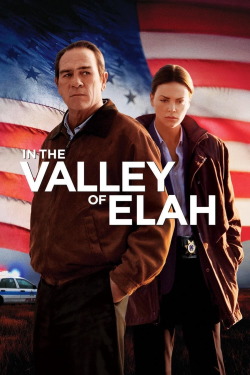
Specialist Mike Deerfield (Jonathan Tucker) has disappeared from the base where he's stationed upon his return from Iraq. His father, Hank (Tommy Lee Jones), leaves his job as a gravel-truck driver to come search for his son. He believes that, since he was an MP in Vietnam, he has the skills to find his boy. Certainly he does not trust local detective Emily Sanders (Charlize Theron)--but then, neither do the detectives with whom she works, because she apparently has a boyfriend higher up in the ranks. They believe this is why she's been promoted from being a traffic cop to being a detective. She, however--with Hank's considerable help--is the one who wrests control of the crime back to her jurisdiction, since Hank has shown her the signs that Mike's body, which is found on the side of the road, must have been moved onto base property from the spot not far down the road, off base property, where he must have been killed.
The thing is, the story works just fine like that. The conflict between town and military, the pain of a father--and, without much screen time, mother (Susan Sarandon as Joan)--who just wants to know what happened to his son, a single mother trying to raise her kid by working at a job she isn't thought qualified to hold. These are simple, basic, universal themes. There's no need to interject the subplot about the treatment of prisoners or any other details of the Iraqi war. The last scene is completely gratuitous. The idea that some of the men returning from the war do so with psychological issues they are not prepared to handle works in context of the story, and I do think it's a good thing that one of the last things in the credits is a list of PTSD resources. Though I'd've put it at the beginning, because hardly anyone watches credits. However, I'm not sure showing the detail is helpful, not least because it doesn't take [spoiler redacted] to come away with post-traumatic stress disorder. Even some people who just sit in theoretically safe places can develop it. It's just that it's more likely from major trauma.
It is also kind of ham-handed, the way they do it. The business with Tommy Lee Jones and the flag is unnecessary, though I suppose the bit where he shows the other person proper flag etiquette goes a ways to establishing his character. But the war stuff seems crammed into what is an otherwise outstanding mystery. For one, we have great performances. Tommy Lee Jones, Charlize Theron, and Susan Sarandon are all great actors. Many of the minor characters are convincing. It's not exactly dripping with subtlety, but it does hold the attention, and I, at least, was interested in finding out what happened to Mike. I was even okay with the bits that talked about how Mike had changed after going to war because, well, people change after going to war. A man who served in Vietnam, and Hank was supposed to have done, would surely have known that. Maybe he just wasn't ready for it when it was his son.
I think history shows us that making films about a war during that war seldom produces good films. World War I, of course, didn't produce a lot of films at all, then or since, and most of World War II gave us propaganda. Hardly anyone does Korean War films, either. Most of the best anti-Vietnam films were made after Vietnam, and the Gulf War was over so quickly there wasn't really time to make and release films about it during the fighting. However, we have been in Iraq for some time now. (Nobody makes films about Afghanistan, really, either.) We are also, these days, more interested in our own time than anything in the past. Therefore, we are inclined to make movies set in our own time, which means movies about the current war. Unfortunately, the box office shows that pretty much no one cares. I've a book set in World War I where a woman who'd never before cared about Geography now can cite you little tiny towns in France where battles take place. That doesn't happen today. How many people can even find Afghanistan on a map?
This review of In the Valley of Elah (2007) was written by Nicky B on 30 Aug 2009.
In the Valley of Elah has generally received positive reviews.
Was this review helpful?