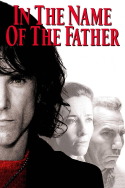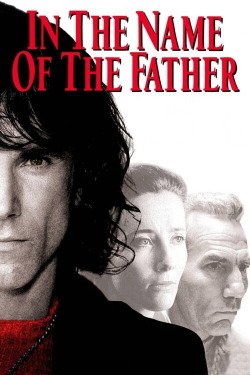
Review of In the Name of the Father (1993) by Edith N — 23 Aug 2009
In Which Coerced Confession Turns Out to Be a Bad Idea.
When I was in college, I was pretending to be an English major so I could get into grad school--Evergreen doesn't have majors, but most of my credits made me look a lot more like a history major, and I wanted to get into a creative writing program. (Yeah, I know--I haven't gone to grad school, and it's been a long time since I was in college. Blame the crazy.) This meant, among other things, that I couldn't be in the "Ireland Program"--there was writing involved, true, but it was more history. On the other hand, Sean Williams, one of the teachers, had been my teacher for Irish Gaelic Language and Song that summer, and she freely invited me to come watch movies with them on Thursdays, the day they watched movies. So I've seen a fair number of movies from and about Ireland, more than one of which talked about The Troubles. After all, they're such a major aspect of Irish history, especially of the twentieth century. And, indeed, this was one of the movies I watched all those years ago. It stuck with me in a way a lot of other movies haven't, and as [i]The Secret of Roan Inish[/i] is a vague and distant memory, but this is clear.
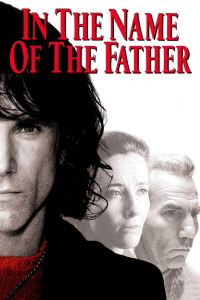
Gerry Conlon (Daniel Day-Lewis) is a ne'er-do-well Belfast boy. He's not IRA; he's just stupid. However, the way he's stupid causes trouble for the IRA, and they strongly suggest that he not be there anymore, so off he goes to London. He and his best friend, Paul Hill (John Lynch) live a dissolute life there, too, determining that they're interested in drugs and free love. They end up robbing a prostitute's house, coincidentally on the same night as the Guildford Bombings, a couple of pub bombings of soldiers' off-hours hangouts. Somehow--I'm not sure exactly how, and even Wikipedia's kind of vague on the subject--the British government got the idea that Gerry and Paul, along with Paddy Armstrong (Mark Sheppard) and Carole Richardson (Beatie Edney), were the bombers. They also decided that Gerry's family, including his father, Giuseppe (Pete Postlethwaite), helped with the bombings, and they all went to jail as well.
The film declines to get involved in the issue of the IRA versus the British government, because it simply isn't relevant to the story. Gerry wasn't a member of the IRA. Certainly Giuseppe wasn't. Not even the British government ever truly claimed he was. The issue here is the assumption that, because these people were Irish and suspected, they were guilty. Indeed, the issue is the enormous miscarriage of justice which these people suffered. There was--this is true--a note in Gerry's file declaring that the exculpatory information, the testimony of his alibi witness, was not to be shown to the defense. IRA bombers, real ones, later came forward and confessed to the bombings--well, they were serving life imprisonment anyway, right?--and the government didn't even consider letting them out. I think the issue was that, if the government admitted it was wrong about this group of the Irish, they might have to admit that some of their other decisions about the Irish were wrong as well.
Most of the film is the dynamic between Day-Lewis and Postlethwaite, and let's face it--if you've got those two in your leads, you're going to get some brilliant performances. Oh, they give Emma Thompson as their lawyer billing over Postlethwaite, but while she's really good, she doesn't get as much screen time as he does. He also must play someone who cannot express himself to his own son. He must show hope even in a situation that calls for despair. Oh, all right, Day-Lewis did a flashier job. However, Postlethwaite should have beaten Tommy Lee Jones for the Oscar; [i]The Fugitive[/i] was good, but it wasn't hugely complicated. The film also had the difficulty of going up against [i]Schindler's List[/i], which knocked it out of consideration. (I suspect the choice between Postlethwaite and Ralph Fiennes is what gave way to Jones's win.) And I will say that Daniel Day-Lewis, whatever else you may say about him, chooses his roles carefully. It would be three years after this before he did another movie; he had only done one between this and 1989's [i]My Left Foot[/i]. I don't always agree with his choices, but he makes them carefully.
I'm not sure this film is actually as good as you walk away believing, actually. The story is powerful and the acting is brilliant, but a lot of the rest of it strikes me, now I really think about it, as so-so. Some of the prison scenes are unnecessary and a bit overdone. I do think some of the strain between the IRA prisoners and the other prison leaders is helpful and powerful, and I really do think that contributes to the film. On the other hand, the whole thing with the LSD-soaked puzzle map of the world is a little much. Yes, there's conflict between Gerry and Giuseppe (his mother really liked the name) about Gerry's use of intoxicants, but there's such thing as too much showing. While we do have a little showing of a few of the other people from the group, apparently only Giuseppe put forth any effort initially after their appeal. It is, however, a very striking--and completely accurate--moment when the judge says firmly that he wishes they were convicted of treason so he could sentence them to death.
This review of In the Name of the Father (1993) was written by Edith N on 23 Aug 2009.
In the Name of the Father has generally received very positive reviews.
Was this review helpful?