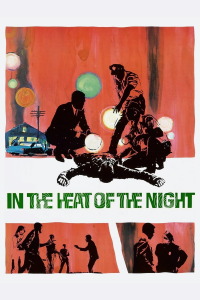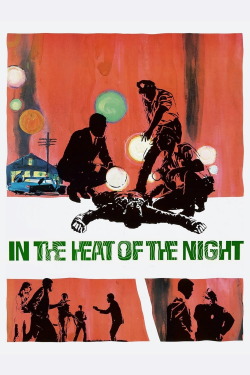
Review of In the Heat of the Night (1967) by Blake P — 23 Dec 2014
Sparta, Mississippi is a homely little town. It's small, desolate, and drenched with unbearable heat. The citizens are self-serving. The picturesque advertisements that paint the faces of the middling businesses are deceiving. At times, the town resembles something out of a '60s teen romance film, a quaint but calm setting that lets love grown on trees. But like in "Twin Peaks," there is a labyrinth of an underground that takes the wholesome Coca-Cola posters and white swing-sets and knots them into a dirty, unsightly torrent of dust and hatred.
When a prominent entrepreneur is murdered, his body discarded in an alleyway, the town's police force doesn't know what to do with the case. Most people have mutually decided to mind their own business, only to join forces when an unwanted visitor makes their way into the isolated bubble that is Sparta. Murder was hush hush before. Bodies being dumped in the middle of the street is something completely new to the citizens.
Chief Bill Gillespie (Rod Steiger) orders his staff to search the area, looking for anyone who may have seen or heard something, or, simply looks guilty. One officer finds an African-American man (Sidney Poitier) sitting alone in a train station; Sparta, being the brewery of racial tension that it is, doesn't ask any questions when he is arrested purely on the basis of his skin color.
But once he arrives at the police station, he makes a fool out of everyone; he introduces himself as Virgil Tibbs, a Philadelphian homicide detective that is merely passing through the town to catch an upcoming train to Memphis. He wants nothing more than to leave, but his chief orders him to stay and aid the investigation. Gillespie has never known anything other than bigotry, but he is suddenly forced to push his personal views aside and follow the duties of a policeman. Tibbs, meanwhile, has to continuously defend himself from the prejudiced people of Sparta, some of whom are viciously violent when it comes to keeping the status quo in check.
In 1967, the social climate of America was drastically changing. After years of fighting for equality, blacks were finally getting the respect they deserved, even if that process was more gradual than it should have been. Varying cultures were beginning to have more opportunity than ever.
But then, there were towns like Sparta, buried in the deep South. In the middle-of-nowhere and completely separated from the open-mindedness of the big cities, the Spartas of America didn't want and perhaps weren't aware of the changes that were being made in society. "In the Heat of the Night" remains so important because it's both a steadfast look into the ugliness of prejudice and a snapshot of a transitioning world.
Beneath all the sweat, snarling animosity, and tumbleweeds, there is a triumphant truth to every single scene. All his life, Bill Gillespie was taught that African-Americans were underneath him, him being a superior, mighty being. But when Tibbs comes onto the scene, we can see a newfound flicker in his eyes. He wants to scream and shout the most appalling things imaginable and put down his newfound colleague in the same way he has treated the black citizens of Sparta. Yet, he can't. Tibbs is a better man and a better detective. He's a hell of a lot smarter than he is, too. In just a matter of days, a realization hits Gillespie unexpectedly. Maybe, just maybe, no race is more sophisticated than the other. Maybe.
The fact that, less than 50 years ago, cities were still as racist as Sparta is stunningly maddening. But Tibbs and Gillespie's relationship represents something more than just two guys attempting to get along. The film represents something more too. Take away the mystery, the formal vocations, and the suits, and you get a full view of a predominantly white society finally understanding the wrongs of their past. As hesitant as they may be in terms of correcting them automatically, there's a knowledge that going on with such discrimination will be venomous, a severe death wish on every person in the room.
Poitier and Steiger are absolutely excellent. They are capable foils that bounce off each other with ceaseless energy. Poitier is electric, stoic and utterly powerful; the scene in which he slaps a small-minded plantation owner is totally sensational. Steiger is extremely fascinating to watch - he isn't your average movie bigot, as there is a lurking variable that fuels his hate more than mere racism.
"In the Heat of the Night" is Southern-fried and completely without boundaries. It's an above average detective film, but beneath its whodunit tropes lays a scathing commentary that still remains relevant.
This review of In the Heat of the Night (1967) was written by Blake P on 23 Dec 2014.
In the Heat of the Night has generally received very positive reviews.
Was this review helpful?