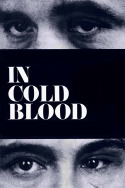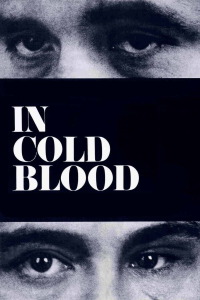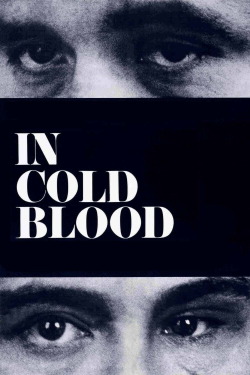
Review of In Cold Blood (1967) by Terri H — 29 Dec 2008
I still haven't gotten around to reading the book, I'm afraid. I meant to after I'd finished [i]Capote[/i], and I didn't. Perhaps I'll have watched it by the time we get to [i]Infamous[/i], the other telling of Truman Capote's version of events. Because, of course, pretty much what we have is Truman Capote's version of events, and how accurate you consider that has a lot to do with what you think of Capote. (Frankly, I shall always think of him as a fat little man in a red suit; thank you, 'Bots.) There are certain bare facts that cannot be changed; Herbert, Bonnie, Nancy, and Kenyon Clutter are dead. (Herein played by John McLiam, Ruth Storey, Brenda C. Currin, and Paul Hough.) Perry Smith (Robert Blake) and Dick Hickock (Scott Wilson) killed them and were executed by the state of Kansas for their actions. For the rest, we must look to what Capote got out of them and what can be gleaned from other sources. And here, of course, Capote is our main source, since the movie is, at least in theory, based on his book.
When Dick Hickock was in prison, his cellmate, Floyd Wells, told him that Wells had once worked for a Kansas farmer named Herbert Clutter. Clutter, Wells claimed, had a safe with a great deal of money in it. It would be an easy job for anyone with the will to accomplish it. So Hickock and a prison friend, Perry Smith, cross into Kansas, breaking Smith's parole, and seek out the Clutter farm in Holcomb, Kansas. Wikipedia describes the murders of the Clutters as part of the plan unraveling, but it's clear from the outset that the Clutters will not live through the night. After all, Hickock says repeatedly that they will leave no witnesses. What [i]is[/i] an unforeseen event is that Herbert Clutter had no safe. He made as many transactions as possible by check, and all in all, there was some $40 in the house. Hickock and Smith took off on a career of frankly stupid crimes, mostly check fraud, and are eventually captured in part because they are driving a stolen car.
We'll stick to the facts of the Clutter case, here, tempting though it may be to drift into Blake's own murder trial. However, I think there is enough material about Hickock and Smith to occupy, well--it's said that Capote amassed 8000 pages of research, and I'm only trying to fill five paragraphs. Part of the chilling aspect of the film, in fact, is the possibility that these men may well be sociopaths. I've read some speculation that at least Smith was probably schizophrenic. Apparently, Capote indicated that the men might not have been entirely repsonsible for their own actions. It is also, however, indicated that no psychological evidence was presented at the trial by either side. Obviously, as I've never read the book, there's only so much I know about the case. It's possible that the punishment--even without going into death penalty arguments--was too severe, and that the men could not have formed intent. It's an interesting speculation, anyway.
Mentally ill they may have been, but all that bright Smith and Hickock were not. The decision to leave no witnesses was, in and of itself, not the smartest decision that could have been made. The original plan to disguise themselves with black stockings would have made it possible to avoid the gallows. Further, making their escape by writing bad checks just left a paper trail that was easier to follow. The escape to Mexico wasn't a bad idea, but the return to the US was. And at the heart of the story, it seems to me unlikely that trusting a random cellmate about the location of a $10,000 payoff was a good idea. I don't know for certain that there was malicious intent there; in fact, I rather doubt it. But I am given to understand that jailhouse stories are prone to exaggeration, and this one seems more likely, given Clutter's propensity for writing checks, to have been an outright lie.
1967 was a curious year in film. [i]The Graduate[/i] beat [i]In Cold Blood[/i] for Best Director. [i]Bonnie and Clyde[/i] (which you won't see here, because I hate that movie) beat it for Cinematography. [i]Thoroughly Modern Millie[/i] won for Original Score. [i]In the Heat of the Night[/i] won for Adapted Screenplay. The five movies really have very little in common with one another except the year they came out. In feel, [i]In Cold Blood[/i] is the oldest. It's from the same year as the others, but it does project a '50s mentality. In that sense, it captures the time it's supposed to quite well. The Clutter murder is a hint at the darker side of an era we see as wholesome, and I think it does very well at that.
This review of In Cold Blood (1967) was written by Terri H on 29 Dec 2008.
In Cold Blood has generally received very positive reviews.
Was this review helpful?