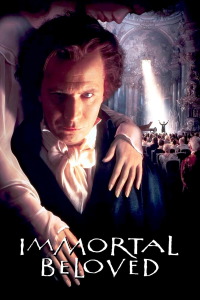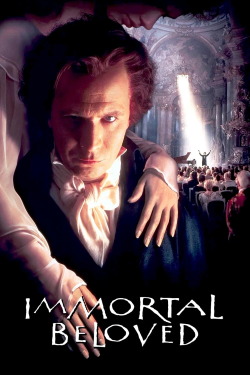
Review of Immortal Beloved (1994) by Alexander F — 30 Aug 2010
Unfortunately, one can't critically view "Immortal Beloved" without making mental comparisons to "Amadeus": both are semi-biopics of classical composers as told from an outside perspective, beautifully featuring their music throughout the soundtrack, with a great deal of mystery behind their life stories. Immortal Beloved, however, offers the story of Ludwig Van Beethoven as a puzzle-biography, told in non-chronological segments from several different perspectives.
The story begins with Beethoven's death, when a secret love letter is found attached to his full estate, turning out to be his last will and testament, leaving everything to his "immortal beloved". His good friend and violinist, Anton Schindler, tries to grant his final wish by following the mystery of this special lady by questioning Beethoven's past love interests, each with a different story to tell.
The film is mostly true, apart from the final resolution (in reality, no special lady was ever found).
"Immortal Beloved" is a bit darker and gloomier than "Amadeus", and the telling of Beethoven's life seems to be altogether more depressing than the aristocratic glamour of Mozart's career, but Beethoven's screen story has something beautiful that "Amadeus" did not: Ludwig's inner inspirations accompanying his music, as shown in dramatic flashbacks of his younger life. As he explains to Schindler, "It is the power of music to carry one directly into the mental state of the composer.".
This quote sums up the entire film in a nutshell.
Although "Immortal Beloved" seems a bit slow at times, not quite as enjoyable, entertaining, or full of beautiful visual elements and musical grandeur as "Amadeus", this story of Beethoven and the use of his music throughout is truly something to see.
This review of Immortal Beloved (1994) was written by Alexander F on 30 Aug 2010.
Immortal Beloved has generally received very positive reviews.
Was this review helpful?