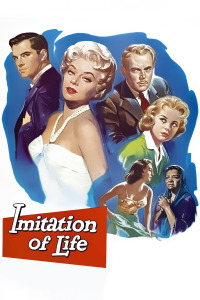
Review of Imitation of Life (1959) by Christopher T — 28 Jan 2010
Douglas Sirk?s remake of Imitation of Life certainly has melodramatic elements; there is simply no denying that; however, the criticisms of melodrama that Sirk includes throughout the film set the foundation for the story, which is one of certain realism.
The story centers on Lora (a white woman) and Annie (an African American woman) who are both widows with a young daughter. Lora temporarily gives Annie and her daughter Sarah Jane a place to stay, but eventually gets Annie to agree to stay permanently and help take care of Lora?s daughter, Suzie, while Lora chases after her dream of becoming an actor. As the story unfolds it focuses on several storylines such as Lora?s career and its affect on her social life and most notably the relationship between Annie and Sarah Jane.
Every aspect of Lora?s story is relatable to a melodrama; from the way she?s stereotyped into believing she shouldn?t have a career, to her daughter?s exaggerated enthusiasm and stereotypical white, teenage girl characteristics. The problems that Lora and Suzie have to deal with are blown out of proportion. It?s obvious that Lora simply needs to spend more time with her daughter and less time acting. As for Suzie?s crush on Lora?s love interest Steve?it all bubbles down to the fact that she?ll still have him around even if she ends up with Lora.
On the other hand, the relationship and story between Annie and Sarah Jane may seem melodramatic at first glance; however, their turmoil?s, while presented in a melodramatic form, take a realistic form when compared to the times. What is their problem exactly? From a young age, Sarah Jane is disgraced by her African American race. This revulsion persists as she grows older and eventually the tension between her mother and reach a breaking point. While emotions run to a melodrama-like high, Sarah Jane?s situation doesn?t support other melodramatic ideals. The fact that she hates her own race is far from a simplistic and exaggerated problem; in fact, it?s a strong dash of realism. For Sarah Jane, she is a child dealing with the fact that she is rather light-skinned (possibly the product of an interracial relationship?) African American with a dark-skinned, African American mother during the pre-Civil Rights time period in which being an African American wasn?t yet being embraced. Sarah Jane?s rejection of her race is the product of a complex, confusing situation which completely defies the melodramatic feeling that is expelled by Lora and Suzie.
So why the split between melodrama and criticism of melodrama? Simple. It acts as a tool of comparing Lora and Suzie?s situation to Annie and Sarah Jane?s. Lora and Suzie?s issues are made out to be more problematic than they really are while Annie and Sarah Jane?s issues aren?t italicized to the point of seeming as big as Lora and Suzie?s. Imitation of Life does a perfect job of classifying middle/upper class white life in the 50?s as emotionally exaggerated while represents the life, problems and issues of the lower/middle class African American very well.
As a side note, Juanita Moore stole the show as Annie. Grade A performance.
This review of Imitation of Life (1959) was written by Christopher T on 28 Jan 2010.
Imitation of Life has generally received very positive reviews.
Was this review helpful?