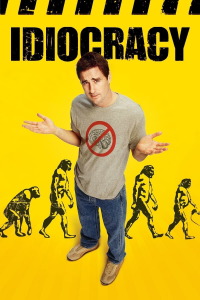
Review of Idiocracy (2006) by Rubia — 17 Nov 2011
"Is the essence of life comic or tragic?".
Brave New World, 1984, Alphaville, Sleeper, Idiocracy. While Godard kept the same cold and grim atmosphere of Aldous Huxley and George Orwell's novels, Woody Allen made a comedy of a future society. More than thirty years after Allen's Sleeper, Mike Judge, taking the same road, uses a sort of slapstick humor to present a very plausible coming reality. Having a tragic or a comic perspective, the main point of concordance among these five works is the pessimism - but have in mind that Idiocracy is a satire, that's why it is done in the same models of the culture it is criticizing.
The future may not have been as hopeless as Huxley and Orwell feared, but we start to see their predictions here and there, dressed as liberty, modernity and other concepts that hide milder forms of control and totalitarianism. Perhaps the highly mechanized individuals of Alphaville seem "too much" to us. Perhaps the orgasmatron of Sleeper or the "Ass" movie that "won eight Oscars that year, including best screenplay" in Idiocracy seems too much "funny" to be taken seriously, but we can't deny the latent discomfort we feel. If Alphaville made me think and amazed me with its aesthetics, and Sleeper pleased me with its silly-intelligent jokes, Idiocracy really worried me.
In Alphaville, Godard brings the importance of the language as a direct influence in thoughts and attitudes. The lack of words like love and conscience, for example, made people of Alphaville "to forget" certain emotions. What Godard may not knew at that time was that it wouldn't happen a suppression of emotions, but an exaltation of them, specially the positive ones, i.e. "happiness". Words were not taken off of the dictionary, but they were replaced by emoticons. One of the greatest hits of Idiocracy is the hospital receptionist that doesn't need to think, only to listen to what the patient is saying and select a button with an icon based on that: for "my head is just killing me", for example, there's an emoticon of a gun pointed to the head of a sad face. The absurd of this scene is that it doesn't seem absurd at all. It is actually, and within the proper proportions, of course, something quite familiar nowadays. There's no need to wake up in 500 years to realize that a poor vocabulary leads to common sense and empty or childish arguments. All we need to do is to access our favorite social networks and thousands of examples will jump in front of our eyes. The problem is that things are very subtle today, what makes us think, for example, that coming to wear branding on our clothes like it happens in Idiocracy is something impossible to happen. As if we already didn't! Every time we "like" a product or a company on Facebook, we are advertising it. Not to mention that lots of things we use are not products but labels. It's curious that Idiocracy was released around the same time that Twitter was created, and some similarities can be noted.
- Brought to you by Carl's Jr.
- Why do you keep saying that?
- 'Cause they pay me every time I do.
The only thing that is missing here is the at sign. Brought to me by @Carl'Jr. Can't you picture that?
The world is already full of publicity disguised as simple sentences. And we are already "strolling" slogans. But, hey, maybe things won't turn out that bad.
This review of Idiocracy (2006) was written by Rubia on 17 Nov 2011.
Idiocracy has generally received positive reviews.
Was this review helpful?