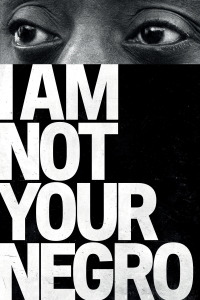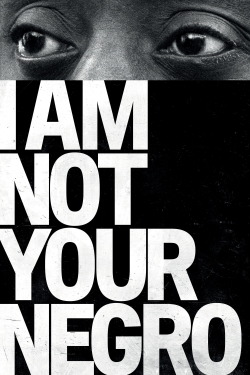
Review of I Am Not Your Negro (2017) by Jack G — 23 Feb 2017
"Because Uncle Tom refuses to take vengeance in his own hands, he was not a hero to me.".
I Am Not Your Negro feels monumental. It's not simply subject matter; just because a film looks at the black experience in America it doesn't necessarily mean it is a great artistic feat (if that were true, then something like Hidden Figures, which is a good but still 'feel good' kind of watered-down Hollywood product, would be in my top 10 this year, and it isn't). There has to be something else to the artistry, to elevate the subject matter and to make us feel, somehow, that through art there can be some redemption. This is significant with a film like this because there is little/nothing that can be found as redemptive in what white people have done to blacks over hundreds of years. While James Baldwin grew up at a time when he was free inasmuch that he wasn't a slave or someone's direct property, the struggle for African Americans to have some kind of semblance not even so much to have civil right but to be *acknowledged as human beings*, to be MEN and WOMEN, was one that he sought and argued for his whole life.
Peck depicts Baldwin's life and times through his words, spoken by Samuel L Jackson in a performance that you can forget easily is a performance because of how masterfully he slips into *being* Baldwin. It may not be a performance at all, it's simply like we are hearing this man reading from his (at the time of his death unfinished) book about the lives and deaths of Medgar Evers, Martin Luther King and Malcolm X as he knew thing (which, I should add, makes it all the more remarkable, hopefully when his career is evaluated in sum this will be one of Jackson's major accomplishments). But Peck also depicts it through the art of juxtaposition - and make no mistake, art is what goes into this process, whether Peck is choosing scenes from films (both famous ones like Guess Who's Coming to Dinner and The Defiant Ones, which Baldwin had some strong and pointed criticisms of, or clips from educational films and newsreels and of course blacks being abused and beaten in the streets and/or marching), or whether it's Baldwin himself, or someone else.
The art comes in the way that Baldwin's words create a context about how society has treated black people, and how, with as clear a sense of purpose as possible, Baldwin wants to strip down further how whites see blacks and even how blacks see whites and blacks see blacks and everything else that goes with that. Some of the juxtaposition is simple enough - John Wayne, who Baldwin describes as someone who "never grew up," is shown slaughtering Indians in 'fun', which Baldwin then uses to bring in the black experience as something comparable, which it is - while others are rebukes, denunciations, and, philosophically and emotionally, seeing how images portrayed by society intersect and contradict and make even more painful how blacks were treated and still are for so long: that fear and rage and hurt, while whites create their own context. And lastly the juxtaposing comes in with modern times (Obama, the murders of Tamir Rice and Michael Brown in Ferguson, all those white politician apologies, with the last one of course being Trump, that superimposed over a montage of a road slowly going along).
If anything the movie is inspiring simply because it sees with the clearest of vision not that things have changed so much but that things have not changed, and that even with the end of segregation or voting rights or whatever, the soul of America is forever stuck in a place where things can never fully be healed (in a moment that seems darkly prophetic and provocative, in 1965 Baldwin calls out RFK for saying that one day there could be a black president as something that feels/seems/maybe is like whites *allow* blacks to become presidents, and it only takes 40 years after 400 years of slavery and oppression... I mean, damn). It may be inspiring simply because it exists and Baldwin's words take on a greater meaning when put to these images, which Peck and his editors have assembled with great care but even a greater sense of purpose.
There is importance to its message, but this goes in tandem with it being a profoundly moving piece of filmmaking, where so many images and sounds of brutality and racism, in the reality of the time, in those white faces set against black ones (i.e. that black teen going to school surrounded by people spitting on her) and in that fantasy-space of the movies and what they've shown over time (in a way this is as much of a movie about movies as La La Land might be from this past year, at least up to a point). While there could be a criticism that the movie goes all over the place with its subject matter, I found this to be a strength of the storytelling. This isn't some talking-head piece looking at Baldwin's life (there's a PBS doc for that), but rather this is simply the story of a man looking at three men who inspired him and sometimes made him rethink his ways and whose deaths caused him intense pain. And by the end of it all is a clip of him saying that he still sees hope, in a sense, in that he's not a pessimist - if the future of America as a whole is better than, perhaps, so it will be for blacks, since it is ALL America, ultimately.
Wow.
This review of I Am Not Your Negro (2017) was written by Jack G on 23 Feb 2017.
I Am Not Your Negro has generally received very positive reviews.
Was this review helpful?