Review of Hysteria (2011) by Frank N — 02 Oct 2012
Electricity Will Solve Everything!
The word "hysteria" actually refers to the uterus. Plato actually wrote of the uterus as an animal, wandering the woman's body and even strangling other organs. Galen was the first extant writer to describe intercourse--or, for unmarried women, "pelvic massage"--as a treatment. And, you know, pelvic massage was a better treatment than a lot of the other possibilities come up with. However, by the time of this story, pelvic massage was what women got. Of course, this emphatically did not produce orgasm; we are assured that orgasm can only be the result of penetration. (Presumably between married couples in missionary position with the lights out.) However, "hysterical paroxysms" resulted, and whatever of the myriad symptoms which sent the woman to her doctor in the first place. Often, the procedure was considered so lengthy and tedious that the job was passed on to midwives instead, because the doctors were far too busy.
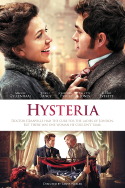
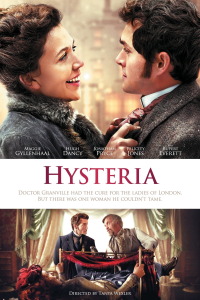
Mortimer Granville (Hugh Dancy) is a young London doctor who seems to have worked for half the hospitals in the city. He believes in such foolish and newfangled notions as germ theory. He ends up working for the eminent Doctor Robert Dalrymple (Jonathan Pryce). Dr. Dalrymple runs a high-class office, one of the best-known clinics in women's medicine in the city. His schedule is full; he treats women all day for hysteria. He's more than happy to pass the work off onto his young assistant, and the patients are happy, too. Even better, Mortimer is being encouraged to quietly court Miss Emily Dalrymple (Felicity Jones), and there is hope that he might inherit the practice. However, his hand is cramping almost to the point of uselessness, and he is becoming intrigued by Miss Charlotte Dalrymple (Maggie Gyllenhaal), who runs a community center for the poor, much to her father's shame. Mortimer teams up with his foster brother, Edmund St. John-Smythe (Rupert Everett), an inveterate tinkerer, to make the treatments easier.
I've actually read a book about the history of the electrical device the historical Mortimer Granville patented--though his was actually for relieving muscle cramps, and it was taken off-label to provide pelvic massage. It is also true that massagers were frequently advertised in places such as the Sears catalog for "muscle relief" that were obvious from their size and shape to be geared toward very specific muscles indeed. The history really is fascinating, but it's also fairly depressing. The whole idea of hysteria is pretty dismal. The film tells us that it was still diagnosed until 1953, when it was finally acknowledged to be the "catch-all" diagnosis it is accused of here. Some women diagnosed with hysteria had serious medical problems, such as epilepsy and schizophrenia. Some were really diagnosed with independent-while-female. And, yes, there were more than a few who just need a really good . . . hysterical paroxysm.
Maggie Gyllenhaal is charming in this, though I'm not sure she's really necessary to the story. In a way, her Charlotte may be seen to be the New Woman, a direct contrast to her sweet and retiring sister, Emily. Emily is studying phrenology. Charlotte teaches slum children to wash their hands. Emily plays Chopin. Charlotte performs midwifery. Emily is decorative. Charlotte is useful. Emily, really, is the kind of woman who ended up being diagnosed with hysteria because she was bored and didn't realize it. Charlotte is the kind of woman who ended up being diagnosed with hysteria because she was a nuisance to the men around her. However, Emily seems completely neutral to Mortimer, and Charlotte seems too much woman for him. Mortimer spends all that time with the dissipated Edmund, but he is still innocent enough so that he doesn't realize that, no really, those are orgasms he's causing in women all day every day. Clearly, he's never seen one of those before.
This is something which has always amused me about the history of the vibrator. Yes, it's harder to bring a woman to orgasm than a man. It is. However, the first patient we see, the one Dr. Dalrymple demonstrates technique with, takes half an hour of constant massage. Mortimer finds it so difficult to do all day every day that he loses his job from what is obviously a repetitive stress injury--he also had to ice his hand, which led to the discovery of the problem in the first place. I have no doubt that at least a few of these doctors' own wives were diagnosed with hysteria, and if they couldn't tell that the "hysterical paroxysms" were the same as orgasms, well, their wives must not have been having any orgasms in bed. It goes without saying that the medical industry was dominated by men almost since a medical profession was a thing. However, it seems that it has also largely been controlled by [i]selfish[/i] men, because a considerate lover would have figured out far earlier that hysteria was a nonsense diagnosis.
This review of Hysteria (2011) was written by Frank N on 02 Oct 2012.
Hysteria has generally received mixed reviews.
Was this review helpful?