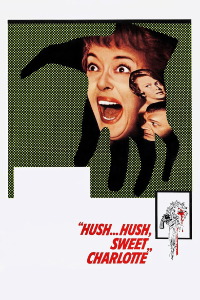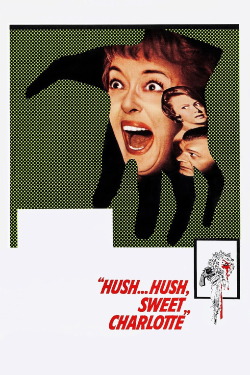
Review of Hush... Hush, Sweet Charlotte (1964) by Paul Z — 21 Oct 2008
There is an ominous feeling about this movie, even its title, which seems to go out of its way to seem like it truly has soul and communicates with us. Its story is very sad. Bette Davis nearly melts down from the heat of her own presence as a wealthy spinster who lives in a big mansion on a plantation that has interminably been in her family. The Highway Commission plans to level her home and build a new highway through the estate. Davis, playing the titular Charlotte, disregards the eviction notice and refuses to leave, feeling that it is all she has in the world. She demonstrates her feelings by keeping the demolition crew and the bulldozer away by shooting at them. They finally give up and leave temporarily.
The movie, rather than opening with cursive credit titles and interchangeable orchestral music, starts immediately, set many years earlier, when Charlotte is still barely an adult, and her married lover, played by a very young Bruce Dern, is murdered in a stunning scene for 1964. Although the killer was never discovered, the local townspeople, and director Robert Wise's camera, are persuaded of Charlotte's guilt. Charlotte has since become a recluse, a black sheep of the community, living with her housekeeper, Agnes Moorehead, in the fading mansion. Now she tries to find support in her struggle against the Highway Commission from Olivia de Havilland, playing her cousin who lived with the family as a girl. Upon her return, she refreshes her relationship with a local doctor who jilted her after the murder, played by Joseph Cotton, who flaunts a hugely persuasive Southern twang.
Olivia de Havilland's performance is inordinately remarkable. She is an actress entirely opposite of Bette Davis. She is of incredible self-control, not only as an actress, but as a woman. Her first instinct is to fight feelings, smother, restrain, and simply not accept her outsized emotional condition. But, in refusing to welcome innate unpredictability, grief is only complicated, but this is never overt. She masks this complexity in her irresistible feminine poise and beauty. She brings such incredible adjustments that slowly build upon one's comprehension of her character. Her looks, her reactions, her completely closeted feelings are knowingly real and natural. Robert Wise, a master of realism in the most haunting contexts, sees this as significant realistic gold and makes sure to steadily maintain its purity.
Wise maintains purity in many areas of Hushâ?¦Hush, Sweet Charlotte. The evil, for instance, that is unraveled is unadulterated, shocking cruelty, heartlessness and sadism. The film is definitely scary in spite of the shock value it bears for its time. As a "grand guignol" sort of story, it is a naturalistic horror tale, a graphic, amoral psychological drama. It is this kind of pure evil that really draws you in to a thriller. Wise's Gothic tale, shot in a telling black and white, has that draw, and would not be out of place being performed in one of the turn-of- the-century French theaters, perhaps a converted chapel, the theater's history shown in the confessionals, angels and stain glass above the stage.
This review of Hush... Hush, Sweet Charlotte (1964) was written by Paul Z on 21 Oct 2008.
Hush... Hush, Sweet Charlotte has generally received very positive reviews.
Was this review helpful?