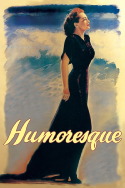
Review of Humoresque (1947) by Ilsa L — 29 Oct 2012
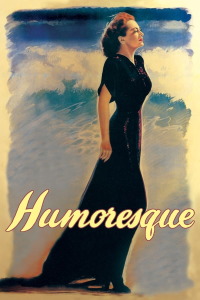
Coincidentally enough, in 1946 both Bette Davis and Joan Crawford starred in mediocre melodramas set in the world of classical music. Davis's vehicle was called "Deception," Crawford's "Humoresque," which is the name of a style of Romantic music. Also coincidentally, I happened to review the Davis film just a couple months ago.
Crawford's film has the far better title, but the films are equally shallow and phony. Audiences in the 1940s flocked to theaters to watch Davis wreak vengeance and Crawford cry of a broken heart. Writers tried to dream up situations where revenge or self-pity would seem authentic to the characters, and they mostly failed.
All through the second of half of the over-long "Humoresque," Crawford's self-lacerating destruction seems fake. Her character is in love with a superstar violinist played by John Garfield, and he's in love with her. For the story of doomed love to work, there has to be a compelling reason why the couple can't be together. But there is no good reason.
I kept wanting to scream at Crawford's character: Just marry the guy already!
There are great elements of "Humoresque" though. The first half-hour is scintillating. It tells the story of the Garfield character, growing up in a working-class family in the Bronx and breaking the social code by falling in love with the violin instead of the baseball bat. We watch him struggle with the competing concerns of developing his artistry and helping his parents put food on the table. His parents emerge as authentic and fully realized characters in their own right. And rarely have I seen Garfield feel so at home in a role.
Then he meets the Crawford character, a high-society alcoholic in a loveless and childless marriage. They meet at a high-society party hosted by Crawford. This party sequence is so good that it should be as legendary as the party scenes in "All About Eve." The dialogue in this sequence was so brilliant, I wrote some of the lines down:
- You just spoiled the beginning of an odious relationship.
- Every time I look at you, I get a fierce desire to be lonesome.
- With all that talent, he'll probably end up in jail.
- I'm constitutionally given to enthusiasm about nothing.
Clifford Odets is credited with writing the script, based on a novel of the same name by Fannie Hurst. But I get the feeling that Odets for the most part had his script dumbed down by the Warner Brothers assembly line of hack script doctors. Only the party sequence bears the mark of a genius writer.
Yes, there's a lot of great music played in the film. In fact I think there's too much. I don't watch movies to listen to an hour of music. No matter how great the music is, that's not what cinema is about for me. I can listen to great music any time. I don't have to go to the movies to hear that. Director Jean Negulesco continually put long concert sequences in the film whenever he ran out of story ideas.
This review of Humoresque (1947) was written by Ilsa L on 29 Oct 2012.
Humoresque has generally received positive reviews.
Was this review helpful?