Review of Howl (2010) by Phillip D — 05 Dec 2010
2.5 Stars out of 4.
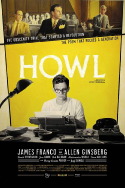
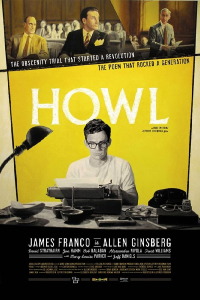
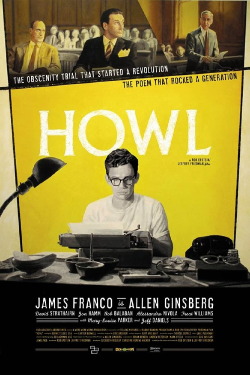
What must be made clear about Howl is that it is about the contentious poem not the poet -Allen Ginsberg. This right away is going to off put some, but the film does capture the rather blunt, ridiculously ardent poem appropriately. To do so, it endures expressionistic animation, court room drama (an unexpectedly one-sided battle), and interviews with Ginsberg from various uncomfortable angles (he's played by the very talented James Franco).
Beat poets, like this movie I will soon tell you, created mixed reactions. Their poetry was violent in a verbal sense - their words tore provocatively through the paper and never exactly made sense but carried terrific beauty. We could give Beat poets literary merit because they had the goals of any classic poet: they wanted to express themselves and certainly wanted to be published.
I was concerned with how 127 Hours would excite us outside of Franco being wedged between a rock. With Howl, my concern was how would they make the film interesting outside of Franco sitting at a typewriter. Was it going to be a psychological study of Ginsberg or a mere figurative analysis of the literary work Howl? The result is the latter, where Ginsberg spends most his time sitting on a couch, smoking up, in bliss, and reflecting via interview.
The major focus for Howl is emphasizing the poem, bringing out its euphoric cacophonies (if that makes sense) and hinting at its deliciously precise double entendres. What we do realize in Howl is that the poem reflects much of Ginsberg's emotions: confused, aroused, and stammering. Franco does not have the Ginsberg voice down but speaks in a way that he creates his own artist. He emphasizes all the verbs, interchanges verbs for nouns, and proclaims his poetry as if a sermon (demonstrated in black-and-white sequences at the Six Gallery Reading in 1955).
Directors Rob Epstein and Jeffrey Friedman, however, have created a film irrepressibly unfocused. Howl jumps too much from scene to scene for it to really become a movie. I admired a biopic called I'm Not There, where the film jumped from personality to personality. It worked well. Never had I seen an enigma brought out by analyzing his (Bob Dylan) character through so many roles - even a female, Cate Blanchett, played Dylan.
To capture a writer or rather his most famous work, Epstein and Friedman project the story through time passages. The trial puts the merit of Howl up to question, with the prosecutor (David Strathairn) becoming more and more humiliated. John Hamm is Ginsberg's attorney, who loves to flex his bantering muscles. The animation creates a reverie, an alluring approach to Ginsberg's poem, which requires a tremendous interpretation.
But Howl, I felt, never took off. It follows a painful monotony of pseudo-mockumentary and pseudo-court room drama, when the drama really serves little appeal. It never makes the Ginsberg character very interesting. Granted the film is called Howl not Ginsberg, but like all art, the piece comes from the creator.
We can forgive the film for its honest claim that Ginsberg was a homosexual, who fell in love with Jack Kerouac's romanticism and then soon went for Peter Orlovsky (Aaron Tveit) who became his life-long partner. Beat poetry is so fascinating all the levels that it exerts freedom, agonizing sex through its irrational wording. Most of these writers were doped up and writing as if each word was a mission. Howl and Other Works, as Howl tells us, is put to question as to whether it is obscene or not. But the poem is just a dark outcry, by Ginsberg the passive communicator who isn't given much time here.
This review of Howl (2010) was written by Phillip D on 05 Dec 2010.
Howl has generally received positive reviews.
Was this review helpful?