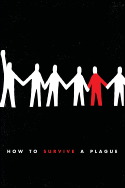
Review of How to Survive a Plague (2012) by Edith N — 14 Jan 2013
In the Hopes That Their Epitaphs Would Not Read That They Died of Red Tape.
Under the Reagan administration, when AIDS was spoken of at all, it was with the claim that an astonishing sum was being spent on research. However, a real look at the numbers showed that the research for literally dozens of diseases was being folded under the "AIDS research" claim, as AIDS patients were indeed coming down with those diseases. Ronald Reagan himself didn't even refer to the disease in public until after Rock Hudson, supposedly his close personal friend, had already died of it. At least one patient didn't have his approval for disability come through until after he'd died. Hospitals were rejecting AIDS patients. Paramedics were refusing to treat them. Children were being thrown out of schools. There was very little coverage of the illness in the mainstream press, and people still had no qualms about saying that all the patients deserved to die.
In such a climate, it's hardly surprising that some people decided that they weren't interested in waiting around to see if their government would help them. They decided that they would make their government pay attention. Though the film doesn't mention it, it started with the New York-based group Gay Men's Health Crisis. However, some of the members decided that the group wasn't doing enough, either, and they created the splinter group the AIDS Coalition to Unleash Power, or ACT UP. Their primary goal was political action. They would proceed to put pressure on the government to pay greater attention to the needs of AIDS patients. They fought for more clinical testing of potential AIDS drugs, and what's more for expedited testing. After all, they were dying anyway and didn't have time to wait. They protested when public figures made comments about how they all deserved what they got. Another group, the Treatment Action Group, covered Jesse Helms's house in a giant condom to protest his homophobic statements.
And things have, mostly, gotten better since then. Money the government claims is going to AIDS research is, mostly, money actually going to AIDS research. Hospitals can't deny AIDS patients treatment. Children are no longer kicked out of schools. While you don't have to like gay people to get elected, you can't say some of the things that politicians said in the '80s and '90s. (Though, of course, the Catholic Church still does.) It's entirely possible, even probable, that there will never be a cure; the virus mutates awfully fast. A vaccine may not even be possible. But, unlike in the early days of the crisis, there is a test, and information about how to avoid contracting the disease is available everywhere. It isn't treated as teaching children how to be gay; it's treated as teaching them how to be safe. We would not have these advances without people willing to go to jail if necessary to get their point across.
And, yes, there is a cocktail of drugs that is remarkably effective in the treatment of AIDS. It is estimated that six million lives have been saved with the drug; AIDS is no longer an automatic death sentence. I have friends who have a friend who has been living with AIDS for over ten years now, and as far as I know, he's still otherwise healthy. However, despite those lives saved, two million others--it works out to four people a minute--die every year because they cannot afford the drugs. Of course, most of those are in places like sub-Saharan Africa, often in communities that don't have very good health care full stop. However, even in the United States, people die because they can't get the medicine. When AZT first came out, it sold for $10,000 a year--and that isn't adjusted for inflation. One of the greatest problems in the current AIDS crisis has been one of profit over humanitarianism. After all, those drugs are made by for-profit companies who don't have to worry about the deaths of those not able to afford the drugs.
The crisis is not over; no crisis that kills four people every minute is over. Currently, TAG is working with the Bill and Melinda Gates Foundation to deal with the problems in Africa where tuberculosis is killing AIDS patients. It is sad but true, but one of the ways to survive a plague, any plague, is luck. Where you were born and when you contracted the disease has a huge impact on whether or not you'll survive. Some people contracted the disease early on but still managed to live until there was effective treatment; others contracted it later but died sooner. It is unknown how many of the people who appear in the footage of this documentary died of the disease, because not all of them are identified. However, the short answer is "too many." The film includes footage of Pat Buchanan asking why they don't just all stop having sex, and he seems astonished by the idea that people can't be certain to do that. He'd prefer oppression to education; the lesson of this film is that education works.
This review of How to Survive a Plague (2012) was written by Edith N on 14 Jan 2013.
How to Survive a Plague has generally received very positive reviews.
Was this review helpful?