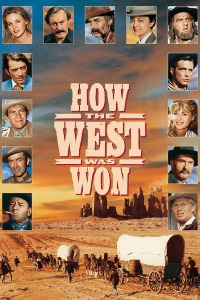
Review of How the West Was Won (1962) by Jacob M — 08 Dec 2013
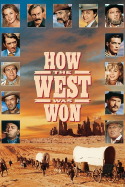
Everyone knows the history behind the discoveries of the western territories of America. But what happens when you create an epic western, have three different directors direct it, film it in the Cinerama format, and feature one of the biggest casts in the history of film? Well, you have How the West was Won, a truly incredible film that definitely an essential viewing.
Narrated by Spencer Tracy, How the West was Won tells the story of the development of the western territory in the point of view of three generations of a traditional family in five different segments. The first, The Rivers, introduces the Prescott family, led by Karl Malden, who head out on the Erie Canal to live out in western territory. Jimmy Stewart appears as a mountain man who falls for one of the daughters, played by Carroll Baker. The family also has to deal with a crooked river pirate (Walter Brennan) and Ohio River rapids. Debbie Reynolds plays the family's other daughter and Agnes Moorehead plays the family matriarch.
In the second segment, titled The Plains, Debbie Reynolds leaves the family to become a signing sensation in the east. She returns to the west during the Gold Rush to inherit some gold. Joining her is the wagon train leader Robert Preston, the wise-cracking pioneer Thelma Ritter, and Gregory Peck joins the party as a gambler. Along the way, the group encounter Indians and Reynolds gets into a love triangle between Preston and Peck.
The third, The Civil War, Carrol Baker's son, played by George Peppard, goes out to fight for the Union in the Civil War. The segment also features John Wayne as Union officer Sherman, Andy Devine as a Union corporal, and Russ Tamblyn as a Confederate deserter.
In the fourth segment, The Railroads, Peppard works on the construction of the railroad, but things get heated up when he feuds with boss Richard Windmark over crossing Indian territory. the segment also features Henry Fonda as a buffalo hunter and also features a very memorable buffalo stampede.
And in the fifth and final segment, titled The Outlaws, Peppard becomes a US Marshal who has to deal with wanted outlaw Eli Wallach. Debbie Reynolds returns in this segment, but much older, and Lee J. Cobb appears as another US marshal who disagrees with Peppard's strategies.
From the opening Cineramic shots of the Rocky Mountains, you automatically know that How the West was Won is going to be an incredible experience. The cool thing is that when I watched the film on TCM, it was presented in a format that replicates the original Cinerama experience. Because of this, the film looks like you're watching it in actual Cinerama. Cinerama is a very awesome widescreen process, and in the case of How the West was Won, it's very awesome. The panoramic shots of the mountains and the deserts are jaw-dropping and the action sequences are very, very intense. The rapids scene, an Indian attack, Civil War battles, a buffalo stampede, and one of the craziest train shootouts ever put on film, in Cinerama, the shots are very cool and makes me wonder why no one makes these films anymore. It would be very cool to see a Cinerama film made today. I hope some director dedicated to preserving old classics can revive the Cinerama format. Maybe Martin Scorsese or Christopher Nolan or something like that.
Earlier, I said that the film features possibly the biggest casts in all of film. While many of the big actors in the film have small cameo appearances (John Wayne, Walter Brennan, Agnes Moorehead, etc.), these small roles are very memorable and it's always great to look for a star that you enjoy to watch. Others (Jimmy Stewart, Debbie Reynolds, Carrol Baker, Gregory Peck, Robert Preston, George Peppard, Henry Fonda, etc.) have larger roles, and in each scene, each actor has a memorable appearance that makes the film great as it is. Some of my favorite appearances include Stewart, Fonda, Wayne, Peck, Reynolds, Wallach, Preston, and Ritter, just to name a few.
Alfred Newman provides the score to this epic film, and it's fantastic. The use of old folksongs as "I'm Bound for the Promised Land" and "Shenandoah" are amazing for a film as this and intense moments in the score gave me chills, especially in key action sequences. One song, called "Away in the Meadows", sung in the tune of "Greensleeves" or in the Christmas world, "What Child is This", sung by Debbie Reynolds, is a very moving song that will likely make the most emotional weep.
By the end of my viewing of How the West was Won, I felt moved. I felt inspired by the inspiration it took for actual pioneers to develop the country that I live in today that I love to live in. As for the film itself, it's an incredible Cinerama experience, filled with stunning sequences, a powerful score, and has one talented cast of some of Hollywood's best actors. With that said, I wonder how epic the film looked on a Cinerama screen back in the day.
This review of How the West Was Won (1962) was written by Jacob M on 08 Dec 2013.
How the West Was Won has generally received positive reviews.
Was this review helpful?