Review of How I Won the War (1967) by Kim W — 19 Feb 2011
A Scene the Harder For the Reality.
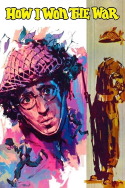
I wanted to like this better than I did. I like John Lennon, of course, and he and director Richard Lester worked together on both [i]Hard Day's Night[/i] and [i]Help![/i] Those movies, I do like. And yet this movie failed to hold my interest. I'm wondering if it's because it was too aware of itself. Lester didn't seem to me to be making a movie. He seemed to be making a Happening, if you will forgive the horrible '60s-ism. We were supposed to be seeing in this film Something Important, and yet what that was seemed a little vague to me. Of course it's Anti-War, because movies of the time were. At least unless they starred John Wayne. Hip movies, I suppose we should say. This may be the problem. The movie, I fear, is more concerned with being hip than good, and I rather think it fails to be either.
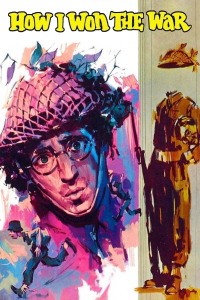
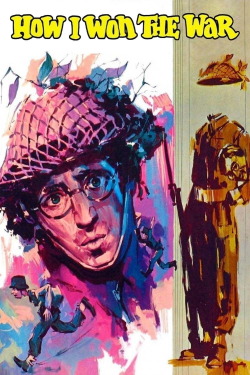
Lieutenant Goodbody (Michael Crawford) is one of those dreadful British officers who has become so on the strength of his connections, not through any ability or training. He is put in charge of a group of soldiers who are sent to take an oasis for the purposes of building a cricket pitch. A morale builder, don't you know. He is accompanied by your standard collection of British War Movie types, most notably for our purposes Cheeky Lower-Class Batsman Gripweed (Lennon). You get your Stiff Upper Lip, Out-of-Touch With Modern Warfare leadership. People who just want to be home with their wives and families. The movie is then intercut with actual newsreel footage tinted various colours; a conceit of the movie is that you can tell what battle people died in by what colour they are painted afterward.
Except the movie didn't make it clear to me that it was what was going on. All I could see was that there was suddenly some guy going around like a plastic army man, and then after that, there was a pink one. Eventually, a lot of them were blue, and that was when I started to work out what was going on. This is one of the places where it's a little too '60s for its own good. It's Symbolic, not concerned with whether or not the audience will understand what's going on. And you can tell that not everyone did when you find out that the people making prints in the United States thought the tinting was a mistake and made it all black and white again. Which doubtless confused people even more than those of us who saw the tinting.
The problem is that this has been done better other places. Roger says that he doesn't think the film is really anti-war at all, and I certainly don't think it's decent satire. There are scenes with hints of it--Roger doesn't like the bit where the man gets his feet blown off and his wife tells him to run them under the cold water tap, but I thought it an interesting summary of a certain attitude. Indeed, of Stiff Upper Lip. I read a graphic novel recently wherein a little old British couple dies a slow and lingering death of radiation poisoning after World War III, and it struck a similar nerve. Better. And there's of course [i]Colonel Blimp[/i]. Neither are really anti-war exactly. Just opposed to the kind of war the British tended to fight in the twentieth century. The old couple tend to forget it's the Russians, not the Germans, that they're fighting this time.
And John asks us if we knew it was going to end the way it did. Perhaps we did. In that moment, perhaps John's future is before us in a way he could not hope to have imagined. In an anti-war attempted satire, the Plucky Comic Relief is doomed. But we who know what will happen thirteen years later also know that it is not the fate of the character alone. John gets a good final speech, really the best lines of the movie, and it is this alone which has left me thinking good thoughts about the movie, this alone which saves it from total failure. It isn't a bad metaphor, really, for all those men who went away and died in Northern Africa. Or somewhere in France. Or the jungle. Or all those places young men have gone off to die. With John . . . at least he wasn't far from home, alone and scared. Most people can't stand her, but he loved Yoko, and she was there in those final moments. Gripweed and the others had no such luck.
This review of How I Won the War (1967) was written by Kim W on 19 Feb 2011.
How I Won the War has generally received mixed reviews.
Was this review helpful?