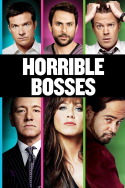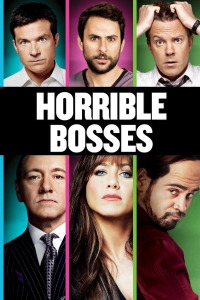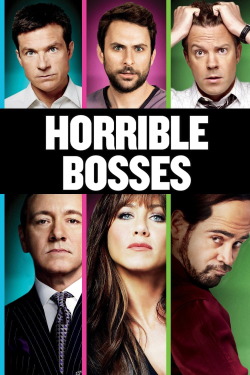
Review of Horrible Bosses (2011) by Shiira — 15 Aug 2011
In retrospect, we concur with Buddy Ackerman(Kevin Spacey), the movie mogul in "Swimming with Sharks", when he tells his disgruntled personal assistant to "grow up", because, culturally speaking, being a horrible boss is just par for the course in the movie biz.
Bad behavior is just part of the culture. The flunky should know this. Upon its initial release, and the intervening years leading up to "The Devil Wears Prada", in essence, the female version of this "Player(The)" rethink, the moviegoer, for the most part, sided with Guy, the beleaguered assistant driven to desperate measures, when during a home invasion, Buddy gets his comeuppance for treating the hard-working underling like dirt, with rope and a chair, and a gun that just might go off.
But now, courtesy of Andy Sachs, Guy is seen in a different light; a whiner, just one big baby, since the assistant for Runway editor Miranda Priestly, who in the 2006 film, bends but never breaks, even when faced with the seemingly impossible task of securing an unpublished manuscript for the next "Harry Potter" book.
Compared to that, Guy's assignment is a relative piece of cake. He lacks Andy's resourcefulness. She would know to hire a helicopter pilot in order to hunt down a whitewater rafting client, somewhere in the Rockies.
Guy just isn't cut out for the movie business. "I want my life back," goes the sniveling ingrate, while he holds Buddy hostage in exactly the same housebound manner as the secretaries' handling of their immediate supervisor, Mr.
Hart, in "9 to 5". Although he lacks the intestinal fortitude to be a movie executive, Guy climbs the corporate ladder, nevertheless, as a reward for sparing his boss' life(he shoots the girl instead), therefore taking the buddy system to surreal heights.
Feeling like a woman in a steno pool, he kills Dawn as a way of overcompensating for his emasculated feelings. Conversely, Andy, despite going toe-to-toe with the reconstituted woman(read: masculine), parlays her success for naught.
Even though Andy may be the heir apparent of Miranda's empire, she goes to work for a dying industry, but the journalist doesn't worship haute couture, whereas Guy loves the movies, and is dumbstruck by the film illiteracy of his colleagues, who know Shelly Winters only from "The Poseidon Adventure".
Insidiously, the filmmaker assigns a director with the name of Foster Kane, as a way to implicate the moviegoer as complicit philistines. He knows that the reference to "Citizen Kane" will go undetected.
Similarly, in "Horrible Bosses", Nick draws a complete blank when Kurt compares their murder plot to "Strangers on a Train", while Dale confuses the Hitchc*ck film with "Throw Momma from the Train".
To say the least, Kurt's analogizing of art and life is deeply flawed, but will anybody notice? In the 1951 thriller, it's not the bosses that Bruno and, arguably, Guy conspire to kill, but a domineering father and a promiscuous wife who won't give the tennis star a divorce.
If these best of friends were to actually sit down and watch the movie, they would realize the fallacy in their thinking, since, as the title clearly articulates, the passengers are "strangers", not familiars, therefore, the proposed murder swap could easily be linked back to them.
Does the filmmaker know this, or is the film as smart as its characters, and the baby sharks working under Guy who don't have the slightest apprehension of classic Hollywood? This misappropriated homage, to its credit, tweaks the plot points with some deftness, especially when Nick's boss(Spacey, again) discovers a lighter in his abode belonging to Kurt's boss, unwittingly planted by the unreliable film buff(as if fulfilling Bruno's plan to drop Guy's lighter at the crime scene), which propels the jealous husband(thinking that his wife is cheating) to gun down the idiot son of Kurt's mentor.
Unfortunately, it lets the passed over VP candidate off the hook. Since the murder(regardless of its unexpected third party participation) is going to incriminate them anyway, it would have been a lot more interesting had Nick gotten out of the car.
This raunchy, but ultimately tame comedy practically desecrates Hitch's good name by it the film's unwillingness to follow through with its lurid premise: What would drive an ordinary man to murder his boss? In "Strangers on a Train", Bruno feels double-crossed when Guy doesn't hold up his end of the deal.
Arguably, he owes Bruno, since the film hints that the tennis star would have eventually done in the wife himself. "Horrible Bosses" isn't calibrated right. Unlike the other targets, Harken is truly horrible, making the game comic performances by Farrell and Aniston seem out of place.
Given the chance, Nick would have slipped the rat poison in Pellitt's cocaine. He has a real axe to grind. Never mind the promotion. Things turn personal when the boss makes light of his grandmother's death.
This review of Horrible Bosses (2011) was written by Shiira on 15 Aug 2011.
Horrible Bosses has generally received positive reviews.
Was this review helpful?