Review of Hop (2011) by Shiira — 11 Apr 2011
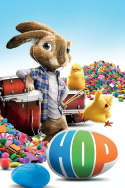
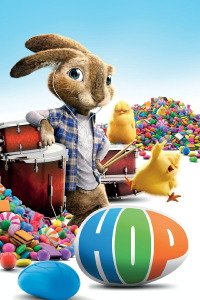
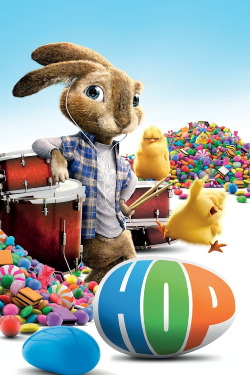
Oh, by the way, Christmas called. It wants its holiday back. Christmas wants to know why the Easter Bunny is delivering his holiday treats in a sleigh pulled by a flock of baby chicks. Who does this rabbit think he is? Santa Claus? On every Easter eve, according to "Hop", the bunny makes his airborne rounds around the world while the good little boys and girls are asleep, all except for Fred O'Hare, who as a child, catches a glimpse of the copycat critter as he lands in his backyard, where the Santa-wanna-be leaves behind a basket of Easter goodies on the child's front doorstep.
Thankfully, some traditions remain sacred. At least the rabbit has the tact not to infringe on St. Nick's signature move: the chimney drop. But otherwise, the Easter Bunny is one shrewd character. He closely follows the successful business model laid out by the dictatorial St.
Nicholas. As de facto leader of a candy factory located on, predictably enough, Easter Island, the rabbit too runs a tight ship. Also known as Rapa Nui, the Polynesian island with an infamous history of colonization, in which Dutch settlers completely wiped out the native population by the mid-nineteenth century through their spreading of infectious diseases.
"Hop", however, suggests an alternative history during the film's opening credit sequence, where the moviegoer sees a long-running lineage of Easter bunnies in portraiture that traces back far enough in time to coincide with the genocide of the Rapa Nui population.
The paintings, rendered in a distinctly European style, recasts the seemingly harmless rabbit as the colonizer. In the absence of Rapa Nui descendants, or elves, the Easter Bunny uses chicks(he's violating child labor laws!) to manufacture the vast array of holiday candies, including Hershey's Kisses, an American institution which creates a host of troubling connotations, since it suggests that the venerable Pennsylvania chocolate-makers moved their operations abroad to keep the cost of labor to a minimum.
The silver-foiled mainstay, in essence, gives this factory the appearance of a sweatshop. After all, it's non-American workers who produce the chocolate treats, seemingly without wages or any opportunities for occupational advancement.
Carlos(Hank Azaria), the Easter Bunny's foreman, a disgruntled lifer, always at his master's beck and call, seizes the moment to make it known that his services are available when E.B.(Russell Brand), the heir apparent, chooses instead to pursue a career in music.
Despite being qualified for the top job, the chick's ingratiating behavior toward his pink-nosed boss leads him nowhere, as Carlos learns the hard truth about being a chicken in a rabbit's world. His job has a glass ceiling.
That's because the chick is a victim of species discrimination. While E.B. is off galivanting in Hollywood, slumming as a musician because he can afford to, being a child of privilege(in the film's trailer, the bunny drums to Blur's "Song 2", but it's another Brit-pop smash, Pulp's "Common People", that's much more apropos to the bunny's breeding), Carlos loyally remains by the Easter Bunny's side, making sure that the gargantuan-sized operation stays right on schedule.
Carlos deserves a shot. Insensitive to the chick's aspirations, the Easter Bunny confides to Carlos about E.B., saying, "I called his dreams ridiculous," which is precisely what he infers to the crestfallen chick after the yellow fuzzball's intimations for securing the top job gets a rise out of the racist rabbit.
The chicks are in the same boat as the Short Ears(!) in Kevin Reynolds' "Rapa Nui", who stage a rebellion against the Long Ears, their longtime oppressors, which culminates in a race called the Birdman Competition, a convoluted triathlon that resembles, ironically enough, during one stage, an Easter egg hunt, where the first man to return home with a Sooty Tern egg intact wins.
Just like "Hop", in the Reynolds film, you're rooting for the underdog(even though Jason Scott Lee is the main protagonist), the Short Ear, but Make(Esai Morales) breaks the yolk just before he crosses the finish line, allowing Noro(Lee), the Long Ear, to win the competition by default.
In "Hop", the moviegoer may want the insurrection to succeed because the chick is better qualified for the job(maybe Carlos could open the gateway to China) than E.B. The rabbits treat the chicks like an indigenous race of people they've held rule over for generation upon generation(as suggested by the portraits).
So in the end, E.B. returns to the fold when his dream to bang the skins in a band comes up short(The Blind Boys of Alabama reject him). To add insult to injury, the Easter Bunny deems that Fred(James Marsden), a human, share the mantel with his slacker son, even though he's not nearly as suited for the job as the chick.
(Incidentally, there's a North Pole reference in "Rapa Nui" by way of an iceberg sighted off-shore.
This review of Hop (2011) was written by Shiira on 11 Apr 2011.
Hop has generally received mixed reviews.
Was this review helpful?