Review of Hondo (1953) by Brynn H — 07 Feb 2011
Most Westerns from the 1940s and earlier were what could be described as "B" Westerns, or Saturday afternoon matinée type films whose audience was mostly kids. Characters and stories were based largely on clichés and cultural stereotypes. Beginning in the late 1940s, a new kind of "adult" Western film emerged, one that we could label as "A" Western. In these films, the characters and stories were more complex; they had more thematic depth; and they tended to be a bit more realistic in their portrayal of the 19th century American frontier. "Hondo" is notable because it is an early cinematic "A" Western.
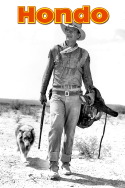
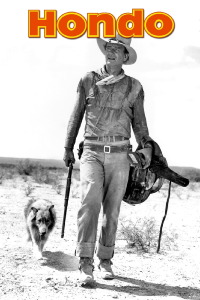
The film's title derives from the main character, Hondo Lane (John Wayne), a tough gunfighter and scout with a sense of ethics, a loner who does not like liars. One day, he happens onto the homestead of a lonely White woman, Angie Lowe (Geraldine Page). She and her young son Johnny (Lee Aaker) live peacefully on Apache lands.
A central plot point in the story is a broken treaty, which causes conflict between the Apaches, headed by Vittorio (Michael Pate), and the U.S. Cavalry. Vittorio has no real quarrel with Mrs. Lowe, however. Indeed, he keeps returning to her homestead, concerned that she and especially Johnny, who appears to be without a father, will not be able to survive in such a harsh land.
Based on a real-life Apache warrior, the Vittorio character conveys a more humanistic portrayal of Indians than what a viewer would see in "B" Westerns. And the multi-faceted Hondo, part White and part Apache, intervenes to help Mrs. Lowe, as she is caught between her desire to remain on Apache land, and the insistence of the Cavalry that she and her son flee the "hostile" Apaches.
The story has a very realistic look and feel, a result of attention to detail in costumes, production design, and outdoor locations. Originally shot in 3-D, mostly to convey a sense of spatial depth, there are very few 3-D gimmicks. Color cinematography is credible, and uses a good mix of close-ups and wide-angle long shots. Colors might be a tad overdone, with too many bright hues, but that's the way many outdoor films were shot in the 1950s. For many scenes in "Hondo", the camera is tilted slightly upward toward the sky, to give a sweeping, majestic look to the landscape.
Casting is fine, except for the odd choice of Geraldine Page who was at that time known mostly as a New York stage actress. Her performance here is fine, but is nowhere near the stellar level in later films. John Wayne is suitably cast, and does a nice job. Ward Bond, Michael Pate, and Lee Aaker all give credible performances in support roles.
Although there are more grandiose "A" grade cinematic Westerns, "Hondo" is a fine example of a story that is slightly more low-key, with an emphasis on complex characters. And the film's visuals are picturesque. I recommend this film for anyone interested in high quality Westerns.
Was the above review useful to you?
This review of Hondo (1953) was written by Brynn H on 07 Feb 2011.
Hondo has generally received positive reviews.
Was this review helpful?