Review of Hollywood Canteen (1944) by Edith N — 04 May 2009
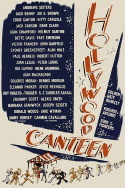
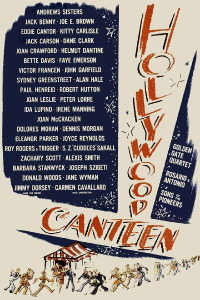
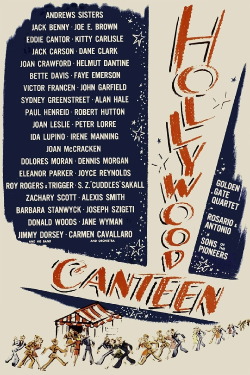
The real Hollywood Canteen was a multi-studio affair. Even before it had opened, over 3000 people in the entertainment industry had signed up to volunteer. Obviously, not all of those people were stars, but stars were prominently featured, and probably in public places as opposed to behind the scenes. Bette Davis, who shows up a lot here, was one of the founders, a woman who worked tirelessly for the war effort to the extent of wanting servicemembers to get into the Oscars. (The Academy didn't go for it.) John Garfield, her co-founder, is here, too, but not as notably. The thing is, though, while the canteen itself was populated by the great and lesser-known and anonymous of every studio in Hollywood, the other studios wouldn't go along for the picture. The real millionth visitor to the Canteen got kissed by Betty Grable, that greatest of World War II pinups, but she's not here, because she was under contract at 20th Century Fox.
Corporal Ed "Slim" Green (Robert Hutton) has been wounded in the Pacific and sent to recover in LA. He wanders aimlessly around town until a counterman at a crap lunch counter tells him about the Hollywood Canteen, a thing he has somehow failed to learn about from all the other servicemen all over the place. Anyway, it's free to servicemen--and women!--so off he goes, ending up in a convoluted love affair with real-life actress Joan Leslie. (She was the "good girl" in [i]High Sierra[/i], and she was in that documentary we did the other day about Hollywood musicals.) A lot of it appears to be a slightly-exaggerated version of the real-life canteens, with celebrities all over the place, being friendly, serving meals, and generally performing. All kinds of great people from the Warner Bros. studio appear. Barbara Stanwyck is serving sandwiches. Eddie Cantor, fresh from washing dishes, is encouraged to come up and sing a song. On the other hand, there's that improbable love affair, which goes so far as to have Joan take Slim home to meet her family. There's even the touching farewell at the train. Silly.
For fans of older movies, this is a fun film. There's Joe E. Brown, best known for his zinger at the end of [i]Some Like It Hot[/i]. Sydney Greenstreet and Peter Lorre intimidating a soldier threatening to dance an Andrews Sister's arm out of her socket. Roy Rogers and Trigger. Ida Lupino. Jane Wyman. Any number of others, the minor and the major. Half the studio seems to have turned out. No Bogart, even though--obviously--he was a Warner Bros. star, too. Few of the male stars put in an appearance, and not all the female ones. (There is, for example, no Olivia de Havilland, even though she volunteered there.) But Rosalind Russell was Columbia. Joan Fontaine was RKO. Ava Gardner was MGM. Rita Hayworth was Columbia. And so forth. (Though it is also true that a lot of the volunteers we think of as big stars didn't really make it until after the war.) Even the musicians were Warner Bros.
The funny thing is that what might well seem the implausible part--like, of course, Barbara Stanwyck serving sandwiches--isn't. The whole point of the thing was to improve morale, and what better for that than to hang out with Red Skelton, Bob Hope--or Gene Tierney? What's more, World War II was probably the most patriotic war the US was ever involved in. Every other war has involved great uncertainty. Woodrow Wilson got elected in World War I on the slogan "He Kept Us Out of the War." (Though, naturally, we then joined.) Eisenhower got elected by promising to go to Korea and seeing what he could do to end that. There were actually riots in New York during the Civil War over the draft, and McClellan became a serious candidate in 1864 by promising to bring a settlement with the Confederacy. But World War II? We'd been attacked, and it was clear that the people who'd done it were big fans of taking over countries. So everyone could get behind that. (Or so you'd think, anyway.) A Hollywood Canteen today would not get the same kind of star power.
The special features accompanying it are worth a look, too. There are a couple of cartoons--including one that requires that great Warners disclaimer about how they know the thing is racist (though so far as I can tell, it's pretty much only offensive if you are, yourself, Hermann Göring, which is unlikely), but to pretend the offensive bits didn't exist would be wrong--a statement, as it happens, that I agree with, and the Warners cartoons were never remotely so offensive as the Popeye ones! There's also a fascinating bit called "I Am an American," celebrating the immigrant experience in America and the contributions immigrants have made over US history. Some people need to watch it, clearly.
This review of Hollywood Canteen (1944) was written by Edith N on 04 May 2009.
Hollywood Canteen has generally received positive reviews.
Was this review helpful?