Review of Holiday Inn (1942) by Carter A — 12 Dec 2011
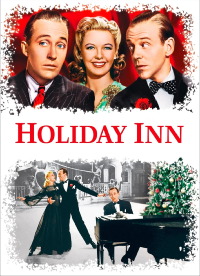
Irving Berlin's 1942 song and dance charmer, Holiday Inn, is a film which, in order to come up with the proper adjective I must hearken back to simpler times. Time when the worst thing one could do is steal the others girl and even then the offense is taken care of with a properly placed song and plot arrangement -- such as portrayed in films like these. Yes, this movie is utterly delightful. There, I said it. It exudes charm and grace.
Of course, we are dealing with the two greatest song and dance men of their, and possibly any other time -- Bing Crosby and Fred Astair. In fact, there's a cute little number (no I'm not referring to a woman, that would be gangster speak) where Fred and Bing vie for the affections of the same woman putting forth their talents as collateral for the love bank. It's rather comical when one tries to impersonate the others gifts. Astair is not a terrible singer by any means, but Bing's dancing leaves much to be desired. In fact, it's quite hilarious to watch.
The story revolves around two show-biz types. Ted is perfectly happy on the stage making a good living for himself as he cavorts around in top hat and tails, taking the floor with beautiful women in arm. Jim, on the other hand is looking for a simpler way of existing, something a nice farm in Connecticut, and a wife could offer. The only problem is that the woman that Jim thinks he's going to marry has plans of her own. She's more of a penthouse lady than pig sty, you see. She decides that she loves Jim's soon to be ex-partner's money and pledges her frivolous love to him for a time... that is until a rich Texan offers her a ring and a couple million dollars ta-boot.
Jim sweeps the heartbreak aside as if it were lint on a jacket and goes to opening his little inn which opens its doors only on holidays (and here you thought this film was about a motel chain). Jim eventually finds a new girl who can sing and dance -- and by the way, she likes him. Isn't that nice. But Ted decides he likes her too. After all, he needs a new dance partner. And so the feud continues on.
As I said, this film really is quite charming. It's got a joy which was common among old song and dance pictures of the time which you never see anymore. It has some wonderful numbers in it as well, both song and dance. The music, of course, is all composed by legendary writer Irving Berlin who, even if you are not familiar with the name I can guarantee you know at least one of his songs. In fact, this was the film which introduced his most famous work (which would later be turned into Christmas musical of its own starring Bing Crosby), White Christmas. This is the part where you say, "Oh! That's the guy." Yeah, that's the guy.
Apart from the multiple numbers, there is not much else here in way of great entertainment. But when you have wall to wall tracks filling up your musical, what more do you really need? Is this film important? Does it have something to say. Well, in it's own little way... No. It has nothing to say. Go with the flow, if anything and, Hollywood will make it all right in the end. But what kind of message were you looking for in the first place? If it can't be fixed with a song, than what's the use in filming it. Right? Right. I guess so.
(Continuance):
It's been a day now since I sat down and watched this holidays family feature, and subsequently imparted my own view on the picture to those non-existent fans who adore my criticisms. And since a day has now come and gone, I am left with a itching, slightly irritating gnawing upon my social conscience. Yes, after all of that whimsical praise I heaped upon this wonderful little film, I must come back to it and burst my perfectly shaped little bubble.
Now as I think back on the film there is only one real dominant scene for me, and boy is it a doosie. It takes place during Lincoln's birthday. Can you see it coming? Yup. I cannot get over the horrid black-face routine that Bing Crosby and Marjorie Reynolds perform. The sound of it is not all that bad and, in a weird way, somewhat amusing. But when you are confronted with it, the scene is nothing but cringe inducing. It gives you a greater understanding of the kind of passive-aggressive racism which was so acceptable back in that day. It's really horrific. No they aren't burning crosses in peoples front yards, but in many respects it is just as bad. It's dehumanizing.
Another issue I take in the same scene is when the song is given off to Louise Beavers' character, Mamie (yes, Mamie. I know...), the house-maid. The song thus far is praising Abraham Lincoln for emancipating the slaves, likening him to a Moses figure leading the Israelites out from Egypt. In fact, they only refer to him as Abraham, making the allusion toward the father of the Jewish people (although that would never be mentioned in that day, as Jews were despised almost as much as black people were). As the song is handed over to Mamie, she has her two children with her as she sings the verse:
"When black folks lived in slavery.
Who was it set the darkie free?
Abraham, Abraham".
I find it nearly unforgivable that the only black character which is given anything at all to do in the picture must defame her own people by using the derogatory term, "darkie." I find it absolutely despicable.
Needless to say, this small section of the picture places an irremovable bad taste in my mouth which colors the rest of the film with an ominous spot. I can no longer, in good conscience watch this film. In fact, the copy that I now own is getting tossed out on its sorry rear end. And that's the way it is.
Good night, and good luck.
This review of Holiday Inn (1942) was written by Carter A on 12 Dec 2011.
Holiday Inn has generally received very positive reviews.
Was this review helpful?