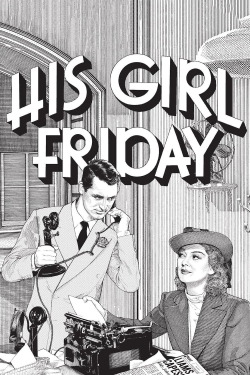
Review of His Girl Friday (1940) by Dhabia A — 27 Apr 2016
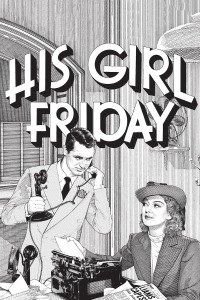
There are films are deal with specific issues and present them as such, but there are films that present themselves as a purely entertaining; however, one should realize that everything is political. Film is a strong political tool because it feeds the viewer the ideologies of it. His Girl Friday, (1940), presents its ideologies in a one-liners comedic form that traps the viewer in a world where there is a clear separation between masculinity and femininity that Hildy Johnson, a newspaperwoman, seem to blur. The film traps the viewer in a specific manner of thought that creates separations, whether in the way the characters are presented or in the way the scenes are delivered. The manipulative business of the press is seen in the manipulative speaking manner of newspapermen and how they would manipulate their way to get "the story," the film itself is in the manipulative business for it presents the viewer with its classification of masculinity and femininity.
His Girl Friday opens with a message telling the viewer that what they are about to see "does not resemble the men and women of the press today." One can sense the sarcasm behind that message, and as a 1940 film, it is still relevant today as a representation of the "inhumane" nature of the press. The film associate the press business with masculinity, as in the beginning Walter tells Hildy, "you're a newspaperman" and she tells him, "that's why I'm quitting I want to go someplace where I can be a woman." She also says, "I'm going to have babies and take care of them." Creating clear boundaries between the characteristics associated with being a man and being a woman, boundaries between binary opposites. However, the film tends to reverse the roles of man and woman in opposite to the ideologies it creates, as Walter says that Sweeny, one of the newspapermen, "picks the day to have a baby," and Hildy having a more masculine character than her fiancé, Bruce. By the end of the film, Hildy starts crying and Walter tells her, "You never cried before," as Hildy is too manly to cry, implying that crying is a characteristic of women.
Moreover, mise-en-scène in the film emphasizes the boundaries created by the dialogue in the film. Doors are stressed in several aspects; the opening shot of the film is tracking shot of Hildy as she walks before Bruce and stops him when they reach a door that separates the newspaper, where she works, and the rest of the world. Later, when she goes inside to see Walter, her ex-husband and the editor, she tells him that her new fiancé opens doors for her and treat her like a woman not an "errand boy." Hildy being a "newspaperman," was never treated like a woman in the newspaper business. As Hildy and Walter walk towards toward her fiancé, Hildy opens the door for Walter, he walks in front of her and he lets the door shut behind him instead of holding it for her, which again shows the reverse of roles in the film. The door in the beginning creates a boundary between being in the newspaper business and not being in the newspaper business, between being human and being a "chimpanzee." There is another door in the movie that separates the two worlds, which is the pressroom door. In the pressroom, Mollie comes in as the newspapermen are playing poker and they completely ignore her. A lamp hangs above the table creating attention to where their attention and cards are. In a later scene, Mollie jumps off the window of the pressroom and the newspapermen gather around the window looking down at Mollie as the streetlights illuminate the spot where she lays. They were giving her complete attention because, as she lies down, she represents a possible story. The jail bars create another boundary, for they create a separation between Hildy Johnson and Earl Williams. Earl tells Hildy, "I couldn't plead insanity... 'cause I'm just as sane as anybody else." The bars here separate the sane from the insane. Also, Burce gets arrested three times during the movie, and each time he insists that he is not guilty, implying that these bars separate the guilty from the non-guilty.
The press business is of manipulative nature that makes the newspapermen associated with barbarity. "They ain't human," says Mollie and Hildy replied, "I know. They are newspapermen." Newspapermen manipulate the words of a story to present it as how they want it rather than how it is. Walter tells Bruce, "My wife that is your wife Hildy," the manipulative reminder that Hildy was his wife first, and tells him that he wants to provide for her to make Bruce feel like he is not needed. Hildy wants to quit the manipulating business of the press, but she bribes the guard into letting her into the cell of Earl Williams. In the jail with Earl, the newspapermen characteristics of Hildy become apparent when she manipulates the words out of him. She tells him, "You didn't mean to kill that policemen" and he replies, "Of course not," but Hildy was merely stating what she wants him to think. She is confining his thoughts, the same way his body is confined inside the cell. She gives Earl the cigarette she is smoking, and he only realizes that he does not smoke after exchanging a few words with her. She asks a question and then stops him when he answers with something other than what she wants him to think and say. Earl mentions that he hears some guys talking about "production for use." Hildy then asks what he thought about with a gun in his hands and he did not know, so she says could it have been "production for use?" It is what he just said after all. She presses Earl into agreeing with how she is leading his thoughts. She first says, "What's a gun for, Earl... Maybe that's why you used it." He replies, "Maybe" but then he fully believes that this is the truth. "I've never had a gun before in my hand and that's what a gun for... Yes that is what I thought of 'production for use." She is seen manipulating him nearing the end of the movie when she is trapped in the pressroom with Earl holding a gun and she says, "You don't want to shoot me, Earl. I'm your friend, remember?" using her the power of her words to manipulate the actions of Earl.
Howard Hawks' His Girl Friday creates confinements for the viewer thoughts by continuously separating the ideologies it is presenting. At the same time, it shows how words can manipulate the thought process of people, and as a film, it manipulates the thought process of the viewers. A woman is playing the role of a man, but is dressed like a woman. She wants to be treated like a woman, but she cannot leave behind the world of masculinity and manipulation.
This review of His Girl Friday (1940) was written by Dhabia A on 27 Apr 2016.
His Girl Friday has generally received very positive reviews.
Was this review helpful?