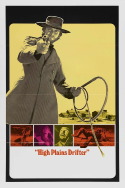
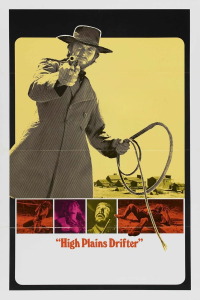
Review of High Plains Drifter (1973) by Achilles Z — 21 Mar 2009
A mysterious stranger was hired to protect the town of Lago when he passed it by. His mastery of the skills of killing and distant character earned him fear from the townspeople. As the sinful past of Lago was gradually revealed, it seemed that the stranger was brewing up something other than what he was paid for. He turned away from the townspeople when they were slain by the three vengeful outlaws, who were then killed by the stranger by methods equivalent to that killing Jim Duncan, the victim of Lago?s past crime.
That is what the film High Plains Drifter is all about, in a superficial sense. But the film sure delivered more than that to get its audience thinking:
Who was the mysterious stranger?
What was the nature of his peculiar actions and attitude towards the townspeople?
Why did different townspeople received different treatment from the stranger?
What was his relationship with the deceased Marshal Duncan?
Did he have supernatural powers?
Who was he to revenge for Duncan?
Why part did the three outlaws play in the revenge for Duncan?
??
The interpretation of this bizarre film is open to discussion. Numerous symbolic meanings and references appeared throughout the film. At the beginning, we see a rider emerging from the horizon, his horse is light grey in color, an obvious reference to Revelation 6:8:
?And I looked, and behold a pale horse: and his name that sat on him was Death, and Hell followed with him. And power was given to him over the fourth part of the earth, to kill with sword, and with hunger, and with death, and with the beasts of the earth.?
The background music started in a disturbing, ominous mood, revealing a dark theme of the film; as the stranger approached the town of Lago the music shifted to a more ethereal and lighter note, bringing the audience back to reality.
The stranger passed through the graveyard, we can see people constructing coffins, it seemed that death was a common visitor to this town. His habitual demand for drinks ?a beer and a bottle? and his inert reactions to the townspeople?s challenge in the bar indicated he was an experienced, weathered wanderer. At this point the stranger had shown no intention to be involved with the townspeople but rather a mere passerby getting some refreshments.
How he came to engage the townspeople started with his killing of three unfriendly townspeople to defend himself. Seeing the stranger?s astounding skills, the people asked him to protect them against three dangerous outlaws whose head was named Stacey.
The following sequences were pretty much all about how the stranger?s manipulation of the townspeople into serving his mysterious purpose, as well as his treatment to them, before all hell broke loose.
The first reference to the Marshal Jim Duncan was during the stranger?s sleep. It happened in the mind of the stranger, but the nature of it was unclear, whether it was a flashback, a dream or a vision forced onto him. What was clearly indicated was the stranger?s discomfort and pain, as if he was tormented in equivalent extent as Jim Duncan suffered under the whips of the three outlaws.
The nature of the dream would inevitably lead to the answer of the relationship between the stranger and Duncan. One important detail was at the beginning when the stranger entered the town, he showed an obvious sensitivity and strong feelings against the sound of whipping. Considering this, it is reasonable to assume that the stranger was Jim Duncan reincarnated, since he was whipped to death by the three outlaws.
The unwillingness to reveal his name further added to the possibility that the stranger was Duncan himself, only in a different, unrecognizable face and body. He did not tell his name to Mordecai, the friendly dwarf who was seen to be one of the few who showed sympathy to Duncan when he was killed, and checked in the hotel without registering his name.
If we take the dream as a vision forced onto the stranger, we might also say the stranger was possessed by the spirit of Duncan, who became more dominant in the stranger?s mind towards the end. The reason to back this up is that the stranger showed no intention to linger in the town for long at first, but only agreed to stay when he was paid to protect the people later. That might just be the point when the spirit of Duncan set in. However, according to this assumption, it is hard to explain the stranger?s reaction to the whipping sound at the beginning; the indifferent attitude at first might also be feigned to earn trust from the townspeople.
Duncan or not, the stranger was apparently judging the townspeople on his own discretion. And different people received different treatments that served them right respectively. Slutty Callie was brutally raped; the mayor and the sheriff were removed of their titles, which were given to the outcast Mordecai??
In time the townspeople were not longer sure they made the right choice because the stranger seemed to do them more harm than good. But the stranger seemed to have supernatural powers to evade his death every time. This was also revealed in previous part of the film, when he survived intact, miraculously, from the multiple gunshots in a bathtub.
Numerous hellish references appeared towards the end, including painting the town bloody red, change of ?Lago? to ?Hell? and the preacher?s complaint of ?the devil himself under my roof?. Under the command of the stranger, a church picnic was set up to welcome the return of the three outlaws, a cynical gesture in contrast of the townspeople?s deeds to the three outlaws, who were previously protectors of the mining business of Lago but framed and locked up by Lago.
Marshal Duncan was whipped to death by the three outlaws due to his attempt to stop Lago?s illegal mining business. This dirty secret was revealed in a desperate conversation between the mayor and the sheriff, as they felt increasingly uneasy with the stranger and the imminent return of the three outlaws. From the flashbacks of the stranger, as well as from Mordecai, the townspeople, almost all of them, acquiesced the killing of Duncan and watched him die. ?Damn you all to hell?. That was Duncan?s last words to Lago.
And indeed, the town of Lago was damned to a living hell. The stranger attacked the three outlaws before their arrival without revealing himself, thus making them even more vengeful towards the town. Apart from decorating the town as a living hell, the stranger commanded that all people to go out in the open. When the three outlaws arrived, the strangers left the townspeople to their own defense, and the latter were slaughtered in a hellish manner.
As Lago burnt in a hellish fire, the stranger reappeared and killed two of the outlaws with a whip, and shot the head of the outlaws, Stacey, whose last words was a question towards the stranger: ?Who are you? Who are you?? The stranger took off the next morning, with a ?Take Care? to Mordecai and an affectionate goodbye to Sarah, the hotel manager?s wife. Both of them showed genuine sympathy to Duncan when he was killed. Before the stranger disappeared into the desert like once he came, before the mysterious, ominous music set in once more, we see a newly carved epitaph ?Marshal Jim Duncan, Rest In Peace? on Duncan?s grave.
There are several important symbolic meanings in the end part of the film. The act of painting the entire town red and ?especially the church?, seemed to suggest that the seemingly peaceful, pious and honest townspeople actually got the blood of Duncan on their hands. When the stranger reappeared to face Stacey, we can only see the stranger?s devilish silhouette against the fire, as if devil himself was taking the lives of the sinners. The three outlaws are parables of the ?beasts of the earth? in the earlier Biblical reference; following the stranger are the three brutal, bloodthirsty murders.
The manners of how the stranger acted against the townspeople and the three outlaws were profoundly different. For the outlaws who were directly responsible for Duncan?s life, they were brutally killed in equal measures, directly by the stranger himself. As for the townspeople who bore the indirect but ultimate responsibility of Duncan?s death, the stranger left them consumed by their own sins of greed and betrayal. ?It?s what people know about themselves inside that make them afraid? The revenge was on a basis of ?an eye for an eye?: whipping for whipping; omission to protect Lago for the omission to save Duncan; death for death.
Before all the shooting and killing, Sarah told the stranger: ?The dead don?t rest without a marker of some kind?. After the bloody night, a piece of epitaph was added to the previous nameless tomb of Jim Duncan. And the always cold stranger became caring and affable. This was the end of the completion of the revenge, and the end of the injustice Duncan suffered.
The three outlaws play an indispensible part in this film. Besides, the Biblical ?beasts? mentioned above, being direct murders of Duncan, they serve as the knife of Lago in murdering the innocent Marshal, the path through which the impurities and sins of the townspeople were materialized; they can also be taken as the direct, tangible form of the sin of Lago, as Lago was, in the end, consumed by its own sin, and the eventual termination of the three outlaws means an end to it.
Back to the biggest question of this film intensified by Stacey?s last words: who is the mysterious stranger? In a more wholly sense, the answer depends on the answer to another question: Does this film involve the supernatural or not? If it does, the most possible identity of the stranger would be Duncan reincarnated, as he said to the sheriff at the beginning: ?I?m not a gunfighter? despite his impossible skills, this indicates that his ability was meant for revenge specifically; another reason is that towards the end when Mordecai said ?I never did know your name.?, he replied: ?Yes you do?, which narrows it down to the previous town Marshal Jim Duncan. His painful flashback of the whipping also backs up this interpretation. If the film is entirely secular, possible identities for the strangers would be a vengeful brother (which is the case in the original novel); or Duncan himself survived with a change of looks, as Sarah, at many points, seemed to know him and shunned his proximity.
But either way, the role of the mysterious stranger accomplishes the theme of justice taking its course. Supernatural or not, the film successfully delivers the message. Evil will always find its way back to its origin, sometimes taking the form of an angel of death. I think Eastwood, in all of his wild-west life experience, might have actually witnessed cases like this and romanticized it or not, appealed for innocent death and denied people like Lago?s townsfolk in his own way.
This review of High Plains Drifter (1973) was written by Achilles Z on 21 Mar 2009.
High Plains Drifter has generally received very positive reviews.
Was this review helpful?