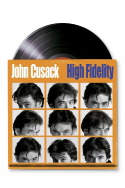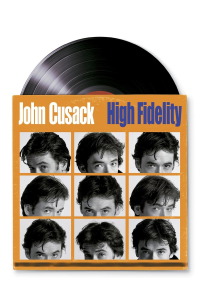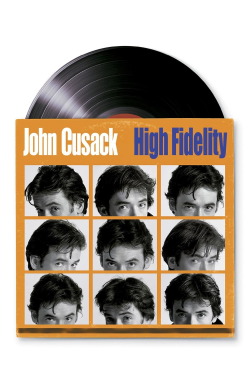
Review of High Fidelity (2000) by Ze F — 27 Aug 2009
I wanted to work in a record store for years. I suppose my desire has diminished lately thanks to both my feigning interest in records and the realization I came to a couple of years ago that one man?s dream job is another man?s own personal hell. Rob Gordon may be able to put his music knowledge to great and enviable use at Championship Vinyl, but he has to deal with waiting on people with bad taste, punks who stuff records into their shirts and his two-man staff of social misfits who would hang out at the store as much as they do even if they weren?t getting paid.
My attraction to ?High Fidelity? dates back as far as 1995, when I started listening to the band Catherine Wheel. The band thanked author Nick Hornby in the liner notes for their 1997 album ?Adam and Eve?, which began and ended with lead vocalist Rob Dickinson singing lines of text from the novel over guitar melodies. I didn?t connect the lyrics with the book until I read it in college, and I remember the moment very precisely, sitting on a Greyhound bus on my way to Peterborough, thinking that the words were familiar at first and then knowing exactly where I?d heard them. Lyrics taken from a book about music. I experienced the crossover of two separate art forms for the first time.
If ?Say Anything? made John Cusack the 80?s teenager every guy could relate to and his character in ?Grosse Pointe Blank? made suffering psychoses in the 90?s hip, his portrayal of Rob cemented the actor as Gen X?s new millennium male touchstone. Rob Gordon says what men think. More often than not, he says it with a calculating intelligence reserved especially for giving order to the things in his life that mean the most to him. When he gives his top five favourite side ones, track ones, he lists them like they?re the examination answers of a child schooled by pop culture.
Rob is savvy about his relationships, yet in spite of the clever observations he delivers through the broken fourth wall, it is clear that he doesn?t understand women. His girlfriend Laura (Iben Hjejle) has just moved out after a few years of living together. Rob concludes that there has to be something wrong with him, so he revisits his most painful breakups to gain insight from the women he dated. These women are played by Lili Taylor, Catherine Zeta-Jones and Joelle Carter. On the level of the superficial, Rob certainly hasn?t done that badly. Nonetheless, there are things in his past that prevent him from moving forward and committing. A sultry songstress named Marie De Salle (Lisa Bonet) grabs his attention, even when the pain of losing Laura has him teary-eyed on the sofa in his office. There are funny moments when Rob?s mind jumps tracks mid-scene as his priorities turn from love to sex and back again.
This is a film of philosophies and honest expression. We get to know about Rob?s insecurities. He forces himself to be open and communicative regardless of his frustration and pigheadedness. He describes moments of regret and seasons them with recollections of songs that come out of a mood or emotional situation. He details how he acts with women with unapologetic self-awareness. He judges others while serving as his own harshest critic. The adapted screenplay, written by Cusack along with D.V. DeVincentis, Steve Pink and Scott Rosenberg, rings with the efforts of those involved to bring out the novel?s greatest revelations of the male mind. I recall reading Hornby?s book at 19 or 20 and feeling as though a writer had successfully captured my emotional thought process exactly, and these men translate it well to film.
It?s hard to imagine anyone but Cusack playing Rob. He?s just vulnerable enough, exhibiting a pretentious worldview punctured only by the right woman. Laura hurts his pride in order to help him make the changes he needs to make. Rob refuses to grow up and extracts validation from the simplicity of the vinyl aficionado?s mindset, music geeks whose primary concerns are duplicating the feeling they had the first time they heard an Elton John song or found an overlooked out-of-print Smiths single. Music is easy to commit to. People are harder.
I haven?t yet mentioned the performances of Jack Black as Barry and Todd Louiso as Dick, who take on a straight man/funny man dynamic as Rob?s employees. Since ?High Fidelity?, Black has made a career of crazy performances that make use of his skill as a physical performer. This remains one of his funniest roles, especially given the payoff of his surprising debut as a lead vocalist at the end of the film. Louiso is barely audible as the introverted Dick. One treat of a segment allows him the chance to go off in a fantasy scenario with great violence.
?High Fidelity? is a movie I watch when I feel as though I?ve lost my understanding of women, not because Rob has a great handle on things, but because he doesn?t. I take comfort in his failures. Like a great song filled with words of heartbreak, misery and loss, the perfectly phrased pain of a guy who?s lost his way can be a balm for heartache. Music, film and books communicate ideas and feelings with greater clarity than we can hope to achieve at moments when we say or do the wrong thing. A lot of songs and stories are written out of those moments. ?High Fidelity? is about coming to terms with our mistakes and moving on down the road.
This review of High Fidelity (2000) was written by Ze F on 27 Aug 2009.
High Fidelity has generally received very positive reviews.
Was this review helpful?