Review of Hell's House (1932) by Robert B — 12 Aug 2014
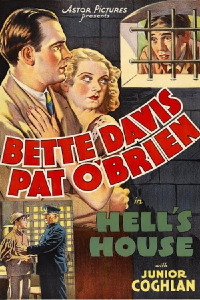
Hell's House (Howard Higgin, 1932).
Hell's House still exists in the public consciousness solely because of Bette Davis. That's a literal statement-the movie was thought lost for years, until Davis passed away and her personal film collection was donated to the National Archives; a copy of Hell's House was discovered therein. It was Davis' sixth feature, made when she was still in her early twenties (all five of her previous features were made in 1931); it was also co-lead Pat O'Brien's sixth. But both of these big-name stars pale in comparison, in this potboiler, to the movie's real star, Junior Durkin. Durkin is very little remembered these days thanks to his untimely death in a 1935 road accident (he was only nineteen years old), but he was big business in the early thirties; his very little screen output included playing Huck Finn in both Tom Sawyer (1930) and Huckleberry Finn (1931) and Franz in Phil Rosen's 1934 adaptation of Little Men. While Hell's House is a potboiler, and Davis and O'Brien give it about the treatment it deserves, Durkin throws himself into the role in a way one rarely sees in movies like this. I mean, we're talking Edward-G-Robinson-in-Scarface here.
Plot: O'Brien plays Matt Kelly, a bootlegger in the days when that was a profitable business. Durkin plays Jimmy, one of Kelly's hangers-on. After a job gone bad, Jimmy gets nabbed for a minor crime Kelly committed. After refusing to snitch, Jimmy is sent to a reform school that make the conditions on the Island of Doomed Men seem downright hospitable. While there, he befriends Shorty (the great character actor Frank Coughlin Jr. in one of his few credited roles), who has a heart condition exacerbated by the brutal treatment he receives there. Once Jimmy gets out, he enlists Kelly and Kelly's girlfriend Peggy (Davis) to help spread the word about the deplorable reform school and bring its tyrant of a headmaster (James A. Marcus, another often-uncredited character actor) to justice.
Yes, it's a genre thriller, predictable and manipulative, an otherwise forgettable product of its time save the fame its two leads would go onto and the once-in-a-lifetime performance given by a child star whose ascent to fame was cruelly ended. But those things make it interesting, at least, as a piece of cinematic history; if you're a student of the early days of film, it's worth checking out on that angle. Others can take it or leave it as they will. **.
This review of Hell's House (1932) was written by Robert B on 12 Aug 2014.
Hell's House has generally received mixed reviews.
Was this review helpful?