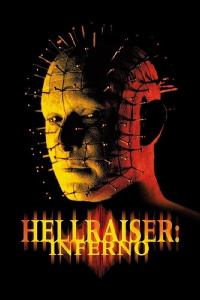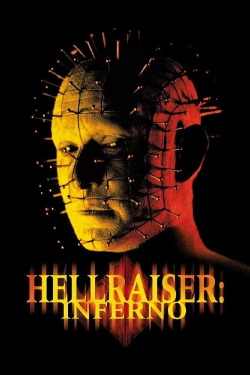
Review of Hellraiser: Inferno (2000) by David L — 16 Jun 2011
This is a series that is very dear to my heart. With the lowest of expectations, it was still necessary for me to rent this. Hellraiser, despite its many flaws, is still one of the best horror films ever made. It's sequel, Hellbound: Hellraiser II, although often inconsistent, was in many ways even stronger and more inventive. Hellraiser III: Hell on Earth brought the series to American producers, an American director with American actors (except Pinhead), and American horror audiences. Although this changed the gothic horror series to a rock-n-roll horror flick, it still maintained the basic themes originally developed by Clive Barker. Hellraiser: Bloodline, although loosely based on the Hellraiser mythology, stunned fans with its complete and utter lack of soul; an 82 minute abuse of celluloid that only Alan Smithee (the name used when you're too embarrassed to put your own name) could have directed. Then, without warning, four years after Bloodline, the fifth installment arrived at video stores.
Joseph (Craig Sheffer) is a dirty cop. He lies, he steals, he abuses drugs, he cheats on his wife to sleep with hookers, you get the idea. When he finds the box at a nasty crime scene, that is, The Lament Configuration, the box that opens the gates to Hell, he can't help but tinker with it. When it opens, he suffers a rather trippy nightmare but survives it. But things are different. People he knows keep getting murdered and at each crime scene he finds the finger of a child that's still alive somewhere. In his quest to find this child he is consistently thrown for a loop by the mysterious Engineer. In the end, in a rather clever development, it turns out that the boy he's been looking for is himself and he's been in Hell ever since he opened the box.
There are several things that are impressive about this movie. The first is that it is actually a movie. It has a beginning, a middle, an end, a plot, and several functional elements that allow it to stand as a feature. Even from the opening credits, it far surpassed the previous installment. Secondly, it has a clear and detectable style that's consistent with a director that must care at least a little bit. It has some rather artful cinematographic choices that generally we only see in theatrical releases. Thirdly, it has a cast of moderately recognizable actors (moreso than even the third film). Craig Sheffer (A River Runs Through It, The Grave, Clive Barker's Nightbreed), Nicholas Turturro (John Turturro's brother, a regular on NYPD Blue), and James Remar (What Lies Beneath and a host of small roles on film and tv) star in what couldn't have been a very high paying job. Although the movie is gory, it relies less on shock value and more on the suggestion that something nasty is happening or has happened out of sight. This is at times very effective, although at times simply cheap.
There are two main things that keep this from being a "good" movie. First and foremost, it is not a Hellraiser movie. The presence of the box and the minute or two of Pinhead's screentime are the only things that tie it to the series. The box is really just used as a plot catalyst to get the main character into Hell. Pinhead only appears for a split second in the beginning and a minute or so at the end... and he really doesn't have anything interesting to say. Pinhead's provoking commentary has always been one of the greatest assets to the series and I could tell Doug Bradley just wanted to cry. It's really just a supernatural detective story. The classic sentimental scores of the first films is missing as well. And, just to be a stickler for details, the film seems to suggest that Pinhead is The Engineer, a character discussed in the novel. Having read the novel, I can assure you that Pinhead is not The Engineer. And if you've seen the second film, you would know it was The Engineer that made Pinhead in the first place. On the other hand, some moments pay homage to the earlier films: hooks on chains, the pillar of souls, and a version of The Chatterer.
The other thing that holds this movie back is direct-to-video syndrome. The acting ranges from pretty good to functional but never really inspiring. In Sheffer's defense, the main role is very demanding, but he often resorts to yelling and holding his breath instead of emoting. The special effects are pretty weak, particularly on the demons (cenobites if you will), but there are a few innovative images. The story sets up a lot of variables in the beginning but tries too hard to wrap them all up in the end. And the attempt to attach a moral to the story (which, as far as I can tell is "don't be such a schmuck") is a weak move. But as co-writer and director, Scott Derrickson does a pretty decent job. Taking into account the damaged series of films and the fact that Derrickson graduated from USC only a few years ago (this is his first feature), he deserves praise for putting together a stylized horror story.
In the end, what we're left with is a pretty good extended episode of The Twilight Zone. Is it a worthy addition to the Hellraiser lore? Not if you're thinking of the first two, but if you're thinking of the last two, at least this is a movie.
This review of Hellraiser: Inferno (2000) was written by David L on 16 Jun 2011.
Hellraiser: Inferno has generally received mixed reviews.
Was this review helpful?