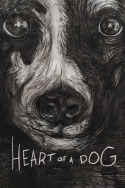
Review of Heart of a Dog (2015) by Helen K — 25 Dec 2015
In her poetic film collage essay Laurie Anderson is more beautifully and thoughtfully herself than ever. Anderson has had a long career, but was most well-known in the 80's as an experimental performance artist, composer, and musician who especially explored the mix of spoken word and music. Those who know her albums such as "Big Science" and "Home of the Brave" will appreciate the return of the fragmented rhythm and quizzical tone of Anderson's speech, opening with voice-over sentences such as "This is my dream body - the one I use to walk around in my dreams," and "It's like one of those old movies..." It's like one of Anderson's old albums, only ... Much, Much, Better (to quote Anderson in "Language is a Virus").
Despite the film's seemingly stream-of-conscious, no-plot, hodge-podge approach, Anderson has meaningful ideas to express, and she's woven together an elegant and smartly structured tone-and-picture poem. The movie combines her personal stories and musings with quotations from renowned philosophers, ink drawings on paper, printed words, animation, scratchy old 8mm home-movie clips, new footage of landscapes, surveillance camera footage with time codes, graphic images such as computer icons, and her ingenious use of music.
As always, Anderson excels at language, and here she combines various types of on-screen text to her own lyrical voice-over. I often leave a movie wanting to run home and download the soundtrack, but in this case I am yearning for a transcript. These are words worthy of reading and contemplating. "Try to learn how to feel sad without being sad," is just one of the many fertile sentences.
But one of the surprises of this project may be Anderson's sophisticated and inventive cinematography. As the film explores a variety of deaths - the death of Anderson's dog, the death of her mother, the death of her husband (Lou Reed), and the mass deaths of 9/11 in New York, it seems the movie is often shedding its own tears. Many sequences are shot through a pane of glass that is dripping with water, like life itself is crying. And then she turns footage of an ocean upside down, with the foreground still raining, so the sea that has become the sky is weeping too. In front of everything, Anderson seems to be saying, is a gentle, pervasive sadness.
And yet, the movie is not even remotely maudlin. It discusses 9/11 in way that actually adds fresh insight, which seems impossible after so many anniversaries full of remembrance ceremonies, and so many other films that have also integrated that tragic event. In fact, this movie would have made a much better selection for the opening of this year's New York Film Festival than "The Walk," which is ostensibly about the man who walked a tightrope between the world's tallest pair of buildings, but is really mostly a sentimental homage to the Twin Towers, complete with golden reflected sunset footage of the Towers and seemingly endless talk about their dramatic importance. For all the "The Walk's" telling us how we should feel, and trying so desperately to rouse emotion, it fails in that regard. Laurie Anderson is a long-time New York resident and artist, and this film speaks so sincerely to New Yorkers in particular, that it would have made an intensely appropriate opening for the New York Film Festival, which took place so close to 9/11. (Of course, the film is also relevant to all Americans, and all human beings, at any time of year.).
Perhaps the strongest moment in Anderson's film is when she takes her dog outdoors in a big field and enjoys watching her run and play in tall grass and aromatic dirt, as dogs do. And the camera pans up to the bright blue sky; it is such a beautiful day. And then we see pretty white trails in the sky, moving in circles. Anderson tells us they are birds. And then she sees that they are hawks. And she describes the look in the eyes of her dog, Lolabelle, as the dog peers up and realizes that she... is prey. The dog understands that these birds have come for the purpose of killing her. And Anderson bemoans the new reality that now the dog must not only be aware of the ground and the grass and the other earthbound creatures, but also that huge, untouchable expanse of sky. The sky is now a danger. And the dog will never view the sky the same again.
Cut to footage of 9/11 as Anderson compares her dog's feeling to hers, and ours, when we suddenly understood that "something was wrong with the air"; the sky brought danger and those flying planes were there for the purpose of killing us. And "it would be that way from now on.".
Anderson goes on to talk about the strangeness of living in a post-911 surveillance state, where we are always being recorded. But she does not take the obvious path of complaining about the social injustice. Instead, she points out that all our actions are now data. And that data is always being collected but will not be watched until after you commit a crime. Then your story is pieced together, in reverse - footage of where you went and what you did, being viewed backwards from the most recent moment. And then she throws in a quote from Kierkegaard: "Life can only be understood backward but must be lived forward.".
And intermixed with philosophy, Anderson keeps her wry sense of humor. At one point, she talks about a dream in which she gives birth to her dog. She illustrates the tale with bizarre comic drawings, and then she tells us that the dog looks at her and says, "Thank you so much for having me," as if it has just been invited to a tea party. Ha.
Later she talks about her own childhood memory of a trauma and how our minds naturally clean up memories, leaving out certain details, and in that way you are holding onto a story and every time you tell it, you forget it more. Cut to the computer icon of Missing File. The associations keep piling up, and they do indeed add up.
The irony is that "Heart of a Dog" will be classified as conceptual filmmaking, and dismissed by those who won't see it as too cerebral, while it actually uses a complex and intellectual style, very astutely, to access emotional and personal realities that are difficult to reach overtly. This film does tell a story, in its own subtly layered way. It is sometimes a meditation on how to go on living despite despair - "the purpose of death is the release of love," but it is also clearly Laurie Anderson's own personal tale. It's her love story, about her dog, her mother, her husband, and her city. In the most uncommon and evocative way, this film has heart.
This review of Heart of a Dog (2015) was written by Helen K on 25 Dec 2015.
Heart of a Dog has generally received positive reviews.
Was this review helpful?