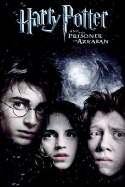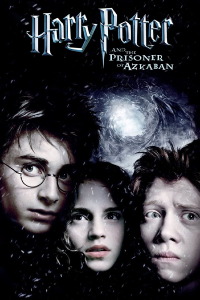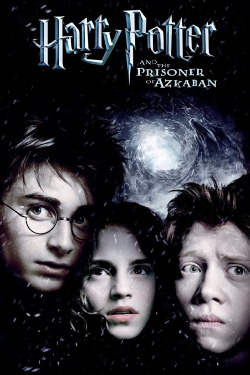
Review of Harry Potter and the Prisoner of Azkaban (2004) by Anzaan A — 22 Nov 2017
Alfonso Cuarón's masterful adaptation does the source material immeasurable justice by exploring its underlying concepts in an intelligent manner. Of course, it certainly helps that the aesthetics of the film are incredible, the acting remains stellar (and the trio of young actors handle their roles admirably), and John Williams offers an amazing (and eclectic) score. Character development is superb - Steve Kloves penned a great script.
First-time and young viewers will likely enjoy the film for its merits based on plot and 'adventure' alone, but it takes multiple viewings and a critical eye to enjoy the abstract ideas and nuances. Cuarón himself credited the source material as being laden with real-world issues: oppression, racism, loneliness, power, friendship, justice and so forth.
This is the Harry Potter film that stands on its own and as a tremendous cinematic achievement. It challenges viewers and yet doesn't patronize them or attempt to offer answers to all of the questions presented. For instance, the ending is bittersweet at best and retains a healthy amount of ambiguity.
If you've never read the books or understood the acclaim of the series as a whole, watch Cuarón's 'Prisoner of Azkaban' and you'll understand why this entry is clearly the zenith of the seven.f there's anything this movie proves, it is the difficulty in separating the series from the demands of fans. This is clear just from hearing some of the comments. "Why didn't they identify the names on the Marauder's Map?" "Why wasn't the second Quidditch game shown?" "Why wasn't there more of Crookshanks the Cat?" By focusing on what the film didn't have, fans fail to look at the film on its own terms. I think this is by far the best Harry Potter movie yet.
The only way to satisfy fans would be to include everything from the book, which would require a miniseries. Since that isn't what these films are, the story has to be abridged. The first two films tried to fit everything they could within a reasonable slot of time. The result was a set of films that felt cluttered yet incomplete. Had they continued with this strategy for this movie, based on a much longer book, it would surely have been over three hours long.
The virtue of the latest film is that it makes a real attempt to adapt the story, not just marching in lockstep with the book's events. The screenplay is sparing, leaving out or simplifying loads of details not directly relevant to the plot. But it captures much of the book's delight and humor. The first two films fell short in this regard, because they lacked the guts to tinker with the details, even though that was the key to condensing the story while staying true to its spirit.
The movie is still faithful to the book, of course. Many of the scenes are exactly as I had imagined them. When it deviates, it does so based on an understanding of the story and characters. This is evident in the way they show, for example, the Knight Bus; Hermione's overstuffed schedule; and the introduction of the Marauder's Map, a scene that captures the twins' mischievous personalities. The changes are clever and funny, and they help compensate for the movie's loss in other areas.
Certainly this has something to do with the new director. Columbus's approach was to stick to the books as literally as possible, often draining them of their subtlety. For instance, where the books only hint that Dumbledore can see through the invisibility cloak, the earlier movies make it unmistakable. The new director never condescends to the audience in that way. This is a children's movie, but it is also a fantasy-thriller that we can take seriously, because not everything is spelled out for us. We're given a chance to think.
But part of what makes the movie work is the book itself. The story is gripping from start to finish, because the threat looming over the school is established early on. Harry's personal life is sharply intertwined with the plot. We feel for him as we watch his disastrous (but hilarious) attempts to escape his uncle and aunt, and his humiliating reaction to the dementors. The story avoids common devices such as the talking killer or deus ex machina, which the other books have in abundance. The ending is nicely bittersweet and ambiguous. The plot is so complicated, however, that the book spends several chapters explaining it all. The movie wisely includes only very little of this, allowing the plot twists to become understood as the story progresses. I was surprised to see certain events that were in the movie but not the book lend support to an important theory some fans have had about what is to be revealed at the end of the series. Of course, it is well-hidden and won't give anything away for those who aren't looking for the clues.
I was so satisfied with the film that it almost seems trivial to mention the flaws, but there are some. The portrayal of Fudge's assistant as the standard hunchbacked dimwit is out of place here, as it would be in anything other than a cartoon or spoof. The most serious misstep, though, is the casting of Michael Gambon as Dumbledore. Gambon's face seems frozen in a perpetual nonexpression, and his voice lacks resonance. He compares poorly to the late Richard Harris, whose line readings had gravity, and who played the character with a twinkle in his eyes. It is a pure mystery to me why this actor was chosen as a replacement, especially considering the fine performances from other members of the cast. Even the children are in top form here.
Those complaints aside, this is the movie I was hoping they would make when the series began. If it doesn't live up to the book, so what? What's important is that it lives up to its potential as a movie. Fans who want a carbon-copy of the book are looking in the wrong place, because they're never going to get it here. This is probably the best example of a Harry Potter movie that we're ever likely to see.Director Alfonso Cuarón has taken the images conjured by J.K. Rowling's magical words and created from her book, 'Harry Potter and the Prisoner of Azkaban,' a film rife with visual symbolism and alive with inventive images beyond those established by the first two films in the series. Cuarón, a native of Mexico City and the acclaimed director of the completely compelling, frequently hilarious and sexually explicit coming-of-age film, 'Y tu mamá también,' was seen by many as an odd choice to follow heartland American Chris Columbus into the Harry Potter director's chair. The selection has resulted in a film darker and more mature than its predecessors, just as was the book, but it is also as approachable for young people as Cuarón's other internationally heralded work, 'A Little Princess.'.
It is late in the summer. Harry (a decidedly more assertive Daniel Radcliffe, making his third appearance in the leading role) is at the Dursleys in Privet Drive, preparing for his third year at Hogwart's, when an obnoxious relative demeans his father's memory, causing Harry to lose his temper. As a result, Harry violates the rules of student witches and wizards, causing the offending aunt to inflate as a dirigible and float away into the night sky on an stream of invectives. It is a delightful opening to a film with far more serious issues to explore and frightening obstacles to overcome. Sirius Black (Gary Oldman), imprisoned at Azkaban for complicity in the murder of Harry's parents, has escaped, and is looking for Harry. The soul-stealing prison guards called 'Dementors' (Latin for mind-removers) are searching for Black everywhere, but when he and Harry meet, there are revelations which change everything.
The symbolism in the film is fascinating. Rowling is responsible for a lot of it, but Cuarón has used symbolism as a visual tool to alert the audience to impending danger and to keep tensions high. Traditionally, black-feathered birds such as ravens, crows, and vultures all have negative images associated with them; they are usually used to represent carnage, bloodshed and battle; they are thought of in terms of scavengers, messengers of the dead, and evil. Crows abound in this film, but Cuarón has extended their traditional roles, turning them into symbols of the Dementors, which fly around menacingly in black garments with feather-like hems. Even when the Dementors are out of sight (they are not allowed on the grounds of Hogwart's School) you can feel their presence in the crows.
Rowling's most obvious use of symbolism is in the name she gives the escaped prisoner Sirius Black. Sirius is a star in the constellation Canis Majoris (in mythology, Canis Majoris is one of Orion's hunting dogs; the Greater Dog), the brightest star in the sky. So, Sirius is also called the Dog Star, and everyone knows that the dog is distinguished above all other inferior animals for intelligence, docility, and attachment to man. Would she give such a name, with all its implications, to a villainous character? Not likely. But she would give it to a wizard who could change into a dog.
Among the new visual images are animal ghosts which wander the halls of Hogwart's Castle and the film's realization of Buckbeak the Hippogriff, like Sirius, falsely accused and condemned. Hermione Granger (Emma Watson), Ron Weasley (Rupert Grint) and all of the established characters return. Led by Harry, all the students have matured considerably, as you would expect of 13-year-olds; they are more independent and self assured, more emotionally developed and far less childlike in their reactions and bearing. Michael Gambon is new and effective as Aldus Dumbledore, following the death of Richard Harris. Emma Thompson is wonderfully wacky as Divination Professor Sybil Treelawney; who leaps from the pages of the book and onto the screen as if Rowling had written the character specifically for Thompson. Also new is Defense Against the Dark Arts Professor Remus Lupin (David Thewles), who comes to Harry's aid in ways that might befit his Latin name. Remus was the brother of the founder of Rome. In mythology, he was nursed by a she-wolf; Lupin means wolf-like (wolf is Canis Lupis).
The unheralded thread of creative continuity in this marvelous series, as it moves from Chris Columbus to Alfonso Cuarón to incoming director Mike Newell (Harry Potter and the Goblet of Fire, now in production) is Screenwriter Steve Kloves. He and the producers have been true to Rowling's works and to Harry's fans, in ways that have always enhanced, not diminished, the author's incredible achievement.
This review of Harry Potter and the Prisoner of Azkaban (2004) was written by Anzaan A on 22 Nov 2017.
Harry Potter and the Prisoner of Azkaban has generally received very positive reviews.
Was this review helpful?