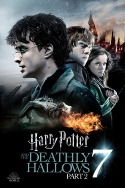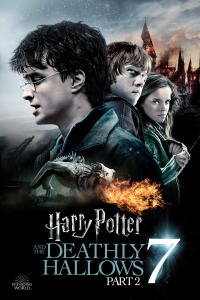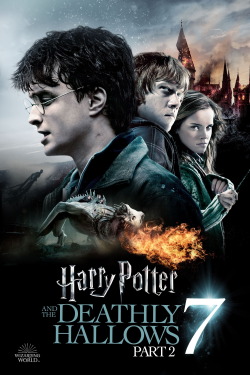
Review of Harry Potter and the Deathly Hallows: Part 2 (2011) by Najd G — 21 Jan 2016
It's a satisfying conclusion. Though, I am left with some questions about the series as a whole, including the following plot devices (i.e., spoilers).
- The character of Luna Lovegood never feels relevant to any of the movies. I was constantly anticipating for her character to make a meaningful contribution to the story, but it never happened. Iâ??m wondering if the character couldâ??ve been left out of the films without consequence.
- Likewise, Draco Malfoy doesnâ??t seem to reach his full potential as an important part of the story. There are plenty of opportunities for him to matter, but each time, heâ??s made to be a passive, unnecessary component to each of the story arcs. I wouldâ??ve liked to see him make a commitment - for better or worse - by the end. Alas, heâ??s ever-drifting with the flow.
- How did Griphook the Goblin die? There is nary an attempt at explaining how he went from escaping Gringotts to being a lifeless body.
- I stated this in my critique of Prisoner Of Azkaban, and it needs to be re-said here: Hermione owns a device that can reverse time. Why is it used in one fleeting incident early in the series, and never again? Wouldnâ??t the Battle of Hogwarts been an opportune moment for such a device? And surely Hermione isnâ??t the only wizard who has a device of the sort, right? The use of this as a subtle plotpoint in an earlier film, and never again mentioned going forward, amounts to a significant plothole.
- In Part One of the Deathly Hallows, some time is spent discussing a potential betrayal before the Battle of the Seven Potters. That is, it appears a member of the Order of the Phoenix tipped off Voldemortâ??s forces about their plan, because how else would they have known to be waiting? In neither of the Deathly Hallows installments does this get explained. Itâ??s made to be a big deal in Part One, and absolutely absent of consideration by Part Two.
- Speaking of unnecessary betrayals, Snapeâ??s â??betrayalâ?? doesnâ??t seem like a relevant plotpoint in the end. Itâ??s used for a magnificently interesting â??ahaâ?? moment in the last 30 minutes of the series, but in terms of its usefulness for Dumbledore or Snape or Potterâ??s cause, itâ??s moot. Snape tricking Voldemort into believing heâ??s a loyalist to the dark forces never helps Potterâ??s cause, and only serves to incite Snapeâ??s destruction. What was the point of tricking Voldemort into buying into Snapeâ??s loyalty if itâ??s never used for any benefit?
- As Snape dies, Harry bottles Snapeâ??s tears to get some revelatory information about Snapeâ??s purpose and Voldemortâ??s weaknesses. It works well and fine until you ask yourself, what if Harry hadnâ??t been there as Snape died? What if Harry walked in on Snapeâ??s lifeless body just three minutes after death? Harry wouldnâ??t have understood his role as a horcrux, and that probably would have significantly altered his approach to confronting Voldemort. For a school of â??wise wizards,â?? it feels like a massive oversight to leave something like that to chance.
- How did the Sword of Gryffindor reappear at Hogwarts for Neville to use? Again, no real explanation.
- How did Harry come back to life after Voldemort killed him? Iâ??m not saying that the explanation they gave was bad, Iâ??m just saying there wasnâ??t an explanation. And if Harry can come back, then why canâ??t any of the other dozens of characters come back to life after their untimely deaths throughout the series by the same means that Harry used?
- The storyline of the three pieces that make up the Deathly Hallows quickly became irrelevant. There was never any acknowledgement from anyone that Harry was in possession of the invisible cloak, and the resurrection stone didnâ??t seem to serve any purpose - so much so, in fact, that Harry tosses it within moments of finding it.
I have to assume that some of the aforementioned questions have answers in the book version of the series. In terms of the cinematic experience, though, I felt a little lost at times - there needed to be more hours spent in the editing, of which Iâ??m certain there were already countless hours of.
As for the series as a whole, I found it decent but not phenomenal. Itâ??s my personal opinion that this series didnâ??t warrant the massive following it garnered, but at the same time, this was an overall enjoyable experience for me. The cinematic series did some things rather poorly, but also had moments of brilliance. Further, itâ??s amazing that with 8 movies filmed across a decade, only 1 of the major characters had to be recast, and all of the young 10 year-olds cast in the original film had serviceable acting skills into their adulthood. Thereâ??s a lot of risk in doing a series like that - just ask the "Chronicles Of Narniaâ?? filmmakers, or the writers of TV series â??LOST.â?? Where other series failed in this capacity, Harry Potter knocked it out of the park.
This series had an adequate amount of appeal and execution, and I stand by my initial sentiment: this was a satisfying conclusion.
This review of Harry Potter and the Deathly Hallows: Part 2 (2011) was written by Najd G on 21 Jan 2016.
Harry Potter and the Deathly Hallows: Part 2 has generally received very positive reviews.
Was this review helpful?