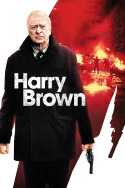
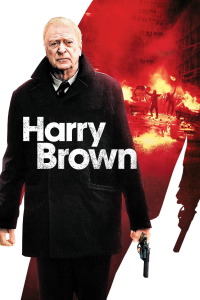
Review of Harry Brown (2009) by Matthew P — 17 Jul 2011
I must question if life in many neighborhoods is as bad as it is portrayed in Harry Brown. There are drug rings, beatings, teenagers cussing at passers-by. This isn't the kind of place one would like to live in, which makes it seem odd that our protagonist, the titular Harry Brown (Michael Caine), would live in such an environment. Surely he would be able to find a better place to live than this.
Regardless, this is where our quiet pensioner lives. He takes a trip daily to visit his sick wife in hospital, and also goes down to the local pub to play chess with his friend Leonard (David Bradley). Shortly after our film begins, his dies. This makes him sad. We get to see Michael Caine be gloomy for a while. He's good at this. We continue to view the world through his eyes, seeing robberies and more drug trafficking. Leonard is constantly harassed at his home, and is also sick of it. Leonard, unlike his former-marine best friend, is willing to do something about it. Brandishing a knife, the last we see of Leonard is him yelling at the local gang.
The next morning, Harry wakes up to a knock on his doorstep. There are cops there, (Emily Mortimer and Charlie Creed Miles), but their names are inconsequential. They inform Harry that his friend is dead. This happens somewhere around 40 minutes into the film. At this point, the real plot begins -- one of revenge and murder and watching Michael Caine shoot some people dead for somewhere around an hour.
I noted that the cops' names are of no significance, and that's because their characters are also that way. They end up serving no purpose except to inform Mr. Brown that his friend is dead, a task that a television set or radio could also perform. But the film seems to think that they're important, because we cut to them just to have plot points we've already grasped reiterated to us. I guess they're also used to inform us that the police force, at least in this area, is useless, but the gangs everywhere seem to do a sufficient job doing this too.
In fact, if they weren't involved, we could lose about 20 minutes of the film's runtime. Sure, we'd have to slightly alter the film's ending, but it would be for the best. While there aren't any real pacing problems, at least, none after the real plot got started, it did seem like Harry Brown went on for a bit too long. Removing the cop characters would have fixed this. Besides, we're really only watching a movie like this to see a great actor risk his life to clean up crime himself, despite being well past his physical prime.
This is a premise that is delivered on in full-force, at least, after the somewhat slow opening. While there aren't actually a lot of large shootouts, the action is intense, and most importantly, it's believable. You're not going to get a huge parkour chase sequence, because someone in their late 70's is not going to be able to do that. First-time director Daniel Barber acknowledges this, and keeps the action low-scale and realistic.
The best scene in the film is when Brown decides that he needs a gun, and goes to these same drug dealers in order to obtain one. The entire time he is there, I was on the edge of my seat. I was worried for him, because at this point, we are not aware of what he can accomplish. These dealers are high and we don't know what they're capable of either. There's more tension in this one scene than in many thrillers I've seen, and while the rest of the film doesn't quite live up to this section, the thrills remain quite high.
Apart from including the police officers that serve little to no purpose, there's only one other problem that plagues the film, and it lasts only a few seconds at best. The blood effects look terrible. I get that making realistic blood effects costs money, and using cheap CGI can be serviceable, but in a film with scenes that are this intense, laughable CGI takes you out of the experience. It's only really noticeable a couple of times, but when it is, you really notice it. It's a shame, especially because having to stifle your laughter right after someone has been shot makes the experience feel cheapened.
What I'm most curious about is how well Harry Brown would work if an unknown actor took Michael Caine's spot. See, revenge films only really work if you can sympathize with its lead characters. We care here, but I'm not sure if it's because we like Michael Caine, or because of his character's situation. Like I said to open with, if the environment was so bad, he could move. Sure, his friend's death was bad, but his friend was the one initially wanting to kill the gang members. He approached them, effectively taking the fight to them. If we had another actor playing Mr. Brown, I wonder if the film would still be this good, because I don't know if we'd care about its protagonist.
Regardless, Harry Brown works because it is a thrilling experience. It may have characters with little purpose and some cheap CGI blood, but the core story is solid. There are scenes with far more tension than many other thrillers, and this is largely because it feels realistic. You won't see Michael Caine performing a ton of stunts, but that actually helps the film seem grounded in reality. Give Harry Brown a look, just don't try to think about the moral ramifications of his actions.
This review of Harry Brown (2009) was written by Matthew P on 17 Jul 2011.
Harry Brown has generally received positive reviews.
Was this review helpful?