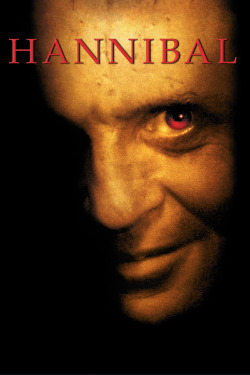
Review of Hannibal (2001) by Gareth R — 31 Mar 2011
Gore is curiously absent from Jonathan Demme's film, The Silence Of The Lambs. It's a thriller, not a horror movie, and although it concerns two particularly gruesome serial killers, it doesn't show us the details. It concentrates on the human cost, the tragedy of murder and the courage necessary to catch murderers. Granted, Anthony Hopkins gives such a diva performance as psychotic Hannibal Lecter that screen villains, especially psychopaths, haven't been quite the same since. The enduring strength of the movie, however, is its hero. We see the story through the eyes of Clarice Starling, a vulnerable but tough young woman. We feel the horror and reality of what's happening because she does. We don't need to see it.
Ridley Scott's sequel is less sophisticated. That's putting it lightly. As the title suggests, this is much more Hannibal's story, and it often focuses on the things he might find interesting, such as sophisticated locations, opera, and guts. The movie revels in the pretty locales and the viscera, drenching all of it in a sense of camp self-awareness that sells the characters, and the audience, down the river. Ridley Scott hopes, at least, that you think the river is pretty.
The slow plot begins with Clarice, now played by Julianne Moore (as Jodie Foster understandably passed), facing disgrace in the FBI when a case goes violently wrong. Dr Lecter (Hopkins), now living incognito in Florence, is aware of this. So is Mason Verger (Gary Oldman), Lecter's only surviving victim, who wants to capture and kill the doctor for obvious reasons. Clarice, along with a similarly disgraced detective in Italy and Verger's lackeys, begins to close in on Lecter. Or is he closing in on them?
There is very little thrill to this chase, probably because Scott invests so much time in Lecter's funny little ways and rock star fame that he doesn't seem to want him to get caught. At one point a character says Lecter "prefers to eat the rude", and Hannibal seems keen to off only the people who are asking for it. It's probably worth reminding the screenwriters at this point, and Thomas Harris, that we're dealing with a deranged serial killer here, not Batman.
Lecter vamps around with the murderous skill of Michael Myers, and quips like Bond. We are encouraged to giggle at his exploits. The lack of perspective, for Clarice Starling is no longer our eyes and is reduced pretty much to a bystander, means cheap giggles and titters of familiarity are the best Hannibal can offer. Anthony Hopkins gives it as much arch awareness as possible, looking directly into camera at least once. He did that in Silence Of The Lambs as well, only then he was looking at another character; the relationship here is strictly that between geeky film-fans and their favourite movie bogeyman.
All of Hannibal's exploits play into the character's pop culture status, ripping him away from the relative reality of Demme's film and showing him for the Freddy Kreuger cartoon he really, sadly is. No wonder Jodie Foster got out while she could. Gary Oldman, on the other hand, tries to out-camp the famous cannibal, in an uncredited performance that's sure to amuse and disgust. Julianne Moore plays an older and less vulnerable Starling, and by definition she is less interesting.
It does at least look good, what with the extensive location filming, and the grim horror beats mean that, to the right audience, it's rarely boring. Only those seeking character development and a touch of realism will be checking their watches, trying to figure how it took two hours for Hannibal to get found out, escape capture, get captured and escape capture again, and why none of that seemed to matter as much as how it all looked. The novel is six-hundred pages long, and there's even more artsy dawdling.
Ridley Scott does at least forgo Thomas Harris's original ending, which would have been the final, ultimate insult to that excellent 1991 film. It's a pity so much else of the grisly novel survives intact, its rich foulness illuminated and celebrated to an obviously-juxtaposed (but very pretty) classical soundtrack. There are lots of other see-what-I-did-there trick shots dotted throughout Hannibal, and much to the filmmakers' disappointment, I doubt they would be regarded as clever by the good doctor himself. The film's nudge-wink grasp of the relationship between art and horror is, if anything, clumsy.
In any case, this love letter to cinema's hungriest psychopath plays to his worst excesses, and ultimately it feels like that piece of advice given early in Lambs - "You don't want Hannibal Lecter getting inside your head" - has gone chillingly unheeded.
This review of Hannibal (2001) was written by Gareth R on 31 Mar 2011.
Hannibal has generally received positive reviews.
Was this review helpful?