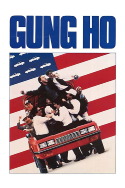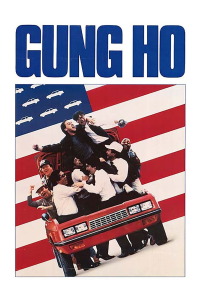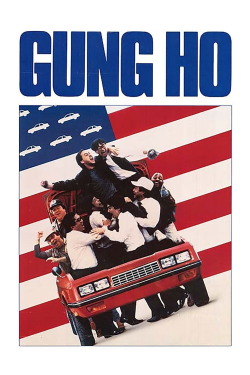
Review of Gung Ho (1986) by Christopher S — 23 Sep 2011
Not Actually Anti-Union, If You Think About It.
Remember, the characters decide at the beginning that working is more important than keeping a union. It's impossible to say how things might have gone if they hadn't made that decision. What probably would have happened is that the plant never would have reopened in the first place and the story would not have taken place the way it did. But it's true that the heroes of the story are management, not labour, and that labour is mostly comprised, in this movie, of sloppy, lazy guys. Not everything they're interested in getting is unreasonable--more on this anon--but they also just don't want to work hard. Or well; the basic premise one guy operates under is "no car is perfect, so who cares if I miss a few things?" I don't know much about the state of the US auto industry in 1986, but I think we can all agree that things haven't been right with it in some time.
Hunt Stevenson (Michael Keaton) was a foreman at an automotive plant in Hadleyville, Pennsylvania. He's mostly coasting on being a good guy who was a sports hero in high school. This, for some reason, leads to his being the one sent to Japan to negotiate with the Assan Motors Corporation to get them to take over the plant. On the one hand, it works. On the other hand, Assan Motors sends over their own corporate guys to run the plant, and the people they send have absolutely no familiarity with American culture and business policy. They expect the American guys to work the way Japanese workers do. The American workers expect the Japanese guys to behave the way American executives do. And since Hunt has been appointed employee liaison, everyone yells at him about it. He convinces plant supervisor Oishi Kazihiro (Gedde Watanabe) that the company should restore everything they've taken away from the workers if the workers can build fifteen thousand cars in one month.
The thing is, a lot of what these guys get away with aren't things most Americans are able to do in their jobs. Willie (a very young John Turturro) wants to get off work and go be with his kid one afternoon, because the kid is having his appendix out. And that's great, and a lot of parents would want to do that. He says the kid will be scared without him, and that's probably true. He's mad because the Japanese executives are going to make him take it out of his sick pay or something; I didn't quite catch the details. But that's what happens. Unless the auto workers in the US have some incredible contract I can't believe they have, that's going to be taken out of your sick pay or something. Come to that, I know a lot of people who have had jobs their entire adult lives and never had sick pay at all. When cuts are made in businesses, those cuts aren't likely to come out of executives' salaries and benefits, and there's only so much sympathy a lot of us can have when the cuts include things we never had ourselves.
And, of course, the Japanese characters in this movie are largely made up up the worst stereotypes of Japanese business that Americans have to offer. Kazihiro is really trying to be the bridge between the two countries, certainly more than Hunt is, but he is introduced doing "shame training," which I'm given to understand was only done for a short period of time by a couple of the crazier Japanese corporations. Yes, his immediate subordinate, Saito (Sab Shimono), is the nephew of the company's owner, Mr. Sakamoto (notable Japanese actor Sô Yamamura), but it's not as though nepotism were uniquely Japanese. The Japanese executives want the Americans to work overtime without overtime pay--which I believe is illegal; thank you, unions. Ito (Rodney Kageyama) tells Mr. Sakamoto that he would rather work than be with his wife while she is in labour. Unfortunately, my understanding is that some of that is probably true. But it seems as though the screenplay basically takes everything anyone saw as a wacky "lighter side" report about what those crazy Japanese are doing now and shoves it in the movie.
Gedde Watanabe and Michael Keaton do a much better job with this movie than might be expected. Michael Keaton dabbled, a few years later, with superstardom, though he never quite reached it, and Gedde Watanabe has always been a minor character actor. (Not a lot of call for goofy-looking Asian guys, I guess.) Unfortunately, instead of seeming to be a celebration of the American way of life, what the movie feels like is a call for compromise. Frankly, several of the characters needed to be fired, and no one ever seems to call them on it. We do see the Americans coming to terms with pre-work calisthenics; these will probably be some of the healthiest auto workers in the country. The Americans can probably take a lesson from the Japanese about work ethic--and American management can take a lesson from Japanese management about loyalty to their employees. But the Japanese can learn that work isn't everything. There's a place for both, and it's somewhere beyond the realm of one wacky fish-out-of-water comedy to find it.
This review of Gung Ho (1986) was written by Christopher S on 23 Sep 2011.
Gung Ho has generally received mixed reviews.
Was this review helpful?