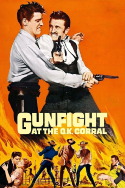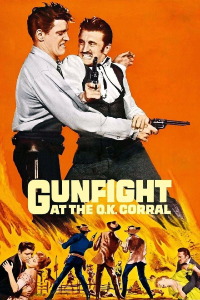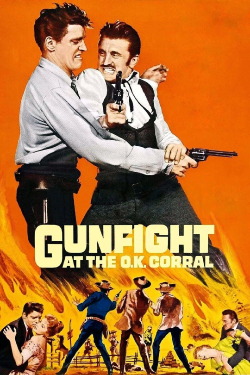
Review of Gunfight at the O.K. Corral (1957) by Edith N — 17 Nov 2009
You Remind Me of a Very Young Leonard McCoy.
The real gunfight was so much less impressive than this. Here, it lasts five minutes, took four days to shoot, and involves much ducking and diving into ditches and so forth. In reality, the gunfight didn't even take place at the O. K. Corral in the first place. It took place in an alley nearby. It only lasted a few seconds--half a minute, for all 34 bullets were fired and three men died. Of course, the real version wasn't terribly impressive or cinematic, and about the only way you see the real version is in TV documentaries called things like [i]The Real History of Tombstone[/i] or whatever. (Not, so far as I know, a real documentary title.) There's a gallery about it at the Gene Autry Museum of Western Heritage, worth a visit if you're ever in LA. (It's across the street from the zoo.) The town of Tombstone makes a lot of money on the cinematic version, but the real version says things about the Old West which we modern types don't really remember.
Wyatt Earp (Burt Lancaster) is a lawman who has befriended gambler John "Doc" Holliday (Kirk Douglas). They are thrown into the kind of coincidental situations which mostly occur in the movies, in no small part because they're intended to show how the two became friends. (The idea that Wyatt wasn't quite so pure as all that is, of course, not possible.) Doc is involved with skanky Kate Fisher (Jo Van Fleet), though of course she cannot be faithful, et cetera. Wyatt, meanwhile, falls in love with Laura Denbow (Rhonda Fleming), who is sweet and pure and innocent--but who will not follow Wyatt around in his career as a lawman. In the end, he leaves her to go on to Tombstone, to help his brother, Virgil (John Hudson), not to mention Jimmy (Martin Milner) and Morgan (DeForest Kelley!), but Laura will not go with him. There is conflict with the Clantons and the McLaurys, and Jimmy is killed, and Wyatt wigs out, and on and on until there is much gunplay.
What has come down to us may or may not be the truth, of course, leaving aside the embellishments. What we have is Wyatt's own version. There was--and this part never makes it into the movies, somehow--a grand jury hearing; Virgil and Morgan were both lawmen in the execution of their duties, but neither Wyatt nor Doc were. The grand jury, however, refused to indict, and no trial was ever held. However, Wyatt told his version, probably many times. That's the version we are told, not hurt by the fact that Wyatt ended up working in Hollywood. It feels as though there should be a greater disconnect in time, but his third wife, Josephine Marcus, died in 1944. She, too, told her version, which coincided with Wyatt's version. Of course, she wasn't there, unless there's something no one was saying. But either way, she promoted Wyatt after his death, and there is no reason to believe she would alter her husband's image. (To be fair, we don't know for sure that they ever actually married.) The story of the Clantons and the McLaurys pretty much only extends to the fact that the headstone says they were murdered.
But back to the movie. The thing is, it would have benefited from some trimming. In 1993 and 1994, two movies came out about Wyatt's life. The one generally considered better starts with Wyatt's getting off the train in Tucson. The other starts in Wyatt's childhood. It seems, therefore, that adding everything pre-Tombstone just weighs down the story. An interesting story might be made about his Dodge City days, but trying to cram so much into one story is a bit much. The addition of a pure, sweet woman into the story instead of the two . . . experienced women he was involved with at the time is a byproduct of the Code but not actually useful to the story. (Mattie Blaylock, the woman with whom he arrived in Tombstone, had been a prostitute and would be again. Josephine Marcus may have worked as a prostitute and definitely lived with another man before Wyatt.) The story of Doc and Kate is tamed down but still feels tacked on.
Many, many movies have been made about Wyatt and Doc and the gunfight. Doubtless many more will be as well. This one is notable mostly because of its two stars, both talented men who were well-known in their field. It's also notable for that young DeForest Kelley and a young Dennis Hopper. It may or may not have the longest version of the gunfight, but it is beautifully choreographed and well-filmed for all that. The costumes are okay, and while the filming isn't outstanding, it's not just the gunfight which benefits from the John Sturges touch. However, the Cowboys are so out of control as to be parodies of caricatures of what we picture wild cowboys to be. Even the people in the actual comedy of [i]Support Your Local Sheriff[/i] aren't so wild. The Cowboys ride horses inside and shoot out just about every lamp in the entirety of Dodge City. It's just silly, and the movie would benefit greatly if they'd been trimmed or else cut entirely.
This review of Gunfight at the O.K. Corral (1957) was written by Edith N on 17 Nov 2009.
Gunfight at the O.K. Corral has generally received positive reviews.
Was this review helpful?