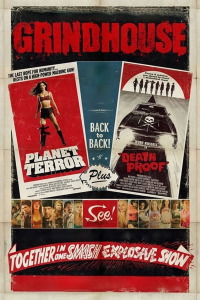
Review of Grindhouse (2007) by Markb. — 20 Apr 2007
Pastiche movies--films in which the makers attempt to communicate the themes of a past director or genre by trying to perfectly reproduce the style--aren't easy to do. Steven Soderbergh proved that last year with The Good German, a smug, contempt-oozing repay of 1940s and 50s films noir that not only got many obvious details completely wrong but committed the unforgivable sin of reconstructing the finale of Casablanca for the purpose of sneering at it.
..and in doing so he made one of the absolute worst movies of this decade. However, this technique also brought us two of the decade's best and most thoroughly enjoyable films: Larry Blamire's incredibly endearing, note-perfect salute to/ parody of rock-bottom 1950s sci-fi horror, The Lost Skeleton of Cadavra, and Todd Haynes's passionately felt Far From Heaven, a brilliantly evoked variation on Douglas Sirk's Universal-International weepers that got me to watch Written on the Wind and imitation of Life all over again, even though I was never a big fan of either (and still am not).
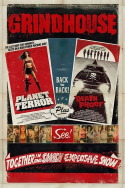
Well, Robert Rodriguez and Quentin Tarantino have brought us the decade's third total success of this type (or is it 3rd and 4th?) Perfectly rechanneling their formative moviegoing experiences in grindhouse theaters (decrepit moviehouses specializing in action/ horror/ exploitation double features in the 1960s and 70s), the two Miramax/ Dimension bad boys evoke a real sense of nostalgia for a moviegoing era I was fortunate enough to catch the tail end of; they actually make me miss theaters in which a few of the patrons didn't exactly make it all the way to the men's room! Rodriguez's Planet Terror recreates a low-grade zombie-attack flick while Tarantino's Death Proof fuses Russ Meyer's female-revenge saga Faster, Pussycat! Kill! Kill! with 1974's nonstop car crasher Gone in 60 Seconds (which, as Tarantino helpfully reminds us, is NOT to be confused with the abysmal Jerry Bruckheimer-produced remake).
The ongoing debate has been whose movie works better: Rodriguez's or Tarantino's? The answer is "Yep". Rodriguez loves these movies both in spite of and because of their flaws; Tarantino just plain loves them.
Rodriguez's fil is a wildly over the top, luridly gore-geysering horror opus (featuring an unforgettable Rose McGowan as a go-go dancer who leads our side in the battle against the mutant undead) whose crayon-drawn characterizations, limited sets, hilariously incomprehensible "scientific explanations" and even more hilariously prodigal use of raspberry syrup are as lovingly rendered as the scratches, hisses and pops that indicate that this flick has been shipped all over the country for far too long and is suffering serious battle fatigue.
(The fact that Planet Terror looks a whole lot worse than Death Proof underscores an accurate observation about grindhouse double bills: Tarantino's is the newer film and the program's star attraction, while Rodriguez's is the shopworn oldie trotted into second-feature action for the umpeenth time.
The dated "topical" reference in Rodriguez's film underscores this.) Those who have complained that Death Proof, the tale of psychotic Stuntman Mike (Kurt Russell, in arguably his best form ever) and his comeuppance at the hands and gas pedal feet of a group of stuntwomen he underestimated starts out far too talky miss the point on three counts: 1.
) Tarantino loves dialogue as much as Joseph L. Manckiewicz and Billy Wilder, and typically provides us with reams of it; 2.) the films he's mirroring killed time before and between action sequences with tons of it too, only not one-twentieth as inspired; and 3.
) this is a revenge film, and Tarantino gets us to truly love the first four funny, free-spirited chicks before...he gets us to accept and encourage any and all means taken against their tormentor. Death Proof will also be remembered for the coolest bar and grill ever put on film, and for the onscreen, starmaking debut of Zoe Bell, who was Uma Thurman's stuntwoman in the Kill Bill movies.
What a shame that by definition that role didn't allow Bell to show her face onscreen, because here she shows astonishing screen presence and a killer smile. To make the grindhouse moviegoing experience complete (almost interactive, in fact) both "features" share a few of the same actors, at least one common character, a costume prop and the same cinematic in-joke (a missing reel that contains precisely the last scene that most audiences WANT to be missing) and are backed up with four brilliant trailers for fictional coming attractions.
(Yes, I said four. Not three, four. Eli Roth's contribution, Thanksgiving, is already notorious for one of its visuals, but it stems from Roth's accurate observation that slasher movies are mostly inherently misogynistic.
Don't attack the messenger.) UNLIKE many of the poorly-paced C-movies Grindhouse so adoringly salutes, there's not a dull or flat moment to be found anywhere. If 1962's Lawrence of Arabia's parching desert visuals caused moviegoers to break records in soda consumption, then Grindhouse may well have the opposite effect on concession sales, causing a downtick in drink purchases if viewers are smart.
This review of Grindhouse (2007) was written by Markb. on 20 Apr 2007.
Grindhouse has generally received very positive reviews.
Was this review helpful?