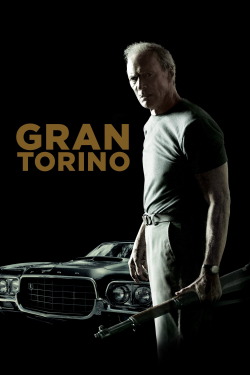
Review of Gran Torino (2008) by Paul Z — 20 May 2012
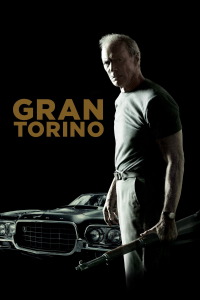
Eastwood plays the lead as a man blasting with intensity, most of which he uses to the advantage of the macho notion to contain his feelings. Each word, each literal growl, seems to have escaped from submergence like steam. Walt Kowalski, a retired and widowed Polish American auto assembly worker and a Korean War vet, lives in a changing craftsman-style Michigan neighborhood which is dominated by immigrants.
It's a character study I've been waiting to see, a study of the old Conservative man. Walt is the classic model. His intolerance of ambiguity or uncertainty, lack of openness to experience, need for simple resolutions and personal structure, and his feeling threatened by the idea of losing status or self-assurance are all established in the first half hour. He has no tolerance for his two sons and their families. He sees them as indulgent and self-involved, sidestepping him except if it's not somehow to their advantage. His sons see him as always unsatisfied with them. I saw them as quite normal, only reacting to his bitterness. Really, he is remarkably judgmental. Immediately after seeing the film, I thought it a flaw that Walt's only sign of racism was a quota the screenwriters filled for derogatory terms: Gook, zipperhead, swamprat, dego, spook, mick. My favorite is Dragon Lady, but other than that, no vital signs. But looking at him as a whole, he's not so much a racist as a guard, defending his own security. He sits on his porch protecting the doctrine that your right to life ends when you're on his lawn.
He sees a carload of Hmong gangstas try to push the shy, bookish Thao into their troublemaking. When they coerce Thao to try to steal Walt's cherished Gran Torino, Walt comes a lightbulb flicker away from blowing his brains out. Then Thao's likable and intuitive sister Sue comes to apologize for her family and offer Thao's household services and Walt unwillingly agrees. When Sue is intimidated by some black punks, Walt's gaze tightens focus and he gets involved because it is his way.
The idea of a 78-year-old action hero initially sounded to the studios similar to how it sounds to the common filmgoer, but Eastwood has spent over forty years making it his trademark. The film is an action movie in more of an internal sense than external. Eastwood's harshness is as much said as shown. Even at 78, he can make "Get off my lawn" a formidable annex to "Make my day" and "Do you feel lucky, punk," and when he says "I blow a hole in your face and sleep like a baby," he is quite convincing.
Sooner or later, his life becomes awkwardly close to these people. Walt makes no apologies for who he is, and that's why, when he begins to feel protective of his neighbors over his own family, it determines meaning. Eastwood's potent requiem isn't a liberal fable, as oddly opposed to fifty-plus-year Republican Eastwood's previous, and superior, film Changeling.
This, apparently the highest grossing film of Eastwood's entire career, is about the overdue evolution of a man's finer essence, and about the power of integration. This isn't a noble metamorphosis as it would've been if Walt were a bona fide bigot. It's a movie geared toward generations close to Walt's, which is admirable. There aren't many bankable directors or stars as old as Clint who brave the themes perspective of those who share his era and old-school outlook.Yes, the final unraveling into the end credits feels too blanket and sleepwalked, happening a little too hastily, but Walt's epoch likes it that way.
This review of Gran Torino (2008) was written by Paul Z on 20 May 2012.
Gran Torino has generally received very positive reviews.
Was this review helpful?