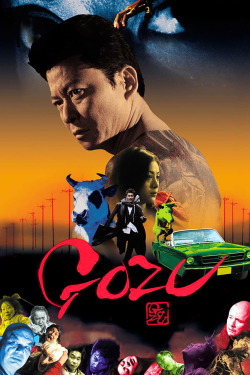
Review of Gozu (2003) by R.c. K — 07 Apr 2009
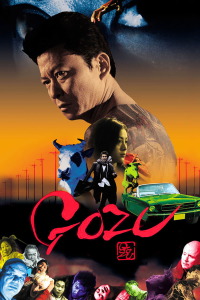
I've seen two Takashi Miike films before (Audition and Ichi the Killer), plus his episode of Masters of Horror ("Imprint") so I picked this one up because it was on sale--and it was Miike. I can't recall what I heard, though I definitely heard it was one of Miike's films to be seen, so when the person I was watching a movie with today excitedly pointed out the previously half-watched (by her, not me) Gozu, I shrugged and didn't know what to expect--except that nothing would be offlimits as usual, which I threw out as a casual warning (it was shrugged at then later justified).
Minami (Hideki Sone) is sort of an assistant to Yakuza man Ozaki (Sho Aikawa), who we learn is a little...off at their meeting with the Azamawari crew Yakuza boss (Renji Ishibashi), where he insists that he's joking, but proceeds to tell the boss that the toy poodle outside is a trained Yakuza-killing attack dog and proceeds to slam it repeatedly into hard, flat surfaces until he has sufficiently killed it (presumably to death). We soon find Ozaki and Minami on the road to Nagoya, when an unassuming, terribly plain car appears behind them, and with a bolt of fear and slammed-on brakes, Ozaki leaps to defend the two of them from what he maintains is a Yakuza-killing car, retooled specifically for this purpose. He walks up with a gun to the plain-looking, frozen smile of the woman inside, only to be stopped with a body block by Minami, who somehow knocks Ozaki out in the process. Receiving a call from their boss, Minami confirms that he is indeed taking Ozaki to "the dump" near Nagoya--until the road to said town suddenly ends at a river, leading to more rapid braking, seemingly killing Ozaki. Minami stops for coffee after discovering his mentor's corpse, only to look outside and find it missing. Now the quest really begins, as Minami must find the missing body and get it to the dump, all the while following the ridiculous and circular directions of the people of Nagoya, who are all just a bit off, it seems, having incessant phone conversations about the same banal subject--but without even variance in how it's discussed. An innkeeper (Keiko Tomita) comes onto him in a bizarre fashion--offering to wash his back and, uh, if you can believe it, offering him milk--fresh, and not from a cow.
Depending on how you read what I've just written, it either sounds like a Troma movie or a David Lynch movie. No, I take it back--obviously there's too much subtle plotting for a Troma production (and where would the stock footage of the exploding car ramping off another car go?!), but the truth is that it's both anyway. It has a lunatic sense of humour, a visceral edge, a dreamlike quality and an essential incomprehensibility. As I've said many times before, I am NOT a fan of most of David Lynch's films. I find them tiresomely obscure and distractingly pretentious, and usually ploddingly slow AND uninvolving, an absolute death knell for the derivation of entertainment of any kind to me. The difference here is that, despite similar qualities (inexplicable logic of character change, disappearance, reappearance, surreal elements), those elements are all carried off as if this is a world in which such things can happen--not that anyone, especially Minami, expects them to, but they simply can. More importantly though, there's that Tromatic tongue-in-cheek feeling, with some elements of grossness seeming to have no plot importance, existing purely for the amusement of Miike's aesthetics. Here again, though, that rampant vulgarity is taken through a slightly more serious lens, not zoomed in on or shown in all gory details (it's not done with silhouettes or only suggested, but it's not pornographically obvious)--in some ways it has that matter-of-fact eye turned toward it, even as a ladle protrudes from a man's rectum--not as some goofy martial arts finishing move or violent slapstick gag, but for his sexual pleasure.
More importantly--for me at least--Minami is someone we can get behind. We're told he's Yakuza, but when an intended seance turns randomly into inexplicably violent sibling abuse, he backs up to a wall and pleads, frightened, for the abuser to stop. It's ridiculous, mind you, and not just a horrifying instance of this violence, so a sardonic smile is elicited by the scene despite the action within it. We can see that despite the fact that he's a gangster, essentially, he is well-meaning--even informs us in conversation with bizarre guide Nose (Shohei Hino) that he has never killed anyone. In essence, these differences make for an experience like a Lynch film...but enjoyable. Many suggest that Miike was influenced by Lynch, but I can hear his words,the way he talks about just making what he wants or feels is right--and that's what you can see in his movies. He plays around, does what he thinks fits, doesn't think about taboos, going too far, not going far enough or anything else most think of--if the obscure becomes clear, he shrugs and it's simply clear now. When you see ridiculous violence, it seems to just occur, rather than being a set up just so we can have some nice gory effects here or there. It makes for a more entertaining experience than movies that aim for obscure meaning or violent/pornographic setpieces with flimsy plot surrounding them. It can come out a weird mix, a glop that may not even seem to fit together quite right--though this time it does--but we can see the guiding hand of Miike putting all those parts where they are, even if they are not where we expect them.
This review of Gozu (2003) was written by R.c. K on 07 Apr 2009.
Gozu has generally received positive reviews.
Was this review helpful?