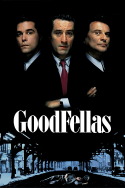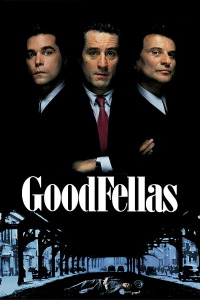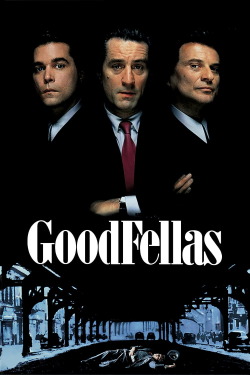
Review of GoodFellas (1990) by Rian P — 05 Nov 2013
"Never rat on your friends, and always keep your mouth shut.".
Next to Chinatown, probably my favourite film of all time. However, I was really underwhelmed by Martin Scorsese's Goodfellas when I first saw it, even at one time preferring Goodfellas II (Casino), I guess mainly because of two reasons: (1) its towering reputation from critics and audiences everywhere was baffling to me and (2) I was in my film infancy (still am, actually) and was... well... an idiot - I was in no position to embrace/judge the flawless technical artistry on show, or compare and rank it with other movies in its genre. But, as any great film should be able to do, it has only improved in my eyes with every single rewatch -- which amounts to about half a dozen viewings at the time of this writing. When it comes to gangster classics, it is probably the second best ever made, after The Godfather. Often imitated, but never surpassed.
Taking inspiration from The Public Enemy, it examines the lifestyles of its Italian/Italian-Irish American subjects down to the last detail. The clothes they wore, the people they associated with, the people they harassed, the crimes they did, the food they ate... everything. It breezily and episodically chronicles 3 generation gaps of their lives, yet still manages to form a structure broken down to three acts of prosperity, coke-dazed paranoia and downfall. Theirs is an unpredictable world; one moment they are the sweetest people to each other... attending weddings, anniversaries, dinners, going on vacations together; and the next, we have wives pointing guns at sleeping husbands' foreheads for reasons of infidelity, teenage bartenders getting shot in the foot [and getting shot dead] for screwing up orders, friends sending long-time friends down lonely alleyways to get ''whacked'' (just to make sure they don't get ratted out on and have to go to prison) and even friends pulling other friends' legs with devilish seriousness (''What do you mean I'm funny? Funny how?!''). It's really one of the best bio movies; Scorsese has always said that he grew up around criminal personalities and, indeed, the world created here never lacks authenticity or rings a false note. It is scary real. Well, [maybe] except for the famous prison dinner scene, where we are enlightened to how far-reaching these guys' power stretches; they get delivered and are allowed to cook for themselves: pork, lobster, steak and even get to drink red & white wine! Ha...
As for the acting, the entire ensemble is absolutely incredible. Scorsese, to my knowledge, is not primarily known as an actor's director, like, say, Elia Kazan, but the truth of the matter is he does have a sublime record for guiding them along. Goodfellas, more than any other one of his movies, can attest to this. No one gives a bad performance here. In fact, no one gives anything less than a great performance, however small their screen time. Joe Pesci is especially explosive in playing Tommy DeVito, a small-built but wholly imitating psychopathic hot head (no doubt inspired from another James Cagney film - White Heat), Ray Liotta - who normally irritates me when he gets typecast in films as some corrupted, cliched villain - has never been better than he is here as the main character, Henry Hill, who "as far back as he can remember, always wanted to be a gangster" - and his excellent narration [which, while not fully complying with Billy Wilder's advice of "in doing voice-overs, be careful not to describe what the audience already sees; add to what they're seeing"], is suitable for the film's razor-sharp editing and works wonders for the film's storytelling. The legendary Robert De Niro is fantastic as ''the guy who always rooted for the bad guys in movies,'' Jimmy Conway [and that one scene where he smokes a cigarette and gets the idea to kill off some associates -- done to Cream's ''Sunshine of Your Love'' -- is him at his most sinister and unnerving best], Paul Sorvino excels in portraying the mob boss Paul ''Paulie'' Cicero ["Paulie may have moved slow, but it was only because Paulie didn't have to move for anybody"], Lorraine Bracco gets overlooked a lot carrying the only major female role as Henry Hill's wife - who, though reserved at first about the lifestyle, eventually becomes comfortable in adjusting herself from a innocent Jewish girl to a mob wife [I also really liked her narration about her POV of the story]... and, hell, even Scorsese's own mother, a non-professional, nails her brief role with utmost believability and affection as Tommy's mother. And if I don't stop now, I'll just go on and on and on about how every cast member is splendid and make me cry tears of happiness with their tremendous work. But moving on!
In terms of the film's flaws, I've only noticed people say they don't like the movie because the characters are repulsive and not very empathetic. Well, I suppose they are, but isn't that exactly the point of the film? In the other famous dinner scene [with the funny painting] in Tommy's mother's house, the one after they half-kill a "made guy" of another crew, Billy Batts [whose most fatal mistake, we remember, was belittling Pesci's character by telling him to "go home and get his fucking shine box"], and unknowingly stuff him half-dead in the car trunk to bury him once they pick up a couple of shovels from the house, the goodfellas appear practically nonplussed by the seemingly familiar event as they casually eat their food and make small talk. I observed this time in the background that there's a painting of The Last Supper, which just goes to show despite their religious roots, these guys have no moral compass whatsoever! So, yes, they are definitely not likeable people. Scorsese did say of the film's ending, where Henry Hill regrets he's no longer a wiseguy "I think the audience should get angry at him and I would hope they do - and maybe with the system which allows this." Goodfellas does not glorify criminals. It rebukes them. Besides, the characters are *all* so interestingly drawn - what with their amusing nicknames and eccentricities, and they're perfectly brought to life by great actors, with the littlest of effort, which combined with the often hilarious dialogue, makes the youth in me find it hard not to be a little enthused by these ball-busters.
And how about that dialogue? As you can clearly see, I've been quoting one memorable line after the other. The screenwriting is insanely entertaining here; it may be infamous for being one of the most profane-heavy films ever, accumulating one of the highest uses of the F-bomb, but the filler is just as satisfying with its hilarity and well-researched facts, and I think this is one of those very rare films, like The Big Lebowski or Pulp Fiction, where you can say without exaggeration that nearly every piece of dialogue uttered [tainted or not] is memorable - personally, I know most of the script by heart! For me, this film is a prime example of improvising and adapting source material at its best.
The cinematography. Goodness. Does Scorsese know how to tell a story with his camera or what? His and Michael Ballhaus' work in this film reminds me of Orson Welles and Gregg Toland's groundbreaking camerawork in Citizen Kane, conjuring up for the viewer every trick in the book. They can be all expansive and do a 3 minute steadycam take representing one character's power, or be subtle and use a dolly zoom (inspired by Vertigo, no doubt) to symbolize a turning of the tide, a change of environment -- which reflects the new character dynamics as their world collapses. The crane shot during the Layla montage (and, man, is it the best use of Layla ever) into the meat truck is so well done... and jump cuts and freeze frames are employed to represent ''the punk attitude" or "a point being reached" in the main character's life. The camera panning is so slick sometimes, you almost miss that one guy getting a blow job during the prison visit scene. I mean, Scorsese is my favourite director and this is for me his greatest achievement at showcasing his wizardry prowess, but without bias, I firmly believe this is one of the best directed films of all time, period. Every technique holds meaning, and never comes across as "HEY, LOOK AT WHAT I CAN DO." The New York Times' Vincent Canby was right when he said ''there is flash also in some of Mr. Scorsese's directorial choices, including freeze frames, fast cutting and the occasional long tracking shot. None of it is superfluous.".
The great Thelma Schoonmaker's editing is... wow. Arguably her finest work in an illustrious career. One of the best things I could say about Goodfellas is that it's a rhythmic film. It starts with that iconic intro ''...ever since I can remember I always wanted to be a gangster,'' with that classic "From Rags to Riches" Tony Bennett song and the pace rarely ever slows down throughout the movie. The images are just brilliantly juxtaposed to the decade-specific soundtrack (from nostalgic golden oldies to energetic rock - and, yes, it is one of the finest ever compiled) and maintains a pulsating flow (depending on character situations) throughout. The last act is so frenetic, the ending always seems to creep up on me and catches me off-guard; so good is the film's spiraling pace. When Scorsese stated he wanted "to begin Goodfellas like a gunshot and have it get faster from there, almost like a two-and-a-half-hour trailer. I think it's the only way you can really sense the exhilaration of the lifestyle, and to get a sense of why a lot of people are attracted to it..." - he was not kidding.
Masterpiece!
This review of GoodFellas (1990) was written by Rian P on 05 Nov 2013.
GoodFellas has generally received very positive reviews.
Was this review helpful?