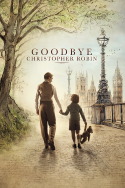
Review of Goodbye Christopher Robin (2017) by Trevorsview — 26 Oct 2017
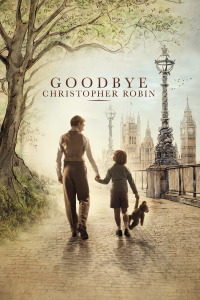
At first, Goodbye Christopher Robin delightfully captures your memories in the Hundred Acre Wood. The boy you know as Christopher Robin hosts a stuffed animal tea party in the morning, then he and his father follow their own tracks in the snow in the afternoon, and before supper, brilliant red balloons are used in an attempt to float up a tree, just like what the bear of very little brain did to obtain some honey. The woods that host these adventures appears alive with its golden sunbeams in the summer, and nostalgic as the boy imagines snowflakes falling upwards in the winter. This feature even parallels the book’s illustrations as various visual effects transition between scenes with a sketch over the live actions.
As these stimulators spark your memories, screenwriters Frank Cottrell Boyce and Simon Vaughan make you rethink whatever you think you know about Winnie-the-Pooh. The author, a WWI veteran, is no Mother Goose himself, as his writing process consists of flashbacks to his time in service, perhaps due to post-traumatic stress disorder. Hence, he prefers life in the lonely countryside to raise his son, Billy.
Yeah, hate to burst your bubble—the real Christopher Robin never even went by that name, but Billy instead… after his mother’s broken expectation of wanting a girl. So, his mother resorted to the stuffed animals she bought for him as a means of communication, which explains why he spent so much time with them: he only wanted his mommy. But because she kept letting his hair grow long and dressed him in classic Mary Janes, he never met her expectations. As she left home to enjoy her riches in the party crowd, and the father traveled for inspiration, the nanny was left the one in charge, leaving his childhood awfully confused. The confusion cut even deeper once the published books turned him into a household name, one about his nonexistent identity.
The script contains several good revisions about the famous ball of stuff n’ fluff; it mentions how the author, Alan Alexander Milne, the protagonist, spent his time writing in the battlefields, and grasps your intrigue with other little-known facts, such as the strange origin behind the name “Winnie-the-Pooh.” Other elements translate quite well onto the visual medium, like Billy watching penguins swim at the zoo and the private birthday band mother arranges for her son—you can tell the producers committed to the truth.
Most of the cast display great dedication, including Margot Robbie as the careless mother, but more so Alex Lawther, who plays Billy in his older years. Lawther helped me to feel a bit sorry for the real Billy’s past, even some in the audience were steamy-eyed by the end. Plus, one older woman sounded flabbergasted after she overheard me telling my Mom I found the experience “okay.”.
Yeah, sorry. After all the wondrous charm, Goodbye Christopher Robin still turns out just “okay.”.
First off, as most child actors tend to be, the boy they got to play young Billy has no talent, clearly cast because of his cheek-pinching cuteness. Director Simon Curtis put no brains behind the heart he put into the production’s sugary aroma; he relied on the boy’s cuteness rather than staged tension to force in drama. The scenes’ pacing either runs too slow or too fast, as evidenced by some pathetic arguments where nobody even bothers to raise their voices. Instead, moments get rushed, even leaving a ten-year time jump that takes you a second longer than intended to figure out.
One of the main issues to the poor direction is that the screenwriters mainly resorted to cliché ideas with no subtext behind the speakers’ words. There are so many other distracting details; the nanny triggers quite a few of those, mainly due to her inauthentic Irish accent. She leads Billy in a prayer each night, which really just proves a missed chance to show how the family’s religious background affected his spiritual condition over the years. Outside the family home, the book’s readers constantly declare how Pooh revived international happiness after the war, so maybe it would have been appropriate to see a distinction in the people’s mentality before and after Pooh hit bookstore shelves?
Ultimately, everyone involved behind this project seemed confused about the core audience. How do I know? Well, many of the pre-trailer ads at my screening starred cute little kids and animals, and the fifty-five and older crowd filled most of the audience seats. This movie had no reason to be family entertainment; it certainly added no effect on its box office returns, as it earned a pathetic $57,917 on its opening weekend. After all, nobody in today’s mobile age gives a hoot about Winnie-the-Pooh; at the same time, the grownups may find Curtis’ effort too cutesy without enough story to resolve the mother’s carelessness toward her son.
Honestly, the books will delight you more than Goodbye Christopher Robin attempts.
This review of Goodbye Christopher Robin (2017) was written by Trevorsview on 26 Oct 2017.
Goodbye Christopher Robin has generally received positive reviews.
Was this review helpful?