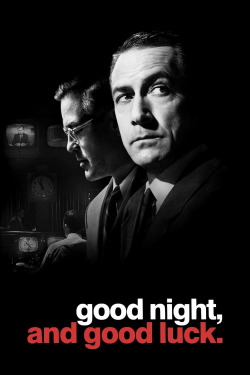
Review of Good Night, and Good Luck. (2005) by Emmylou A — 19 Jan 2009
I'm terrible at seeing Best Picture contenders. This is amusing only if one considers that I'm actually interested in them. This film was nominated four years ago, and only now have I gotten around to seeing it. Sure, there are plenty I haven't seen nominated forty years ago (or even seventy years, for that matter, hell, eighty), but I was alive, conscious and interested in film when this was released. I still haven't seen two other films from 2005 nominated (the winner, Crash, and Munich, and actually I've not seen all of Brokeback Mountain), nevermind 2004, 2006 or 2007. This is even despite the fact that things like McCarthyism fascinate the hell out of me--injustice perpetrated by the gloryhounds, overly powerful and the bigoted is a weakness of mine to see condemned. I did not go in knowing much about Edward R. Murrow, especially in light of my age, being far too young to have seen or heard the actual broadcasts for which he is known.
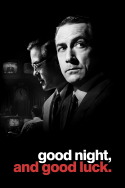
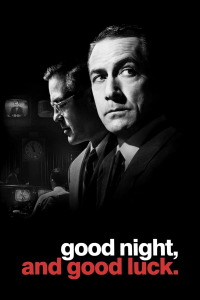
Edward R. Murrow (David Strathairn) is speaking before the Radio and Television News Directors Association in 1958, leaving no confusion as to his feelings about the state of the television news industry. A slow fade brings us back to 1953, as Junior Senator from Wisconsin Joe McCarthy (played by himself in stock footage throughout) is at the height of his fame and notoriety, propagating what would later be known as "McCarthyism," his Communist witch-hunt in the United States Government. In a meeting with his coproducer Fred Friendly (George Clooney) and the writers for CBS News, Murrow brings up the case of Milo Radulovich, who had been ousted from the Air Force for refusal to denounce his father's alleged ties to the Communist Party. CBS Chief Executive Bill Paley (Frank Langella) is reluctant to air something that could risk damage to corporate sponsorship and government relationships, but reluctantly agrees to allow Murrow to air the program. The Air Force is displeased, but positive response encourages further shows--and encourages Murrow to take an open stand against McCarthy's methodology. Behind Murrow, writer Joseph (Robert Downey, Jr.) and Shirley Wershba (Patricia Clarkson) attempt to hide their illicit marriage from their coworkers, while fellow journalist Don Hollenbeck suffers by association, slammed by Hearst's Jack O'Brian, begging Murrow to defend him. Murrow is relentless though, and takes on the bill-paying celebrity interviews to supplement his ethics-driven journalism.
I was always surprised when I discovered the running time of this movie--it's rare, these days, for a Best Picture nominee to run at only an hour and a half, but this film does. It's also less common for films to choose black and white and succeed on this without driving motivation being related to budget. It was a decision apparently made around the decision to keep McCarthy appearances purely from stock footage (thus requiring that all images be black and white, because those were), and it works. It doesn't seem pretentious or artificially chosen, it seems simply like a natural choice. The running time also doesn't seem to be an improper choice, however short it is in the modern age. The story is told economically, efficiently and with great care and skill. I've seen the other film Clooney had directed at that point (with Leatherheads subsequently added to his credits, but remaining unseen), and was quite surprised and delighted by the film, but recognized far more of Charlie Kaufman in it than Clooney.
This time there was not a clear identity, but it was brilliantly assembled, with interesting transitions from scene to scene. Usually a slow fade to black and an abrupt return to image would mark a shift in scene, but it is never jarring. The more interesting ones are the montages that are placed between the sessions where a show is discussed and where it is aired. They don't feel like standard, run-of-the-mill montages, being somewhat more measured and interesting, probably enhanced by a slow jazzy score that brings down the pacing of such short cuts to make them feel more full. This kind of filming was interspersed with scenes that were filmed as reality, from speeches and words taken directly from Murrow's real life (including his actual address of the RTNDA), and with dialogue overlapping in an Altman-style. The sound is carefully engineered to bring the narratively important conversations into the forefront without sacrificing background noise and conversations completely, maintaining the feeling of a real news office (even if some of us, say, haven't ever seen such a thing). Most interestingly for the sound, the music is primarily live singing by Dianne Reeves and a small jazz combo doing standards, and this is occasionally used like some dialogue as a sort of "voice-over" through transitions to tie two scenes together. This kind of care in assembly is the kind that can melt my heart to a film and make me truly appreciate the interest, effort and desire to create that so obviously was put into this film.
Strathairn's nomination for Best Actor was absolutely deserved, with my brain failing to recognize him and instantly associating him with the identity of Murrow despite having never seen Murrow before. I often found myself thinking of the character onscreen as the man instead of an actor portraying him, and even the more openly famous cast members easily ingratiated themselves to the idea of losing themselves in the background to Strathairn's Murrow, with Downey showing none of is typical quirks and Clooney never dominating, always working equally with Strathairn but easily taking on the command that the real colleagues claimed Friendly had, especially when he is seen dealing with the Air Force Colonels who visit to express displeasure with the Radulovich story. This, though, is where the film shines--even Strathairn's excellent performance doesn't draw attention to itself as a performance, just like Downey's, Clarkson's, Langella's or Clooney's. It enhances the film, rather than detracting, to have it filmed in this way that emphasizes the events, the images and the dialogue over all else, but with the dialogue and events carefully snipped, placed and stretched to fit exactly with the flow of the film. I am utterly impressed with Clooney's direction, and with the script he and Grant Heslov put together--as well as the original words of Murrow and his colleagues.
Truly an excellent film.
This review of Good Night, and Good Luck. (2005) was written by Emmylou A on 19 Jan 2009.
Good Night, and Good Luck. has generally received very positive reviews.
Was this review helpful?