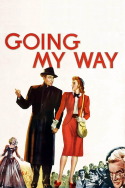
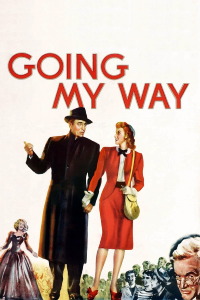
Review of Going My Way (1944) by Jon O — 01 Apr 2010
Some movies are simply beyond criticism. Despite having been written off in recent years by many mainstream critics -- with much repeated, off-base allegations of over-sentimentality -- this is one of them. It belongs in the pantheon of truly great films. The cynicism of the world we live in today no doubt prevents countless viewers (and critics) from looking beneath the placid surface of "Going My Way", but it's definitely worth the effort.
Part of this reluctance to delve may be due to the film's pastoral (no pun intended) ambience and relaxed pace, which could have easily inspired the creators of the Andy Griffith Show a few years later (check out the checker game scene). It takes its time, telling its story on its own terms, and this simply doesn't sit well with the majority of modern multi-taskers who've been fed a steady diet of breakneck action orgies, sophomoric sex comedies, and formulaic, artificial romantic comedies. But if you give it a chance and let it work its charms it will eventually win you over. To borrow a line from the film, it will "grow on you." Maybe not in the first viewing, maybe not even in the first few... but eventually.
Its charms worked instantly on audiences in need of hope, inspiration, and a chuckle or two during the Second World War, making it a huge box office hit in 1944. It even won over critics of the day: James Agee stated that "Going My Way" "points the way to the great films which will be possible when Hollywood becomes aware of the richness and delight of human character for its own sake." It earned seven Academy Awards, including Best Picture, and a Best Actor Oscar for Bing Crosby (as Father Chuck O'Malley), who was starting his run as the #1 box office star for a record five consecutive years.
Not quite a comedy, not quite a drama, this slice-of-life piece gently sets an example of all generations helping one another, ultimately working together as one extended family. It's basically an enactment of how one person can make a difference by helping his or her neighbor -- an important message in any era, but especially in the war-ravaged one into which this film was released. That helpful, caring attitude is infectious to the point that disparate members of an urban neighborhood eventually come together as a community. The twist is in Father O'Malley's appealingly relaxed methods, which appear unorthodox to the staid, older, by-the-book Father Fitzgibbon, providing the conflict of the main plotline.
Fitzgibbon (Barry Fitzgerald, Best Supporting Actor Oscar winner) has been the pastor of St. Dominic's Parish for forty-five years, and as the neighborhood around him has changed, his old school ways have become less effective. Gangs of unsupervised boys roam the streets getting into trouble (a real-life consequence of fathers fighting overseas and mothers working in war production plants during WWII), and the church is deeply in debt and about to be foreclosed on. The financial state of the church reflects the spiritually bankrupt community around it, and the physical structure itself will ultimately undergo a literal baptism by fire in order to be born again. In the meantime, young Father O'Malley is sent by the bishop to put things right, basically being assigned to take over for Fitzgibbon without letting the old man know it.
After assuming he's no longer needed, and having left in despair (only to be summarily returned by the local beat cop), the contrite Fitzgibbon eventually comes to understand and embrace O'Malley and his methods, and puts complete faith in the younger man. It all comes together in a delightfully subdued, justly celebrated scene in which the two men bond over a "wee drop of the creature," as Bing endearingly intones a couple of choruses of "Too-Ra-Loo-Ra-Loo-Ral" while sitting at the convalescing Fitzgibbon's bedside. Whoever came up with the term "screen chemistry" must have had this scene in mind.
Sooner or later, nearly everyone in the film gives of themselves: young Ted Haines, the son of the banker who's foreclosing on the church, leaves his father's line of work to volunteer for military service; an opera star (Rise Stevens) auditions a Father O'Malley-penned song for a music publisher, the royalties of which it is hoped will raise badly needed funds for St. Dominic's; the members of a street gang provide their (previously unrealized) singing talents for the (also previously unrealized) church choir; even the greedy banker (Gene Lockhart) forgives the church its mortgage. All the giving is sparked by the efforts and example of O'Malley, whose ultimate gift is saved for a no-dry-eye-in-the-house ending, just before he leaves for another parish he's been called on to save.
Sentimental? Certainly. But every iota of moisture in every teardrop is earned, and one doesn't feel foolish blubbering like a fool.
"Going My Way's" Oscar winning writer-director Leo McCarey probably summed up his film best when he stated his storytelling philosophy: "I love when people laugh. I love when they cry, I like a story to say something, and I hope the audience feels happier leaving the theatre than when it came in.".
From where I'm sitting, "Going My Way" succeeds on all counts. If it doesn't for you, give it a chance. It just may grow on you.
This review of Going My Way (1944) was written by Jon O on 01 Apr 2010.
Going My Way has generally received very positive reviews.
Was this review helpful?