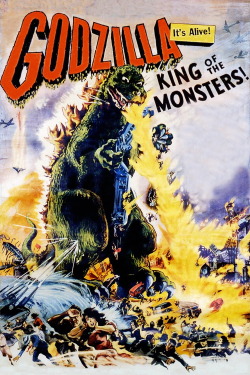
Review of Godzilla, King of the Monsters! (1956) by Adam F — 07 Apr 2014
For every film genre, be it slasher, rom-com or heist, there's always an iconic film that embodies everything that's great about the genre. When it comes to the Kaiju (or giant monster) movies, the great one, which all others owe praise to is the original 1954 "Godzilla". It's a film that has aged remarkably well and that is surprisingly effective and deep, even if some of the special effects are a bit dated. The premise is simple: When a Japanese fishing boat is attacked at sea, no one can figure out what has happened. Ship after ship is sent to investigate, but all are sunk down before any information can be collected. Finally, the cause of these attacks is revealed, an enormous dinosaur-like creature dubbed "Godzilla". Awakened by atomic testing, the creature attacks Japan like a malicious hurricane, deliberately reducing cities to rubble and leaving deadly radiation in its wake while the government scrambles to find a way to fight against it.
To really understand why this is not just another movie about a giant monster attacking Tokyo, you need to know a bit about what was happening in Japan at the time of the film's release. Picture a country that's been utterly defeated during the Second World War. It's the only country to experience firsthand the destructive power of Nuclear Weapons, with an atomic bomb being dropped on both Hiroshima and Nagasaki. Not only that, but the country is now under strict sanctions after its defeat and the inhabitants of the country have to accept that the people that they would have hailed as war heroes are now villains. Now flash to March 1954. Even with the nuclear weapons successful being deployed and the war over, the United States government continues to develop an even deadlier weapon, the H-Bomb. Testing of the H-Bomb is very secretive and done on islands near Japan, in areas that are off-limits to the Japanese. No one is told why these areas as off-limits however and on March 1st, the Daigo Fukury? Maru or Lucky Dragon No. 5, a tuna fishing ship wanders near the U.S. Castle Bravo nuclear test. The crew and their cargo are contaminated and suddenly, the fear of nuclear radiation is brought to the front line once again. Forward to November 3 of the same year, "Godzilla" is released in theatres across Japan. Once again, the first victims of the nuclear fallout is a small fishing ship who wanders accidentally in the path of a radioactive monster who destroys everything that comes anywhere near it. The scenes of people running away in terror as their homes are destroyed and of mass evacuations of cities, something already fresh in the minds of the Japanese appear once again on the big screen when Godzilla makes its attack on the mainland. These are just a few examples of the iconic imagery in the film that brought flashbacks to the people in the theatre (something not entirely unlike the effect that "Cloverfield" had on the residents of New York decades later).
Ok so now you know why the film made such an impact when it was first released, it was a very topical issue. But what else is there to it? First, let's talk about the titular creature, Godzilla. So usually, when you have a giant monster rampaging through a city, it's depicted as confused and just trying to do its thing while accidentally stepping on people. Not here. Godzilla is more like a cross between Michael Myers and a nuclear bomb than an actual animal. The reason I chose Michael Myers, the killer from "Halloween" is because it isn't enough that Godzilla goes around toppling buildings and crushing the population of Japan beneath its feet, it deliberately goes out of its way to kill and destroy. Several times during its rampage we see Godzilla avoid areas that are not populated or streets that are relatively easy to walk on in favor of buildings and skyscrapers filled with people. The monster looks for survivors and seeks them out, unlike a natural disaster which just kills and destroys at random; there is something deliberate about this creature's rampage. Its sheer size isn't its only weapon though, Godzilla is also radioactive. Like a nuclear bomb, the immediate destruction it causes is only a preview. Its presence will irradiate the land and give cancers to the survivors. Everyone knows about Godzilla's radioactive breath (which it uses at least once on a single family it spots on the ground) but what you don't realize is that it represents an invisible fear that was present at the time, the deadly radiation emitted by atomic weapons. So, how do we defend ourselves against it? Well, that's a big problem. The instinct in any monster movie is to try conventional war machines. Tanks, planes, mortars, flamethrowers and bullets prove completely ineffective against Godzilla (as they often do against giant monsters). So the next step is the ultimate weapon, the nuclear bomb but this is just as ineffective. Godzilla was awakened/mutated by nuclear weapons and itself uses radiation as a weapon. The most powerful weapon mankind has ever developed is therefore useless against it. All we can do is run away from the creature and hope that it will eventually move and even then, being within eyesight of the creature likely means that you will eventually die from radiation poisoning.
So we've got our opponent, what about our heroes? We've actually got a pretty compelling story from the human's point of view. Archeologist Kyohei Yamane (Takashi Shimura) is the one that discovers Godzilla's origin. He sees the potential for science that Godzilla shows: if this creature is able to not only survive, but thrive in nuclear fallout, would it not be beneficial for mankind to study it and discover what's special about it? Instinctually you would associate this guy with either one of those mad scientists or tree-huggers that refuse to accept the idea that the threat must be killed no matter what the human casualties are but it's not the case here. Remember that this story is set within a society that has been devastated by radiation. Despite the risks it poses to not only Japan, but the world, this is a unique creature, the last of its kind and it surely holds untold ways to benefit mankind despite its malicious nature (the idea that he wouldn't understand or realize the danger that Godzilla poses is also moot because after one of Godzilla's first attacks, he actually adopts one of the few child survivors). He is linked through his daughter Emiko (Momoko Kochi) to Dr. Serizawa (Akihiko Hirata). Serizawa's character really comes into play during the conclusion of the film so I don't want to say too much about him, but he's a character that has a lot of inner turmoil and is akin to the scientists responsible to the development of the weapons that were used on Japan. His character and the reasoning behind his actions will really make you think and wonder how people who happen upon scientific breakthroughs, only to see them used for war or other evils must feel. His role in the film is important, so your instinct would be to believe that he's the romantic lead, but he isn't. His fiancé Emiko is actually in love with another man, Hideto Ogata (Akira Takarada). Ogata plays a larger role in the story than just the third side of the romantic triangle, he's the one that more than any of the other lead characters sees first-hand the destruction of Godzilla and, like the rest of the world rushes to find a way to destroy it, regardless of the consequences. He's the human character that upsets all three of the people he is tied to, Yamane, Emiko and Serizawa. All three of these are torn between two decisions that weigh heavily on their shoulders.
We've got a monster that's truly iconic in every way, a compelling story that really gets you thinking (though you might not know it at first, which is why I encourage you to explore, along with the movie some of the bonus materials, particularly the commentaries offered on the Criterion release of the film) and a simple, primal terror that's ever present. The only negative point I have to say is that the special effects vary in quality. Sometimes, they're truly amazing to the point where you won't even realize that there are special effects on the screen (For example the shots where footprints of Godzilla are added to the background) and often even if you know that they have miniatures and tiny sets being stomped on by a guy in a rubber suit you are entranced by the film and you don't care at all. There are at least a couple of instances though where the miniature planes are clearly held up by strings (and it's way too obvious to ignore) and a Godzilla puppet is used to create the special effects, with mediocre results. It's not really enough to warrant any points being taken away from the rating of the film, particularly considering the time and circumstances the film was made in, but I feel the need to mention these just so you know what you're getting into. With the new Godzilla movie coming out soon this year you'll probably be tempted to revisit the older Toho movies and you'll be surprised by how good the first chapter is. Despite the fact that a significant amount of the sequels were cheesy, campy or just straight-up bad, the original is an impactful and very well made film that's culturally and historically significant. (Original Japanese version with subtitles on Blu-ray, March 22, 2014).
This review of Godzilla, King of the Monsters! (1956) was written by Adam F on 07 Apr 2014.
Godzilla, King of the Monsters! has generally received positive reviews.
Was this review helpful?