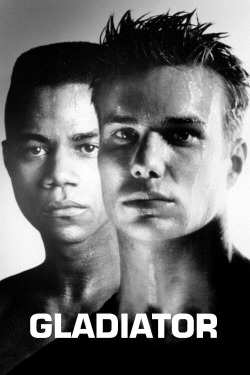
Review of Gladiator (1992) by Moviemastereddy — 06 Apr 2016
A muscular and bloody combat picture, a compelling revenge drama and a truly transporting trip back nearly 2,000 years, Ridley Scott’s bold epic of imperial intrigue and heroism brings new luster and excitement to a tarnished and often derided genre that nonetheless provided at least one generation of moviegoers with some of its most cherished youthful memories.
Jagged and impressionistic in a way clearly influenced by “Saving Private Ryan,” 10-minute opening battle is a savage spectacle, as General Maximus (Crowe) commands his troops to “unleash hell” on their overmatched adversaries with a deluge of arrows and flaming canisters that set the barbarians’ protective woods on fire.But as external conflicts are put to rest, internal trouble is only beginning. The arrogant and unbalanced Commodus (Joaquin Phoenix) arrives at the front, along with his beautiful older sister, Lucilla (Connie Nielsen), just in time to learn that his ailing father (Richard Harris) has named the triumphant Maximus his successor as emperor. For his part, Maximus, a Spaniard who has never seen Rome and, far more important, has been separated from his wife and son for nearly three years, wants no part of this plan.But Maximus makes the mistake of spurning Commodus. After killing his father in a fit of jealous spite, the insecure new emperor orders the execution of the popular general. The resourceful Maximus escapes this fate but reaches home too late; when he arrives, he finds his wife and son dead, his farm torched. In the poetic manner of Sergio Leone, Scott uses a man of action’s bitter and idealized memory of his lost family as a motif and a motive for the single-minded pursuit to which he devotes the remainder of his life.
At the 45-minute mark, action shifts to a distant North African outpost of the empire, where the captive Maximus is taken as slave. Purchased by gladiatorial entrepreneur Proximo (Oliver Reed), Maximus conceals his true identity but, when thrown into the arena for the first time, he fights well as a team with the African Juba (Djimon Hounsou), who will become his closest confidant.
In the meantime, of course, Maximus must survive arena combat that is heavily rigged against him. The gladiatorial contests are tense, dynamic and brutal, to be sure, and probably no less or more violent than most viewers would want them to be. Less fetishistic about the weaponry and modes of fighting than “Spartacus” and some other Roman combat pictures of yore, “Gladiator,” with its fast flurries of action and jump cuts, emphasizes the ferocious speed and urgency of every move in the arena, to the slight detriment of spatial unity and action continuity; in terms of the classical building of tension in a one-on-one fight, the standard is still the Anthony Quinn-Jack Palance battle in Richard Fleischer’s “Barabbas.”.
But “Gladiator” enjoys a solid foundation in the strength of Maximus, the vividness of its evocation of the Roman world and the integrity of the story arc. Script by David Franzoni, John Logan and William Nicholson shrewdly appropriates touchstone moments from previous epics, just as it also cuts down the talk to a minimum when possible; there is none of the windy speechifying that ground many an epic to a halt in decades past. The action is presented in strictly Roman terms, with none of the Judeo-Christian angle so common to the genre in the ’50s.
The film revels in both the glory and the horror that were Rome. Proximo’s luminous description of the Colosseum to Maximus beautifully conjures an image of what was then the center of the universe, and the games themselves are presented in context as gaudy, lowbrow entertainment. Countless details in Arthur Max’s brilliant production design and Janty Yates’ highly diversified costume design are offered up in wonderfully offhand fashion.
But the scene stealer, in his last role before his death on location, is Reed, who hadn’t brought such relish to a performance in years, and to whom the film is dedicated. Proximo’s excitement over being able to return to Rome brings out the old man’s boyish delight in his profession, which he insists is just “entertainment,” and Reed clearly reveled in both the physicality and the modestly hammy opportunities the part presented. Pic reps a great sendoff for him and a fine way to be remembered.
Production represented a gargantuan undertaking in four countries; even if the film is a big hit, it’s unlikely that the genre will come back in any significant way due to the costs involved. CGI effects have allowed numerous sets, notably the Colosseum, to be enhanced in size and spectacle value; the stunts, fights and battles are as forceful and realistic as anyone could want, John Mathieson’s widescreen cinematography is magnificent, and the pacing across 2½ hours is well modulated.
This review of Gladiator (1992) was written by Moviemastereddy on 06 Apr 2016.
Gladiator has generally received positive reviews.
Was this review helpful?